Format: Short Film / Anthology Episode | Est. Length: 10-12 minutes
This episode serves as a standalone entry in a speculative anthology series titled Residual Realities, which explores the intersection of mundane, dysfunctional domestic life and intrusive, high-concept sci-fi phenomena. The series posits a world where the fabric of reality is thinning, allowing multiversal "glitches" to manifest as bizarre, often unwanted, intrusions into the lives of ordinary, struggling families.
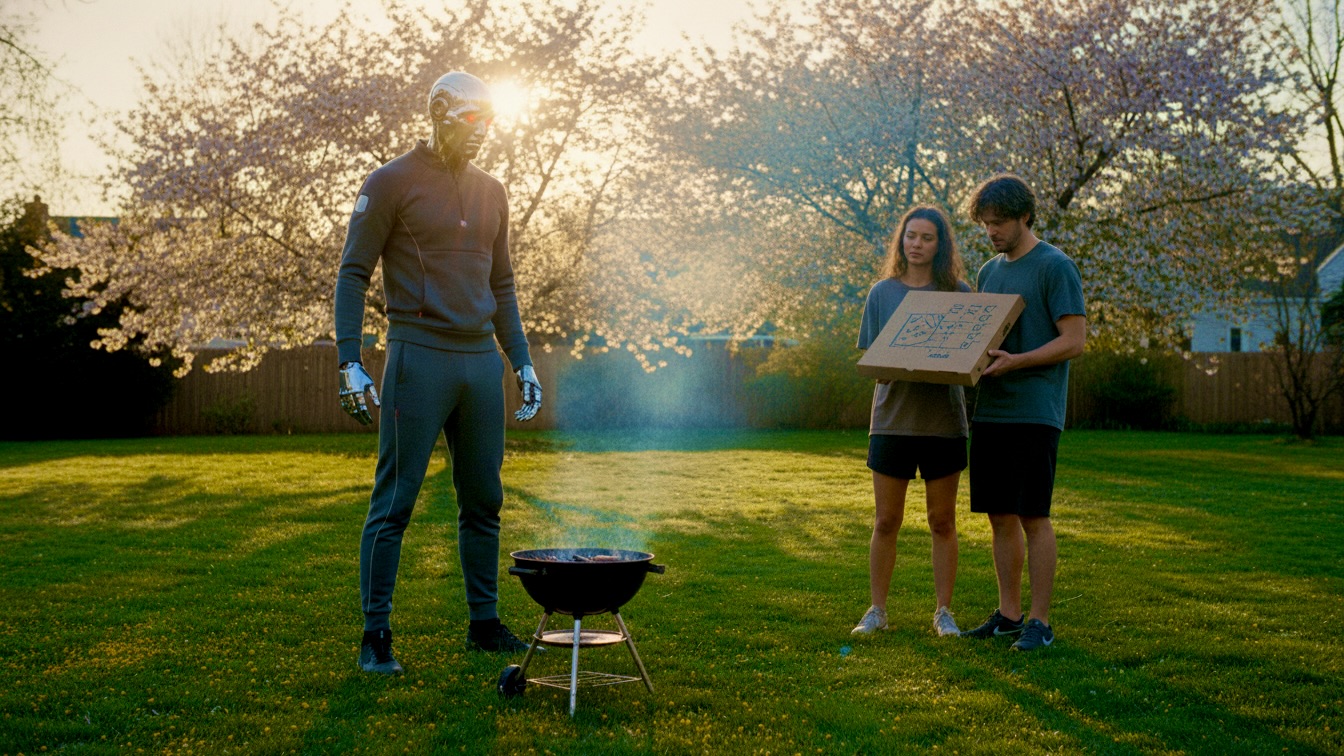
A standard, tension-filled Sunday barbecue is abruptly interrupted when the sky tears open like a zipper, depositing a chrome-limbed, hyper-optimized cyborg version of the family’s deadbeat uncle into their plastic kiddie pool. The sudden shift from suburban irritation to cosmic absurdity leaves the family stunned as the intruder immediately begins critiquing the molecular inefficiency of their lunch.
When an estranged, cyborg version of their uncle arrives from a future dimension to initiate a hostile corporate takeover of their family, two disillusioned siblings must out-hustle him using a fake, buzzword-heavy investment scheme. They must prove that their chaotic, inefficient lives are too complex for his cold logic to process before he succeeds in turning their family into a tax write-off.
The episode explores the crushing weight of late-stage capitalism and the performative nature of modern "hustle culture," contrasting the messy, authentic reality of family trauma against the sterile, optimized perfection of a corporate-dominated future. It examines the human need for connection versus the desire for efficiency, highlighting how our flaws are often the very things that define our humanity.
Beneath the sci-fi veneer, the story is a dark comedy about the generational divide and the feeling of being trapped in a cycle of mediocrity. It questions whether we would truly choose a life of perfect, painless optimization if it meant sacrificing the messy, painful, and deeply personal bonds that keep us grounded in our own reality.
The stakes are both existential and deeply personal: if the family signs the adoption papers, they lose their autonomy, their memories, and their identity to a corporate entity that views them as mere assets. Conversely, if the siblings fail to drive their uncle away, they risk being permanently "optimized," effectively erasing the emotional complexity that, while painful, is the core of their existence.
The primary antagonist is Dan-Prime, a manifestation of the siblings' own insecurities and the societal pressure to be constantly productive and "upgraded." The internal conflict stems from the siblings' own jealousy and exhaustion, as they struggle to reconcile their resentment toward their parents with the sudden, terrifying realization that they might actually prefer the status quo over a cold, efficient, and loveless future.
The story follows Kaylee and Rob, two siblings struggling with the stagnation of their lives, as they host a disastrous family barbecue. The arrival of Dan-Prime, a cyborg version of their failure-prone uncle, turns the gathering into a "trauma audit," where he uses advanced technology to dismantle the family's emotional defenses and prepare them for a mandatory corporate takeover.
Realizing that Dan-Prime’s logic is his greatest weakness, Kaylee and Rob devise a "reverse-hustle" strategy. They feed the cyborg a nonsensical, buzzword-laden pitch about "neuro-node staking" on a fictional blockchain, successfully overloading his processing systems and tricking him into returning to his own dimension to secure his imaginary assets.
Kaylee (24) is a cynical, high-functioning logistics worker whose repressed anxiety manifests as jaw-clenching and a desperate need for control. Her arc moves from paralyzed victim of family dysfunction to a proactive, manipulative strategist who realizes that her own "messiness" is a weapon.
Rob (22) is a drifting student who masks his lack of direction with internet-fueled apathy and a deep-seated jealousy of success. His arc shifts from passive observer to active participant, finding purpose in the shared, chaotic "hustle" of outsmarting his uncle.
Dan-Prime is a cold, calculated, and arrogant cyborg CEO who views all organic life as a series of inefficiencies to be corrected. His arc is a flat line of hubris; he remains entirely incapable of understanding human nuance, ultimately falling victim to his own greed for "optimized" assets.
The episode opens with the suffocating atmosphere of a failed family barbecue, establishing the baseline of tension and resentment between the characters. The midpoint occurs when Dan-Prime forces the family into a "trauma audit," stripping away their social facades and revealing the deep-seated insecurities that define their dysfunctional unit. The climax features the siblings' desperate, high-stakes pitch of the "Quantum Ape-Chain," where they successfully manipulate the cyborg’s greed to force his departure and restore their own broken, but authentic, status quo.
The mood begins as heavy, stagnant, and irritable, reflecting the suburban malaise of the characters. As the sci-fi elements intrude, the tone shifts into a surreal, high-anxiety dark comedy, peaking during the "trauma audit" and the frantic, improvised pitch in the garage. The resolution returns to a quiet, melancholic, yet strangely comforting sense of normalcy, leaving the audience with a renewed appreciation for the beauty of human imperfection.
If expanded, the series would follow the siblings as they discover that Dan-Prime’s "hostile takeover" was merely the first in a series of multiversal incursions. Each episode would feature a different "glitch" or visitor, forcing the family to adapt their newfound, cynical survival skills to defend their reality from other, even more dangerous, entities.
The thematic escalation would track the siblings' growing realization that their timeline is becoming a target for interdimensional entities, eventually forcing them to decide whether to protect their stagnant, unhappy life or seek a way to escape into a more chaotic, but potentially more meaningful, existence.
The visual style contrasts the warm, over-saturated, and slightly dingy aesthetic of the suburban backyard with the cold, sharp, and sterile neon-grid visuals of the interdimensional portals. The camera work should be handheld and intimate during the domestic scenes, becoming static, wide, and clinical whenever Dan-Prime is the focus, emphasizing his alien, mechanical nature.
The tone is a blend of The Twilight Zone’s existential dread and the sharp, cynical humor of Succession or Rick and Morty. It relies on a grounded, naturalistic performance style to anchor the absurdity, ensuring that the audience feels the weight of the family’s emotional baggage even amidst the sci-fi spectacle.
The target audience is young adults (18-35) who are familiar with the pressures of the modern gig economy, digital culture, and the complexities of dysfunctional family dynamics. It is designed for viewers who appreciate genre-bending narratives that use speculative fiction as a lens to explore contemporary social anxieties.
The pacing is designed to be relentless, mirroring the anxiety of the protagonist; it starts with a slow, grinding tempo that accelerates rapidly once the portal opens. The act structure is compressed, with the first act establishing the domestic misery, the second act focusing on the "trauma audit" and the siblings' scramble for a solution, and the third act delivering the high-energy, deceptive climax.
The primary visual challenge is the rendering of the "tear" in reality and Dan-Prime’s chrome arm, which should be achieved through a mix of high-quality practical prosthetics and subtle, seamless CGI to maintain a grounded, tactile feel. The contrast between the "warm" suburban environment and the "cold" digital portal effects is essential for the film’s visual storytelling and should be prioritized in post-production color grading.
Practical production should focus on the claustrophobic nature of the backyard, using tight framing to emphasize the family's inability to escape their dynamic. The "trauma audit" scene requires precise, rhythmic editing to highlight the mechanical, unfeeling nature of Dan-Prime’s dialogue against the raw, emotional reactions of the family members.


