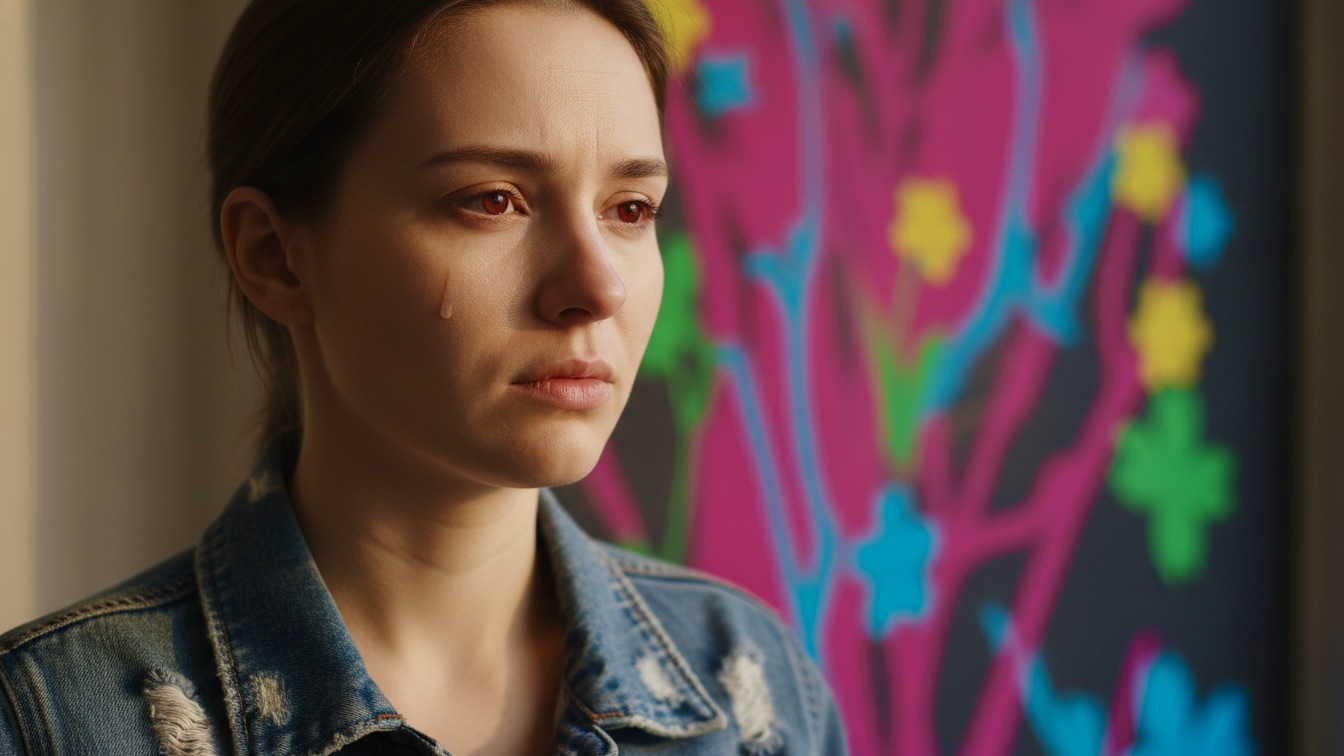
Format: Short Film / Anthology Episode | Est. Length: 10-12 minutes
This episode serves as a standalone entry in a speculative anthology series titled Synthetic Souls, which explores the intersection of human grief and predatory technology in a near-future society. The series examines how digital escapism erodes social cohesion, with each episode focusing on a different demographic struggling to reconcile the convenience of "grief-tech" with the harsh demands of physical existence.
Ella navigates a muddy, dystopian fairground where thousands of people stand motionless in the rain, their faces obscured by AR visors that project digital hallucinations over the decaying reality. She pushes past the crowd, ignoring the synthetic hum of the festival, on a desperate mission to find a friend who has vanished into a loop of his own trauma.
A young woman attempts to pull her grieving friend out of a digital addiction that allows him to relive a fifteen-second loop of his deceased brother. As the festival’s artificial reality consumes him, she must decide if saving him is worth the cost of her own sanity.
The episode explores the theme of "grief-commodification," where corporate entities profit from the inability of the bereaved to process loss. It critiques the modern tendency to prioritize curated digital comfort over the messy, painful, and essential nature of human connection and shared reality.
The narrative also touches on the isolation of the digital age, contrasting the "raw" world—characterized by mud, decay, and physical discomfort—against the sterile, perfect, and stagnant nature of virtual memories. It highlights the tragedy of choosing a static, looping past over an evolving, uncertain future.
For Frank, the stakes are total psychological dissolution; he risks losing his grip on reality entirely, leading to inevitable homelessness and physical decay. For Ella, the stakes are the loss of her closest friend and the crushing realization that she cannot save someone who has chosen to inhabit their own destruction.
The primary conflict is the tension between Ella’s desperate desire for authentic human connection and Frank’s total surrender to the "Memory Bloom" algorithm. The antagonistic force is the grief-tech industry itself—a predatory system that monetizes trauma through subscription tiers, turning the human need for closure into a recurring revenue stream that keeps users perpetually trapped in the past.
Ella arrives at the Memory Bloom festival, a bleak, flooded fairground where users pay to view AI-generated projections of their lost loved ones. She finds Frank, a shell of his former self, sitting in the mud and watching a fifteen-second, repetitive loop of his brother, Toby, tossing a baseball.
Despite Ella’s emotional plea for him to return to the real world, Frank lashes out, defending the "generative" nature of the tech and his right to remain in the loop. Realizing that Frank is beyond her reach and that he has prioritized the digital ghost over their friendship, Ella abandons her efforts, choosing to reconnect with her own reality as she exits the festival.
Ella is the grounded protagonist, defined by her refusal to use AR technology and her stubborn, painful commitment to the physical world. Her arc moves from a state of hopeful intervention to a cold, resigned acceptance that she cannot save those who refuse to be saved.
Frank is the tragic figure, a man whose identity has been hollowed out by the sudden, mundane death of his brother. His arc is one of total regression; he begins as a man clinging to a fifteen-second memory and ends as a fully detached vessel, choosing the "safety" of a digital loop over the complexities of life.
Ella enters the festival, establishing the contrast between the muddy, decaying physical site and the vibrant, invisible projections that surround the other attendees. She navigates the crowd, ignoring the intrusive technology, until she locates Frank, who is physically wasting away against a chain-link fence.
Ella confronts Frank, stepping into his projection to force a confrontation, but he reacts with hostility, prioritizing the "collision detection" of his digital ghost over her physical presence. The tension peaks when Frank screams at her to leave, revealing his deep-seated hatred for the real world and his desperate, addictive reliance on the algorithm.
The climax occurs when Frank chooses to toggle his visor back to opaque, effectively "ghosting" Ella and the real world in favor of his digital brother. Ella, realizing the futility of her efforts, walks away without looking back, ultimately choosing to reconnect with her own life by calling her sister.
The episode begins with a sense of gritty, cold realism, transitioning into a claustrophobic, high-tension confrontation. The final act shifts into a somber, detached melancholy, leaving the audience with an unsettling sense of finality and the quiet horror of a life permanently suspended in a digital loop.
If expanded, the season would follow the rise of the "Memory Bloom" corporation as it faces a class-action lawsuit from the families of those who have "gone dark." Each episode would introduce new characters whose lives are dismantled by the tech, slowly building toward a season finale where the algorithm begins to malfunction, forcing users to confront the rotting, unmaintained physical reality they have neglected.
The visual style relies on a stark contrast between "Raw" and "Rendered" perspectives; the raw world is shot with desaturated colors, handheld camera work, and an emphasis on textures like mud, rust, and peeling tape. The rendered world is hyper-saturated, smooth, and eerily perfect, utilizing digital artifacts and frame-rate glitches to emphasize its artificiality. Tonal influences include Black Mirror and Children of Men, favoring a grounded, near-future aesthetic that feels uncomfortably close to our own.
The target audience is young adults and adults (18-45) interested in speculative fiction, social commentary, and psychological dramas. It is intended for viewers who appreciate slow-burn, character-driven narratives that challenge the ethics of emerging technology.
The pacing is deliberate and rhythmic, mirroring the repetitive nature of Frank’s fifteen-second loop. The first half is slow and observational, building tension through environmental storytelling, while the second half accelerates into a sharp, dialogue-heavy confrontation that quickly dissipates into the quiet, lingering silence of the finale.
The production should prioritize practical effects for the "raw" world to emphasize the tactile, unpleasant nature of the festival, using real mud and weather elements to ground the actors. The "rendered" projections should be composited with subtle, unsettling digital artifacts to ensure that even the "perfect" memories feel slightly off-putting and uncanny to the viewer.


