Format: Short Film / Anthology Episode | Est. Length: 10-12 minutes
This episode serves as a standalone entry in a speculative anthology series titled The Static Between Us, which explores a near-future America physically fractured by the manifestation of extreme ideological polarization. Each episode focuses on different residents of "divided" towns, examining how human connection survives when the environment itself is weaponized by algorithmic hate and cognitive dissonance. The overarching narrative arc tracks the slow, mysterious expansion of these "Zones" and the grassroots attempts by youth to bridge the gaps before the anomalies consume their communities entirely.
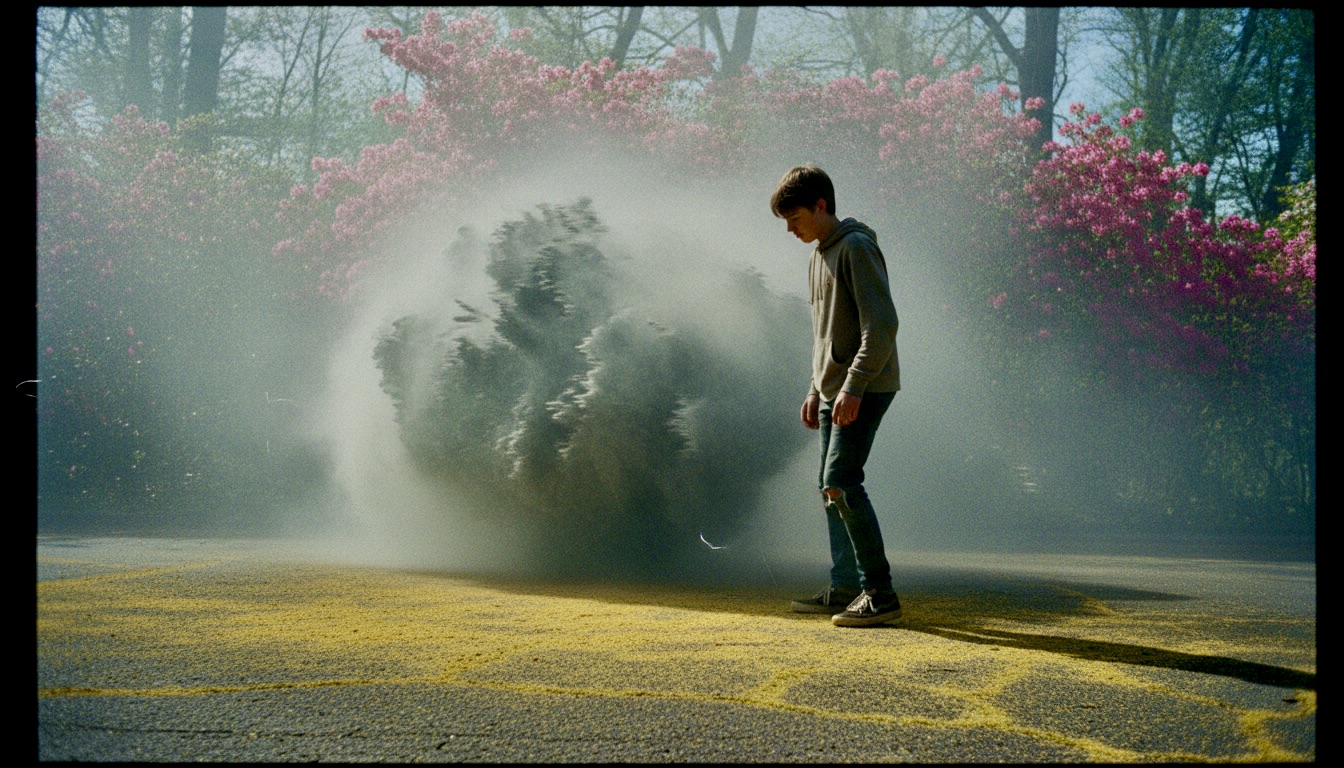
Zack stands on the edge of a churning, grey fog bank that slices his town of Oak River in half, his jaw aching from the stress of a town literally tearing itself apart. Despite the warnings of his friend Leo and the terrifying reputation of the "Red Zone," Zack clutches a single, crumpled dance ticket, determined to cross the barrier to invite a girl named Penny to the Spring Fling.
In a town physically divided by a manifestation of toxic ideological hatred, a teenage boy must navigate a hallucinogenic barrier to reach the girl he loves. He faces his own internalized biases and the psychological weight of the town's collective rage to prove that connection is stronger than the algorithm.
The episode explores the corrosive nature of extreme polarization and the way digital echo chambers manifest as tangible, suffocating realities. It highlights the struggle to maintain individual agency and empathy in a world that demands binary, hateful alignment, suggesting that "truth" is often a casualty of the fear we project onto those we deem "other."
Beneath the sci-fi premise lies a coming-of-age story about the courage required to defy social pressure. It examines the emotional toll of performative hatred and the quiet, revolutionary act of choosing to see the humanity in someone labeled as an enemy.
Zack risks his sanity and potentially his life, as the "Red Zone" is known to permanently alter those who cross it, leaving them broken or delusional. Beyond his personal safety, the stakes involve the survival of his relationship with Penny, which represents a fragile hope for reconciliation in a town that has surrendered to the static.
The primary antagonist is the "Static," a sentient, atmospheric anomaly that feeds on cognitive dissonance, shame, and confirmation bias. Internally, Zack battles his own internalized prejudices and the paralyzing fear that he is no better than the people he has been taught to despise, making the journey a deeply personal psychological gauntlet.
Zack prepares to cross the barrier dividing the Blue and Red Zones, ignoring his friend Leo’s warnings about the "bugs in the skin" and madness that plague those who enter the static. He enters the grey void, where the environment immediately attacks him with auditory hallucinations and grotesque, distorted projections of his own fears and biases.
As the static forces him to confront his own hypocrisy and hatred, Zack nearly succumbs to the pressure to turn back. However, a memory of a genuine, human moment with Penny anchors him, allowing him to push through the final barrier and emerge into the Red Zone, where he finds a quiet, ordinary street and finally approaches her.
Zack is a cautious but determined teenager who begins the story defined by the town's binary divisions, harboring subconscious biases he is afraid to admit. By the end, he has shed his fear of the "other," transitioning from a passive observer of the town's decay to an active participant in his own life.
Penny is a girl from the Red Zone who serves as the catalyst for Zack’s journey, representing the "real" person behind the political caricature. She is observant and seemingly isolated, acting as a mirror to Zack’s own desire for normalcy and connection outside of the town's toxic narrative.
Leo is Zack’s friend and the voice of the status quo, representing the cynicism and fear that keep the town divided. He serves as a cautionary figure, highlighting the psychological cost of the divide and the social pressure to remain within one's designated zone.
Zack and Leo stand at the edge of the static, establishing the physical danger of the barrier and the social taboo of crossing it. Zack’s internal struggle is highlighted by his physical pain and the contrast between his fear and his resolve to deliver the ticket.
Inside the fog, the narrative shifts to a surreal, psychological horror sequence where the static weaponizes Zack’s memories and prejudices against him. The midpoint is reached when Zack collapses, overwhelmed by the voices and the urge to surrender to his own biases, only to find the strength to continue through the memory of Penny.
The climax occurs as Zack pushes through the final, dense layer of the static, the sound of a "bubble popping" signaling his breakthrough into the Red Zone. The resolution finds him in a mundane, quiet neighborhood, where the reality of the environment—and Penny’s presence—shatters the illusion of the monster he was taught to fear.
The episode begins with a high-tension, claustrophobic mood characterized by the physical ache of the protagonist and the oppressive, humming atmosphere of the town. As Zack enters the static, the tone shifts into a disorienting, psychedelic nightmare, before resolving into a grounded, hopeful, and quiet clarity upon his arrival in the Red Zone.
If expanded, the season would follow Zack and Penny as they attempt to map the "Static" and understand its origins, discovering that the anomaly is spreading to other towns. They would become part of a clandestine network of "Crossers" who share information across the divide, slowly uncovering who or what is profiting from the town's forced separation.
The character evolution would see Zack and Penny move from naive teenagers to leaders of a movement, facing increasing pressure from both sides of the divide to stop their efforts. The season would culminate in a confrontation with the source of the static, forcing the town to decide between the comfort of their hatred and the terrifying work of reconciliation.
The visual style utilizes a stark contrast between the "Blue Zone" and the "Red Zone," with the Blue Zone depicted in saturated, slightly surreal colors to emphasize the "pollen-heavy" spring, while the Red Zone is shown in a more naturalistic, sun-bleached palette. The static itself is rendered as a dense, shifting grey mass with high-contrast, glitch-like visual effects that distort the environment and the characters' features.
The tone is a blend of psychological thriller and grounded drama, with tonal comparables including The Twilight Zone for its speculative nature and Stranger Things for its focus on youth-led discovery. The sound design is crucial, using a low-frequency hum that builds into an overwhelming, cacophonous barrage of voices to represent the psychological weight of the static.
The target audience is young adults and adults (16-35) who enjoy speculative fiction, social commentary, and character-driven narratives. It is designed for viewers who appreciate stories that explore the intersection of technology, psychology, and modern social dynamics in a high-concept, accessible format.
The pacing is deliberate, starting with a slow, heavy tempo that mirrors Zack’s internal anxiety, before accelerating into a chaotic, rapid-fire sequence within the static. The final act slows down significantly, allowing the audience to breathe and absorb the quiet, grounded reality of the Red Zone, ensuring the emotional payoff lands effectively within the 12-minute window.
The "Static" should be achieved through a combination of practical, in-camera fog effects and digital compositing to create the "churning" quality described in the text. The grotesque, distorted faces seen by Zack should be handled with subtle, unsettling prosthetics or VFX that mimic the style of political cartoons, emphasizing the "unreal" nature of the hallucinations.
The transition from the Blue Zone to the Red Zone needs to be seamless, with the "pop" sound effect acting as a clear auditory marker for the shift in reality. The location for the Red Zone should be chosen to look intentionally similar to the Blue Zone, forcing the audience to realize that the "monsters" are simply people living in the same, mundane circumstances as the protagonist.


