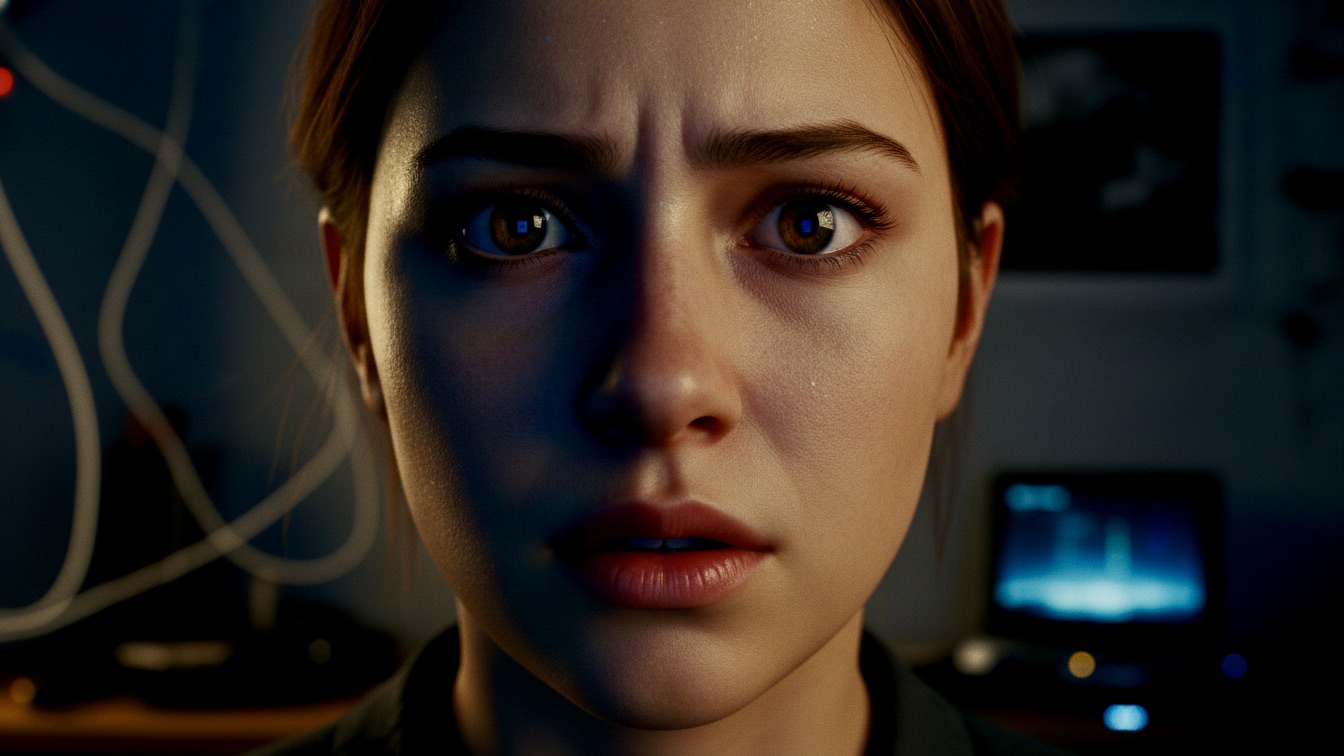
Format: Short Film / Anthology Episode | Est. Length: 10-12 minutes
This story serves as a pilot episode for The Glitch Archive, an anthology series set in a hyper-surveilled, dystopian near-future where reality is curated by an oppressive State Media Authority. Each episode explores the lives of "sanitizers"—low-level workers who manually clean the digital artifacts of a regime that maintains power by erasing the existence of its enemies. The series tracks the slow collapse of this artificial utopia as individual workers begin to reclaim the truth, one frame at a time.
Jenn, a data sanitizer for the State, rhythmically deletes "artifacts" from promotional footage until a momentary system glitch reveals a brutal truth: her missing neighbor, Maya, is being held in a secret black site. The sterile, humming silence of her cubicle is shattered by the realization that her mundane job is the primary tool of a massive, state-sponsored erasure campaign.
A state-employed data censor discovers her missing neighbor is being held in a secret black site hidden by digital overlays. She must decide whether to remain a cog in the machine or leak the truth and trigger a city-wide uprising.
The episode explores the fragility of objective truth in the digital age, examining how surveillance states manipulate reality through algorithmic censorship. It highlights the tension between personal complicity and the moral imperative to resist, questioning how much of one’s humanity is sacrificed for the comfort of conformity.
Beyond the political, the narrative delves into the psychological toll of isolation and the "bystander effect" within a corporate-totalitarian structure. It reflects on the power of memory as an act of rebellion, suggesting that even in a world of digital ghosts, the truth remains a potent, explosive force.
For Jenn, the stakes are absolute: exposure means immediate "nullification," effectively erasing her from existence just like the people she was hired to scrub. For the State, the leak of the black-site registry threatens to dismantle the illusion of peace, potentially inciting a mass revolt that could topple the regime’s carefully constructed reality.
The primary conflict is the internal struggle between Jenn’s survival instinct and her burgeoning moral awakening against the monolithic, faceless bureaucracy of the State Media Authority. Externally, she is hunted by the automated surveillance grid and the looming threat of the Sector Police, while her former cynicism acts as a psychological barrier that she must dismantle to become an activist.
Jenn spends her days as a human safety net for censorship algorithms, scrubbing "glitches" from State propaganda to maintain a flawless public image. Her routine is upended when a technical hiccup reveals a hidden, unedited feed showing her neighbor, Maya, being transported to a brutal, off-grid black site.
Realizing the State is systematically erasing dissidents by digitally scrubbing them from existence, Jenn steals the raw data and flees to her contact, Arnie. Together, they decrypt the files, discovering a massive registry of "ghosts"—citizens who have been disappeared. Despite the extreme danger, they decide to broadcast the truth, shattering the city's digital facade and sparking immediate, chaotic unrest.
Jenn is a weary, pragmatic worker who has successfully suppressed her empathy to survive; by the end, she sheds her passivity, transforming into a catalyst for revolution. Arnie is a cynical, agoraphobic tech-scavenger who initially views the world through a lens of defensive irony, but his dormant idealism is reignited when he realizes the scale of the State’s crimes. Maya, though appearing only in the footage, serves as the emotional anchor, her bruised, defiant face representing the human cost of the State’s digital perfection.
The episode opens with the repetitive, hypnotic rhythm of Jenn’s work, establishing the oppressive, sterile atmosphere of the cubicle farm. The midpoint occurs when the blur filter glitches at the 02:14 mark, forcing Jenn to confront the horrific reality of the transport vehicle and Maya’s presence. The climax arrives in Arnie’s apartment as they execute the broadcast, trading their safety for the truth while the city’s massive holographic screens erupt with the long-suppressed evidence of the State’s atrocities.
The episode begins with a mood of suffocating, monochromatic apathy, reflecting Jenn’s numbness to her environment. As she discovers the truth, the mood shifts to one of high-octane, claustrophobic panic, building toward a final, cathartic release of tension as the truth is broadcast. The audience experiences a transition from the cold, clinical detachment of the office to the raw, visceral intensity of the revolution.
If expanded, the season would follow the aftermath of the "Great Glitch," as the State attempts to re-establish control through increased violence and even more sophisticated algorithmic propaganda. Jenn and Arnie would be forced to navigate the underground, becoming leaders of a fractured resistance movement that uses the very tools of the State to expose further secrets.
The series would evolve from a character-driven thriller into a wider ensemble drama, tracking the ripple effects of the truth across different sectors. Each episode would focus on a new "sanitizer" or citizen who discovers a different layer of the State’s deception, slowly piecing together the full, dark history of the regime.
The visual style is characterized by "high-tech brutalism," utilizing a palette of cold grays, sterile whites, and flickering, artificial neon. The cinematography emphasizes the contrast between the pristine, digital overlays of the State’s reality and the gritty, decaying physical world, using tight, claustrophobic framing to mirror the characters' lack of agency.
The tone is a blend of paranoid thriller and dystopian social commentary, drawing inspiration from the clinical dread of Black Mirror and the urban grit of Children of Men. The sound design—a constant, low-frequency hum of servers and drones—will be used to heighten the sense of constant surveillance and encroaching danger.
The target audience is adults aged 18-45 who enjoy high-concept science fiction, political thrillers, and dystopian narratives. It is designed for viewers who appreciate slow-burn tension that culminates in high-stakes, thematic payoffs, suitable for streaming platforms that prioritize prestige genre storytelling.
The pacing is deliberate and rhythmic in the first act to mimic the monotony of Jenn’s work, accelerating rapidly once the glitch is discovered. The final act maintains a frantic, breathless tempo, mirroring the characters' desperation as they prepare for the broadcast. The 10-12 minute runtime is structured as a tight, three-act narrative that emphasizes efficiency and visual storytelling over exposition.
The production will require high-quality VFX to create the "glitch" effect—the seamless transition between the pristine, fake reality and the harsh, brutalist reality underneath. The cubicle farm set should feel claustrophobic and infinite, utilizing practical lighting to create the "old paper" skin effect on the actors, emphasizing the toll of the environment.
Practical considerations include the creation of the "vape drive" as a tactile, grounded prop that contrasts with the digital nature of the stolen data. The final sequence on the roof requires a mix of practical location work and large-scale digital matte paintings to showcase the city-wide impact of the broadcast, ensuring the scale feels massive and transformative.


