Arthur and Martha battle over a skeletal rose bush while their aging bodies protest the arrival of another spring.
My left knee made a sound like a bag of dry cereal being crushed under a boot. It wasn’t a new sound, but in the damp air of a Tuesday morning in April, it felt louder. More personal.
I stayed there for a second, crouched over the dirt, waiting for the joint to decide if it was going to lock or just hum with low-grade electricity for the rest of the hour. The mud was the color of bad coffee and twice as sticky. It clung to the knees of my trousers—the pair I’d bought back when I thought I’d still be hiking in my seventies. Now, they were just expensive gardening rags.
The bush was in front of me. It looked like a cluster of barbed wire that had lost a fight with a lawnmower. No leaves. No buds. Just gray-brown stems that seemed to be actively trying to withdraw back into the earth. It was a 'Peace' rose, or so the tag had claimed three years ago. Since then, it had offered nothing but thorns and disappointment. It was a stubborn, ugly thing, and I hated it. I hated it because it reminded me of my own spine—stiff, unyielding, and largely decorative at this point.
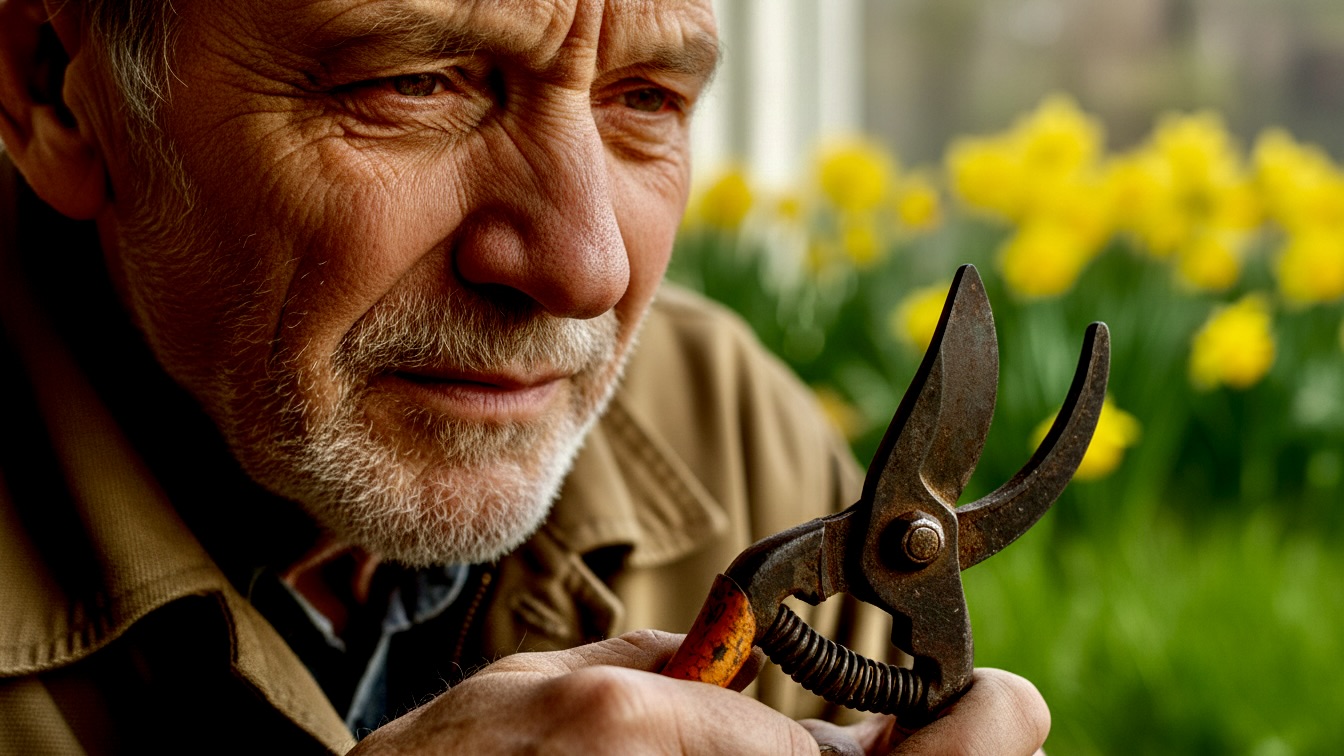
I reached for the pruning shears. They were orange-handled and rusted at the hinge. I’d left them out in the rain again. Everything I owned was slowly returning to the elements. My house, my car, my skin. It was all a slow-motion dissolve. I gripped the handles, feeling the cold metal bite into my palm. I needed to cut the dead wood back, but where did the dead wood end? It all looked dead. It looked like a museum exhibit of a plant that had died during the Great Recession.
"You’re going to kill it."
I didn’t look up. I knew the voice. It was Martha from next door. Martha, who dressed like she was perpetually ready for a high-speed chase in a climate-controlled vehicle. She was wearing a neon-green athletic vest over a black turtleneck. It was 2026; everyone was wearing fabric that could survive a nuclear winter, even just to pull weeds.
"It’s already dead, Martha," I said. My voice sounded like it had been stored in a drawer full of gravel. "I’m just performing the autopsy."
"It’s dormant," she said, her boots squelching as she crossed the property line. We didn't have a fence. We had a 'mutual understanding,' which mostly meant she felt entitled to narrate my failures in real-time. "It’s been a long winter. The ground hasn't reached the right temperature yet. You’re being impatient."
"I'm seventy-two. Impatience is a survival strategy. I don't have time for a plant to find its motivation."
I snapped the shears shut on a particularly thick cane. The wood didn't give. It just compressed, a dull thud echoing in the quiet morning. I groaned, the effort radiating up my arm and into my shoulder. Martha stood over me, a shadow of judgment blocking the weak spring sun.
"Look at the sensor," she said, pointing a manicured finger at the small white plastic spike sticking out of the mud. It was a 'SmartSprout 4,' a gift from my daughter who lived in the city and thought I needed an app to tell me when I was thirsty. The little LED on top was blinking a frantic, irritating red.
"The sensor is a liar," I said. "It’s been blinking for three days. It says the nitrogen is low. I put nitrogen down. I practically drowned the thing in it. The sensor is just a tiny robot designed to make me feel inadequate."
"It says the soil is too acidic," Martha countered, peering at her phone. She’d linked her app to my sensor last summer when I was in the hospital for the hernia. She never unlinked it. "You’re overcompensating, Arthur. You always do. You think if you just throw enough chemicals at something, it’ll love you back."
I finally looked up at her. Her face was a map of sharp lines and expensive moisturizer. She looked good for sixty-nine, in the way a very well-maintained classic car looks good—you can see the work, but you respect the effort. My face, by comparison, was a crumpled brown paper bag.
"It’s a rose, Martha. Not a relationship."
"Everything is a relationship," she said. She reached down, her movements fluid and annoying, and plucked a stray bit of mulch off my sleeve. "And you’re losing this one. Give me the shears."
"No."
"Arthur."
"Get your own bush to harass."
I tried to stand up, but my knee had other plans. It made a wet, popping sound. I froze, halfway between a crouch and a standing position, looking like a gargoyle that had fallen off a roof. The pain was sharp, a white-hot needle behind the kneecap. I let out a breath that was mostly a hiss.
Martha didn't laugh. She didn't even smirk, which was worse. She just stepped in, grabbed my elbow, and hauled me up. She was deceptively strong, the kind of strength you get from forty years of Pilates and spite. I smelled her perfume—something that smelled like citrus and expensive laundry soap. It was a clean, sharp smell that made the smell of the mud seem even more offensive.
"Sit down," she commanded, nodding toward the weathered teak bench by the porch. The bench was gray and peeling, much like my shins.
"I'm fine," I said, even as I hobbled toward it. "It’s just the damp. It gets in the gaps."
"You have a lot of gaps," she said. She followed me, still holding the shears she’d managed to liberate from my hand during the lift. She looked at them with professional disdain. "When was the last time you sharpened these? 2015?"
"They cut fine."
"They crush. They don't cut. You’re giving the plant a concussion, not a trim."
I sat on the bench, the wood hard against my tailbone. I watched her walk back to the rose bush. She looked at it with the intensity of a diamond cutter. The sun finally broke through the gray clouds, hitting the mud and making it steam slightly. It was that weird, fickle spring light that made everything look simultaneously hopeful and pathetic.
"Why do you care so much?" I asked. "It’s a stick in my yard. It’s not bothering your begonias."
Martha didn't answer immediately. She knelt—actually knelt, both knees in the dirt—without a single crack or pop. I envied her joints more than I’d ever envied a man’s bank account. She began to poke at the base of the rose, her fingers nimble.
"Because it was Sarah's," she said quietly.
The name hung in the air, heavier than the damp. Sarah. My wife. She’d been gone four years, but her name still had a way of flattening the conversation. She was the one who had planted the 'Peace' rose. She was the one who understood the nitrogen and the acidity and the delicate ego of a flower that only bloomed for two weeks a year.
"Sarah’s rose died with her, Martha. This is just a ghost I haven't dug up yet."
"That’s poetic and wrong," Martha said, not looking back. "It’s a living organism. It’s just tired. It’s had a rough few years. Sound familiar?"
I leaned back, my head thumping against the siding of the house. The plastic siding was slightly loose, making a hollow clack. I watched Martha work. She wasn't hacking at it like I was. She was removing tiny, spindly bits, clearing the center so air could move through. She looked like she was performing surgery on a spider.
"I’m going to pull it out next week," I said. "I’m going to put in some of that plastic turf. Or gravel. Something that doesn't need a therapist."
"You do that, and I’ll call the neighborhood association. I’ll tell them you’re running a chop shop in your garage."
"I don't even have a car that works, Martha."
"I'll plant evidence. Don't test me."
She stood up, brushing the mud from her knees. Her expensive leggings were ruined, stained a deep, permanent brown. She looked at the stains and then at me, her expression unreadable. For a second, the subtext was so thick I could almost taste it. We weren't talking about the rose. We were talking about the fact that she’d been bringing me casseroles for three years and I’d been returning the containers unwashed.
"It needs water," she said, her voice snapping back to its usual crispness. "Real water. Not the recycled stuff from your rain barrel that smells like a swamp."
"The rain barrel is eco-friendly."
"The rain barrel is a mosquito nursery. Use the hose. And for god's sake, Arthur, buy some new shears. These are a hate crime."
She tossed the rusted shears onto the bench next to me. They bounced and hit my hip. I didn't flinch. I just watched her walk away, her neon vest a bright, neon middle finger against the dull gray of the street. She didn't look back. She never did. She just marched back to her perfectly manicured life, leaving me with my dead stick and my throbbing knee.
I looked down at the shears. There was a tiny bit of green on the blade. Not rust. Green. Sap.
I looked at the bush. I still couldn't see it. To me, it was just a failure. A reminder of a garden I couldn't maintain and a woman I couldn't save. But I stood up anyway, my knee screaming in protest, and I walked over to the spigot. I turned the handle. The pipes groaned, a subterranean growl that felt like the house was complaining about the effort. The water came out cold and clear, splashing over my boots.
I dragged the hose over to the rose bush. I stood there, the water soaking into the mud, making that soft, bubbling sound as the earth drank. The sun was warmer now. I could feel it on the back of my neck, a gentle, insistent pressure. My lower back felt like it was being held together by rusted staples, and my hands were shaking slightly from the cold of the water.
I was a seventy-two-year-old man watering a dead stick in the middle of a muddy yard, guided by the instructions of a woman I mostly found exhausting. It was ridiculous. It was a comedy of errors performed for an audience of squirrels.
I looked at the SmartSprout sensor. The red light was still blinking. Blink. Blink. Blink.
"Shut up," I whispered to the plastic spike.
I stayed there until the mud turned into a slurry, until my boots were buried an inch deep. I thought about Sarah’s hands—how they always had dirt under the fingernails, no matter how hard she scrubbed. I thought about the way Martha’s voice changed when she said her name. There was a history there, a layer of sediment I hadn't bothered to dig through. We were all just layers of stuff, weren't we? Years of nitrogen and acid and bad weather, piled on top of each other until we became something hard and unrecognizable.
I turned off the water. The silence that followed was heavy. The neighborhood was quiet, save for the distant hum of a delivery drone and the chirping of a bird that sounded like it was having a nervous breakdown in the oak tree. I walked back to the bench and picked up the shears. I wiped the sap off the blade with my thumb. It was sticky. Real.
I sat there for a long time, watching the water sink into the ground. The rose bush didn't look any different. It was still a tangle of brown canes. It didn't bloom instantly. It didn't burst into life like a movie. It just sat there, wet and ugly.
But as I sat there, the wind picked up, carrying the scent of damp earth and something else—something faint and sweet, like a memory of a flower that hadn't happened yet. I closed my eyes and let the sun hit my face. My knee was still throbbing, a rhythmic reminder that I was still here, still moving, still capable of being annoyed. And for now, in the middle of this cold, ridiculous spring, that was enough.
I wondered if Martha was watching from her window. I figured she probably was. She had nothing better to do than watch me fail, and I had nothing better to do than prove her right, one gallon of water at a time.
I stood up, more carefully this time, and began the long, slow walk back to the porch. The mud pulled at my heels, reluctant to let go. Every step was an argument with gravity. Every breath was a negotiation with the air. It was exhausting. It was absurd. I reached the door and looked back one last time. The rose bush looked smaller from a distance, just a smudge against the gray fence. A tiny, stubborn smudge that refused to give up the ghost.
I went inside and started the kettle. The house was too quiet, the way it always was when the TV wasn't on. I sat at the kitchen table and watched the steam rise from the spout. My hands were stained brown, the dirt mapped into the deep lines of my skin. I didn't wash them. I just sat there and waited for the whistle.
The sensor on my phone buzzed in my pocket. I pulled it out. Soil moisture: Optimal, it read. Nitrogen: Low. Action required.
I swiped the notification away. I didn't need the phone to tell me what was low. I already knew. I looked out the window at the yard, at the mud, and at the thin, neon-green line of Martha’s house. Spring was coming, whether I was ready for it or not. The world was demanding to be reborn, and it didn't care about my knees or my grief or my rusted shears. It just kept pushing.
I took a sip of my tea. It was too hot, burning the tip of my tongue. I winced, the pain sharp and immediate, a little spark of life in the quiet room. I looked at the dirt under my fingernails and thought about tomorrow. Tomorrow, I’d probably have to buy some fertilizer. Not because the sensor told me to, but because if I didn't, Martha would never let me hear the end of it.
And maybe, just maybe, I wanted to see if she was right. I wanted to see if that skeletal thing could actually turn into a flower again. It seemed impossible. But then again, so did getting out of bed most mornings, and I’d managed that today.
“I looked at the green smudge on my thumb and realized I had no idea if it was life or just the stain of something long dead.”


