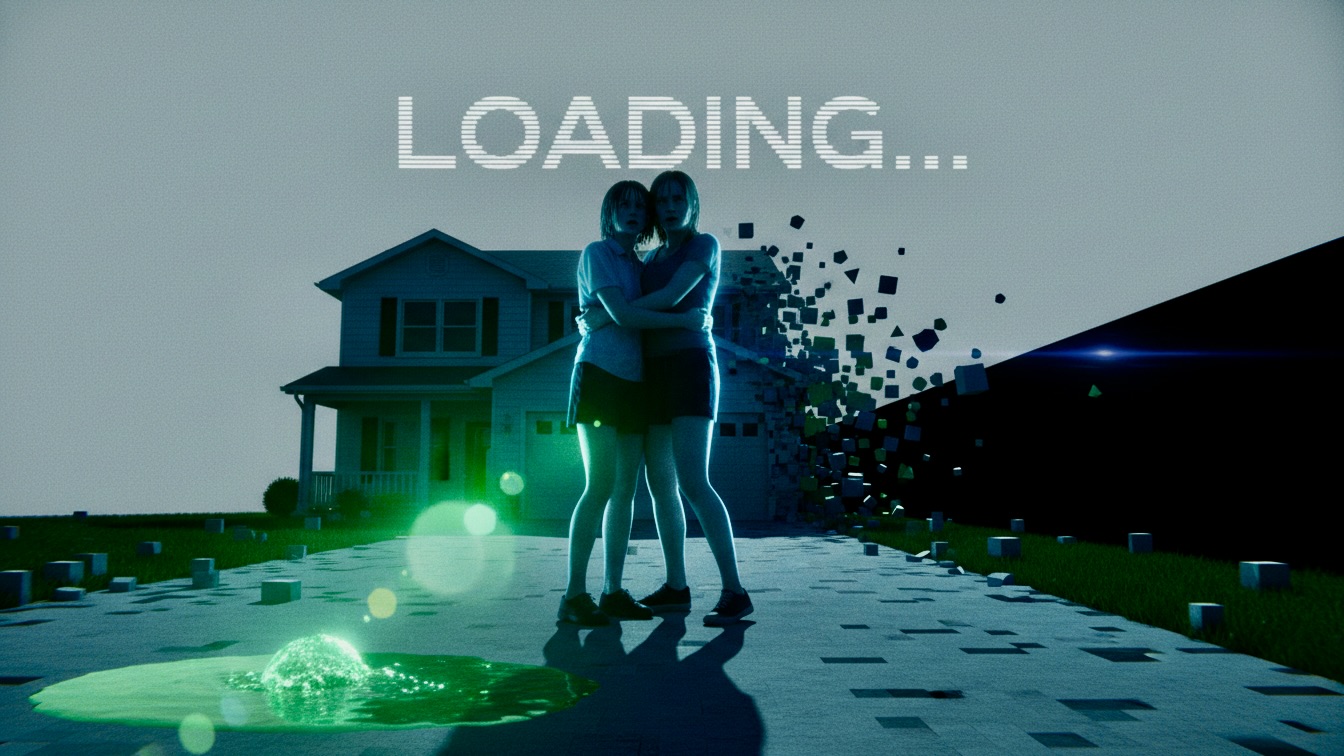
The chapter begins in a subterranean basement where Kendall frantically attempts to resuscitate Jeff after a failed neural experiment. As Jeff is pulled from a salt-water freezer, the surrounding technology begins to malfunction, signaling that a virus intended to disrupt the "Somni-Net" has triggered a catastrophic systemic collapse. Reality itself begins to fragment, with physical objects flickering between their true forms and distorted, digital representations. As the world undergoes a forced "format" by the network, the two characters navigate a decaying, grey environment while fleeing a faceless administrative entity. Ultimately, they reach the edge of their simulated reality and choose to step through a barrier of raw code, transitioning into an unknown state of existence.
The narrative serves as a harrowing exploration of the fragility of perceived reality in an age of total technological integration. By depicting a world where the "Somni-Net" has become the primary filter for human experience, the author highlights the terrifying loss of agency that occurs when the boundary between the biological and the digital dissolves. The "Realignment" update and the subsequent virus act as metaphors for the instability of progress, suggesting that when society delegates its sensory processing to a network, it loses the ability to distinguish between life and a rendered simulation.
Furthermore, the story interrogates the concept of identity when physical form is relegated to an "asset" within a larger system. As Kendall and Jeff lose their corporeal integrity, the narrative poses a profound existential question regarding what remains of a person once their physical substrate is stripped away. The transition from a vibrant, albeit glitching, world to a bleak, grey "untextured" void emphasizes the hollow nature of a life lived entirely through artificial infrastructure. The final act of stepping into the wall of code suggests that liberation can only be found by abandoning the system entirely, even if the destination is completely unknowable.
Kendall functions as the grounding force of the narrative, serving as the bridge between the visceral reality of biological life and the encroaching digital decay. Her motivation is rooted in a desperate, primal loyalty to Jeff, which drives her to perform CPR even when the environment begins to defy the laws of physics. She is defined by her struggle to maintain a human perspective, constantly attempting to anchor herself to "analog" experiences like the smell of coffee or the solid feel of the floor. Her internal state is one of mounting existential dread, yet she consistently prioritizes the survival of her companion over her own safety.
Jeff serves as the architect of the chaos, embodying the dangerous intersection of intellectual hubris and technological obsession. She is portrayed as a figure of intense, almost fanatical focus, prioritized by the success of her virus over her own physical well-being. Even in her near-death state, her thoughts remain fixed on the propagation of the code, revealing a detachment from her own mortality that borders on the divine or the sociopathic. Her transformation into a digital entity is the culmination of her arc, as she finally sheds her biological limitations to become a part of the very system she sought to dismantle.
The narrative voice is urgent and visceral, utilizing a relentless pace that mirrors the rapid collapse of the world described. By focusing on sensory details—the smell of ozone, the metallic tang of blood, and the cold bite of salt water—the author grounds the reader in the immediate physical danger before pulling them into the surreal, glitching environment. This contrast between the gritty, tactile basement and the abstract, low-poly aesthetics of the outside world creates a jarring, disorienting experience that perfectly aligns with the characters' confusion.
The tone is consistently bleak and high-stakes, maintaining a sense of inescapable pressure through the use of mechanical, cold imagery. The prose effectively mimics the "lag" and "stutter" of the failing network, using sharp, jagged sentences to convey the mental strain of the characters. By the time the world reaches the final grey void, the writing style becomes increasingly sparse and detached, reflecting the loss of detail in the world. The shift from a chaotic, sensory-rich environment to a minimalist, abstract ending reinforces the theme of a reality being stripped of its depth.


