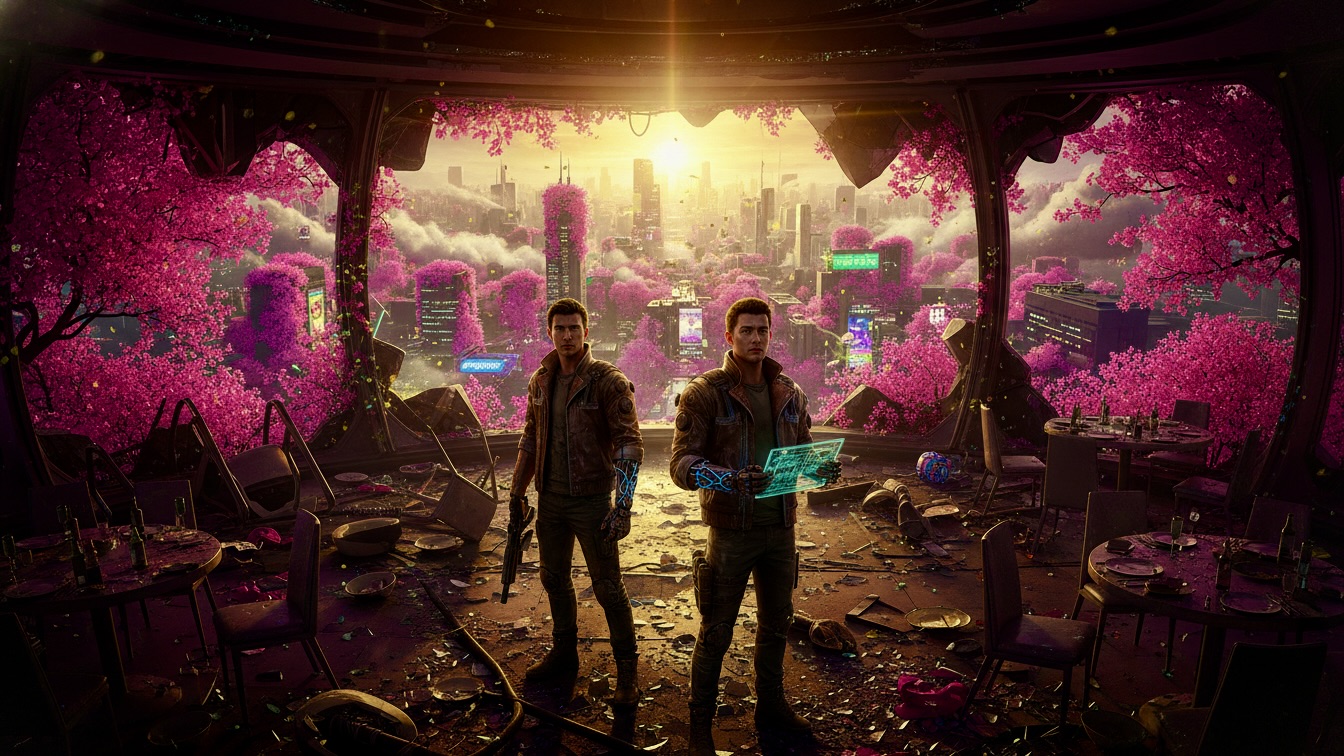
The story follows two brothers, Sam and Yung, meeting in a rotating high-altitude restaurant to confront a financial catastrophe. Yung has mishandled their shared assets, investing them in a high-risk scheme with the dangerous Vargas Group, which has subsequently led to a corporate extraction squad targeting them. As the brothers argue, an EMP blast disables the restaurant, followed by a violent assault by the extraction team. Amidst the chaos of shattered glass and high-altitude winds, the brothers barely survive the encounter through a combination of desperate physical defense and a narrow escape into a manual elevator shaft. The chapter concludes with the brothers ascending toward the maintenance deck, physically wounded and emotionally fractured, yet temporarily distanced from their attackers.
The narrative explores the volatile tension between familial obligation and individual survival in a hyper-capitalist dystopia. The setting of the rotating restaurant serves as a metaphor for the precarious nature of their lives, where everything is subject to a slow, grinding shift that eventually leads to a total breakdown. The rug-pulling, both literal and financial, underscores a world where trust is a liability and digital assets are essentially ghost currency that can vanish at the whim of corporate entities.
Furthermore, the story highlights the dehumanizing impact of technology on interpersonal relationships. The constant presence of recording devices, the reliance on neural jacks, and the cold efficiency of the extraction agents demonstrate a society where human life is subordinate to data and profit. The yellow pollen, described as toxic dust, acts as a pervasive atmospheric symbol of the decay and artificiality that coats every aspect of their existence, emphasizing that even the promise of spring in this world is merely a layer of hazardous debris.
Sam serves as the grounded, weary anchor of the pair, defined by his physical and emotional scars. His mechanical prosthetic is an extension of his status in the lower sectors, representing a past injury or a life of hard labor that contrasts sharply with the sleek, new neural hardware Yung pursues. He is a man driven by a profound sense of duty, yet he is exhausted by the cycle of cleaning up his younger brother’s catastrophic mistakes. Sam’s internal state is characterized by a simmering, suppressed rage that only breaks when the threat becomes immediate, revealing a protective instinct that overrides his resentment.
His decision to protect Yung during the assault, despite his vocalized disdain for the boy's selfishness, reveals the core of his character. He is trapped in a protective role that he despises, yet he cannot abandon it. The physical pain he endures throughout the chapter, particularly the injury to his leg and the strain on his metal arm, mirrors the psychological toll of carrying the weight of his brother’s failures. Sam is a survivor who values reality over the illusions of wealth, making his struggle to keep them alive a desperate attempt to maintain his own moral integrity.
Yung is defined by his restless, impulsive nature and his desperate desire for upward mobility. His constant leg bouncing and the tremor in his fingers reveal a nervous system pushed to its limit by the overclocking of his new neural jack. He represents the tragic victim of the get-rich-quick culture, believing that a single, high-stakes gamble can undo years of systemic poverty. His motivations are framed by a misguided sense of love; he believes he is saving them from their aunt’s betrayal, yet his inability to see the consequences of his actions makes him a dangerous liability.
Despite his recklessness, Yung possesses a latent capacity for action when the situation turns lethal. His use of the water pitcher to save Sam shows that he is not entirely defined by his failures; he is capable of violence and bravery, even if his judgment remains flawed. He is a character who lives in the future, constantly looking for an escape, which leaves him blind to the immediate dangers of the present. His apology at the end of the chapter is sincere but hollow, as he remains unable to offer anything beyond a promise to keep moving, highlighting his lack of long-term accountability.
The pacing of the chapter is masterfully controlled, beginning with a slow, grinding tension that mimics the rotation of the restaurant. The dialogue-heavy opening establishes the interpersonal conflict with sharp, clipped sentences that build frustration and anticipation. As the narrative progresses, the author shifts to rapid, visceral action sequences that mirror the suddenness of the EMP and the subsequent glass detonation. This transition from a psychological standoff to a kinetic struggle effectively conveys the brothers' lack of control over their environment.
The sensory details are particularly evocative, grounding the sci-fi setting in a tactile reality. The smell of gun oil, the metallic tang of ozone, and the sight of toxic pollen create a world that feels lived-in and abrasive. The author uses mechanical sounds, such as the grinding of servos and the clicking of the elevator winch, to emphasize the physical nature of their struggle. By focusing on the gritty, malfunctioning aspects of their technology, the narrative voice maintains a grounded, cynical tone that rejects the polished aesthetic of typical futuristic fiction.


