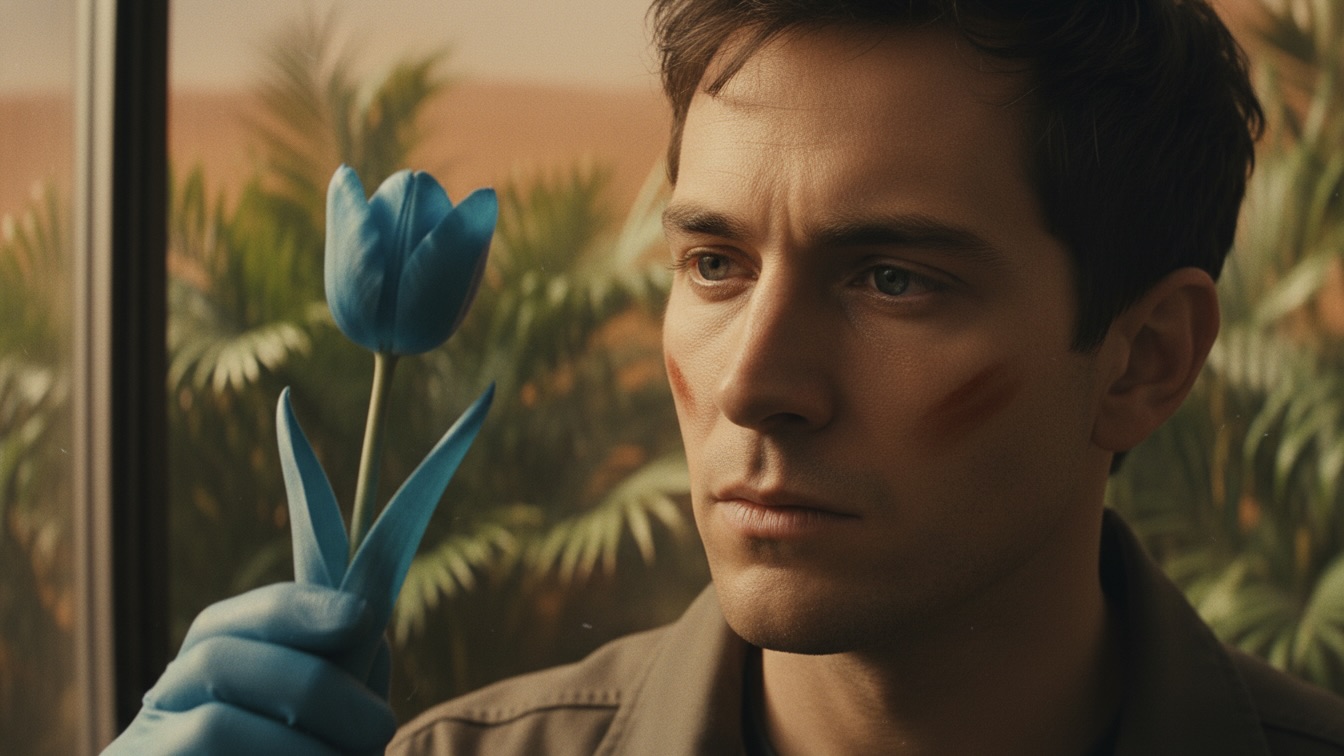
The narrative opens in the New Kyoto dome on Mars, where a man named Kevin observes a simulated spring that feels profoundly hollow. He stands before genetically modified tulips with electric blue stems, feeling a deep sense of alienation from the artificial environment that surrounds him. This "spring" is a digital and chemical approximation of a season on a planet that is currently being destroyed. Kevin’s internal malaise is compounded by the sterile smells of ozone and recycled plastic, which stand in stark contrast to his memories of Earth.
Dr. Qin, an older scientist who remembers the natural world, joins Kevin to discuss the survival of these alien-looking plants. Their conversation reveals the grim reality of their situation: the Svalbard seed vaults have been destroyed, leaving these blue tulips as some of the final remnants of Earth’s botanical history. While they talk, Kevin watches a low-bandwidth feed of London’s final moments, eventually hearing a harrowing, interrupted transmission from his sister. The realization that Earth is truly gone brings Kevin to the brink of a violent psychological break.
In a moment of intense emotional volatility, Kevin contemplates sabotaging the dome’s atmospheric controls to end the charade of their existence. He is stopped not by physical force, but by Dr. Qin’s perspective that their survival and the growth of these "ugly" flowers constitutes a protest against a cold, empty universe. Choosing to channel his grief into action, Kevin picks up pruning shears and begins to tend to the plants. The story concludes with Kevin and Qin working in silence, choosing the burden of a synthetic life over the silence of the Martian void.
The central theme of the story is the tension between authenticity and artificiality in the face of extinction. Kevin struggles with the "uncanny" nature of his surroundings, where every attempt to replicate Earth results in a distorted, plastic-like imitation. The blue stems of the tulips symbolize this distortion; they are alive, but they are no longer recognizable as the flowers of his home. This creates a psychological rift where the characters feel like curators of a museum rather than inhabitants of a living world.
Another significant theme is the concept of survival as an act of existential rebellion. Dr. Qin posits that the universe is naturally inclined toward emptiness and death, and therefore, any act of cultivation is a defiance of that entropy. This reframes the "fake" garden from a pathetic lie into a heroic stand. Even though the environment is synthetic and the flowers are "glitching," the act of keeping them alive serves as a stubborn refusal to be erased by the void.
The narrative also explores the weight of collective and individual grief. The destruction of Earth is not just a distant catastrophe but a personal one, punctuated by the loss of Kevin’s sister and the literal burning of the planet’s history. The story suggests that when a world dies, the survivors are left with a profound sense of "survivor's guilt" that manifests as a hatred for their own safety. Kevin’s desire to "let the red dust in" is a manifestation of his need for the external world to reflect the devastation he feels internally.
Finally, the story touches on the theme of stewardship in the aftermath of a collapse. Kevin’s transition from a potential saboteur to a gardener indicates a shift in his psychological state. He moves from a place of nihilistic despair to a grudging acceptance of his role as a protector of what remains. The "ugly" and "fake" garden becomes his responsibility, suggesting that meaning is not found in the perfection of the world, but in the labor spent trying to preserve it.
Kevin is a man suffering from a profound sense of displacement and existential dread. As a resident of New Kyoto, he is physically safe but psychologically fractured, unable to reconcile the sterile comfort of the dome with the violent end of his home planet. His hyper-awareness of the "fake" nature of his environment suggests a personality that values authenticity and is currently being traumatized by its absence. He views the blue tulips not as a miracle of science, but as a mockery of the nature he once knew.
His internal conflict reaches a breaking point when he witnesses the final moments of his sister’s life through a grainy, delayed feed. This event triggers a suicidal and homicidal urge to destroy the dome, reflecting a psychological state where the burden of being "the last" becomes unbearable. Kevin’s desire for the red dust to choke the dome is a cry for an end to the cognitive dissonance of playing "house" while a civilization dies. He wants the honesty of death over the lie of a plastic spring.
However, Kevin’s ultimate decision to prune the dying leaf reveals a resilient core beneath his cynicism. By choosing to work, he finds a way to ground his grief in a physical task. The act of pruning is not an act of hope—he still hates the blue stems and the smell of the air—but it is an act of agency. He chooses to be the curator of this "ugly" reality because it is the only reality left, showing a transition from passive suffering to active, albeit bitter, endurance.
The author employs a heavy use of industrial and synthetic imagery to create a sense of sensory claustrophobia. The air smells like "tennis balls" and "burnt-out microwaves," and the light is "high-definition and lonely." These descriptions effectively place the reader in Kevin’s shoes, making the setting feel more like a laboratory than a home. The contrast between the "rust" of the Martian landscape and the "electric blue" of the tulips creates a visual palette that feels unnatural and jarring.
Pacing in the narrative is carefully managed to mirror the build-up of Kevin’s internal pressure. The slow, quiet observations of the garden are interrupted by the sharp, static-filled horror of the London feed. This juxtaposition of the "boring" life on Mars with the "cinematic" end of Earth highlights the psychological gap between the two worlds. The "Signal Lost" icon bouncing like a game of Pong is a particularly effective stylistic choice, using a trivial, retro-gaming image to punctuate a moment of absolute tragedy.
The tone of the story is one of weary melancholia, yet it avoids total nihilism through its ending. The dialogue between Kevin and Qin is sparse and weighted, reflecting the exhaustion of men who have seen too much. The final image of the "bruised purple" sky matching the flowers suggests a merging of the Martian reality and the human attempt to change it. This stylistic choice underscores the idea that while the garden is artificial, it has become a permanent, if scarred, part of the new world.


