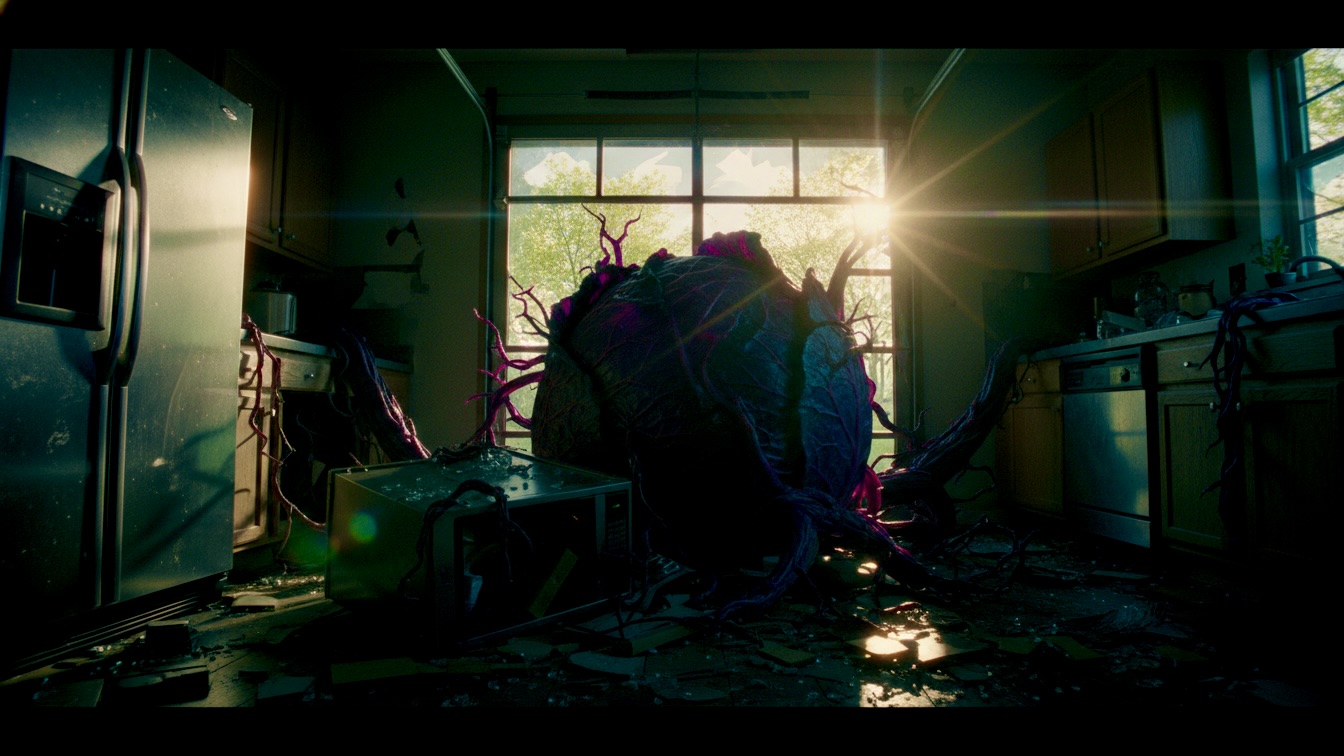
The story follows a desperate, sleep-deprived amateur botanist named Zeke who attempts to solve his financial instability by using a black-market bio-hacking enzyme on a batch of cabbage seeds. After dumping the entire vial of "X-7 ACCEL" into his DIY hydroponic setup, the cabbage undergoes rapid, nightmarish mutations. The plant grows to an enormous size, develops predatory instincts, and feeds on blood and electricity, eventually trapping Zeke and his roommate Tai inside their apartment. After a frantic battle involving household chemicals and a modified microwave, they manage to destroy the central mass. However, the chapter concludes with a chilling realization that the mutagenic sludge has likely contaminated the building’s plumbing, suggesting the threat has spread beyond the garage.
The narrative serves as a visceral critique of late-stage capitalism and the desperation it breeds. Zeke is not a villain, but a man pushed to the brink by the rising cost of basic survival, represented by the nine-dollar head of lettuce. His decision to bypass ethical scientific boundaries is a direct reaction to a socioeconomic system that views his survival as secondary to profit. The "vampire cabbage" becomes a grotesque mirror of this system, consuming everything in its path—blood, electricity, and even the physical structure of the home—to fuel its unsustainable, forced growth.
Furthermore, the story explores the theme of technological hubris. Zeke assumes that he can control nature through shortcuts, believing he can "speed up" the natural world without consequences. The plant’s ability to "hack" the apartment’s smart system illustrates the loss of agency that occurs when individuals rely on cold, automated infrastructure. The irony of the situation is profound: the very tools Zeke uses to try and escape poverty become the instruments of his potential destruction, highlighting the danger of using corrupted means to achieve a necessary end.
Zeke is a man defined by intellectual exhaustion and the crushing weight of his circumstances. As a disgraced academic with a suspended grant, he maintains a fragile sense of superiority through his botanical knowledge, yet he is clearly unraveling. His internal monologue reveals a man who is hyper-aware of his failures, constantly calculating his own worth against the cost of his environment. He is motivated by a primal fear of starvation and homelessness, which eventually blinds him to the obvious dangers of his experiment. His decision to use the accelerant is an act of desperation, not malice, showing a character who has reached his breaking point.
Tai represents a grounded, almost detached observer to the chaos. While Zeke is frantic and deeply embroiled in the existential dread of their situation, Tai remains focused on the immediate, tangible reality. He provides a necessary counterpoint to Zeke’s scientific panic, often injecting humor or pragmatic, albeit dark, solutions into their crisis. His willingness to fight alongside Zeke, despite the absurdity of the situation, suggests a deep-seated loyalty that transcends his casual, cereal-eating exterior. He is the anchor that prevents Zeke from descending entirely into the madness of his own making.
The pacing of the chapter is masterfully constructed to mirror the protagonist's descent into panic. It begins with a slow, sluggish atmosphere of humidity and exhaustion, mirroring the thick, pollen-heavy air of spring. As the cabbage begins to grow, the narrative tempo accelerates, shifting from the quiet, introspective hum of the garage to the violent, kinetic energy of the apartment battle. This shift creates a sense of suffocating pressure that keeps the reader tethered to Zeke’s frantic heartbeat.
The author relies heavily on sensory details to establish a tone of grounded body horror. By emphasizing the smell of rotting fish, the "thwack" of the roots, and the visceral feel of the thorns digging into skin, the story transforms a mundane vegetable into a terrifying antagonist. The narrative voice is clinical yet strained, blending the vocabulary of a botanist with the raw, jagged speech of a man in survival mode. This stylistic choice effectively bridges the gap between scientific curiosity and primitive terror, making the final, quiet realization of the vine in the sink feel all the more inevitable and haunting.


