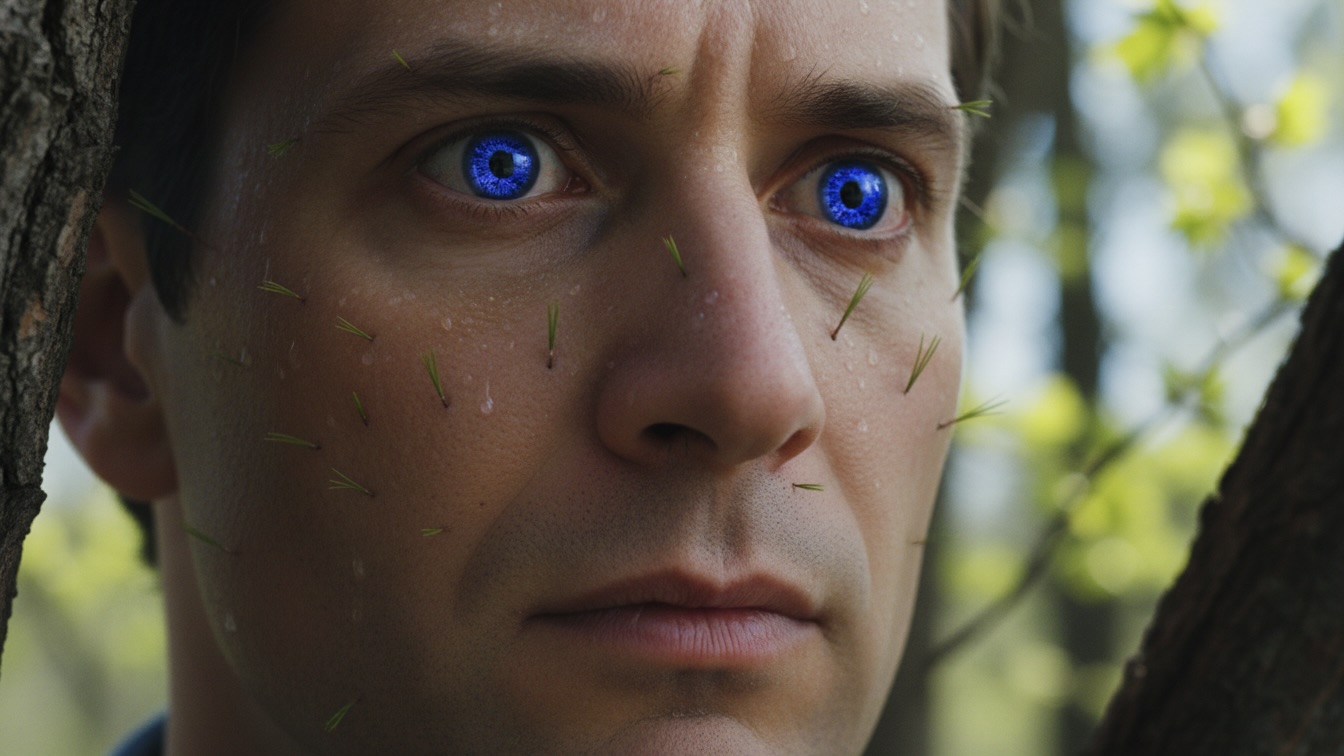
Dr. Aris Harte explores a disturbing section of the Black Hills, where the environment seems to pulse with a sentient, subsonic energy. He discovers a discarded tape recorder containing the frantic final words of a woman whose thoughts became her physical reality. As the atmosphere curdles into a sickly purple hue, Harte is confronted by his guide, Simon, who warns him that the forest is a mirror reflecting his own internal psyche.
Harte attempts to rationalize the growing horror as a neurological malfunction caused by vibrating pine cones, but his clinical skepticism only provides the forest with more material to manifest. A terrifying entity composed of pine needles appears, taking the shape of a trauma from Harte’s childhood. Simon abandons him to his fate, recognizing that the doctor’s overactive mind has made him a target. The story concludes with Harte losing his physical and mental cohesion as he is stitched into the landscape, becoming a permanent part of the forest’s memory.
The central theme of the narrative is the failure of rationalism and the scientific method when confronted with the subjective nature of reality. Dr. Harte represents the modern intellectual who believes that naming a phenomenon is equivalent to controlling it. However, in this specific environment, his labels and diagnoses act as blueprints for the forest to build upon. The story suggests that logic is not a universal shield but a specific human construct that can be turned against the thinker.
Another prominent theme is the inescapable weight of repressed trauma. The forest does not create new horrors but harvests existing ones from the recesses of the human mind. The appearance of the "tall man" from Harte’s childhood fever dreams illustrates how the past is never truly gone; it is merely waiting for the right conditions to resurface. The entity is not an external predator but a projection of Harte’s own unresolved fear, making the conflict internal and inescapable.
Finally, the story explores the concept of identity dissolution. As Harte’s physical body begins to turn into bark and needles, his sense of self—his name, his degrees, and his memories—evaporates. This suggests that identity is a fragile narrative we tell ourselves to maintain a boundary between the self and the world. Once that boundary is breached by an environment that "believes" our thoughts, the individual ceases to exist as a separate entity and becomes a mere data point in a larger, indifferent system.
Dr. Harte is a man defined by his professional armor, using his background in psychology to distance himself from the visceral world. He views the environment through a lens of pathology, attempting to reduce the terrifying phenomena to "prefrontal cortex" interference and "sensory hijacks." This intellectual arrogance is his primary character flaw, as he refuses to accept the evidence of his senses in favor of his academic training. He is a man who has spent his life studying the minds of others to avoid looking too closely at his own.
His internal conflict reaches a breaking point when his clinical detachment fails to protect him from the needle-creature. As he faces the manifestation of his childhood trauma, his reliance on "concrete" facts becomes a desperate, failing mantra. The transformation of his hands into bark signifies the total failure of his ego. By the end of the chapter, he is no longer a doctor or even a person, but a victim of his own inability to stop thinking and simply exist.
Simon serves as the pragmatic foil to Harte’s intellectualism, representing a more primal and instinctual relationship with the world. He understands the rules of the Black Hills not through study, but through observation and a healthy sense of fear. He recognizes that Harte’s "thinking too much" is a lethal liability in a place that mirrors the mind. Simon’s refusal to carry a gun, opting instead for a simple iron rod, suggests he knows that physical weapons are useless against psychological manifestations.
His decision to abandon Harte is not portrayed as a simple act of cowardice, but as a necessary survival tactic. He explicitly states that he has his own "ghosts" and cannot risk them being triggered by the doctor’s mental turbulence. Simon’s character highlights the theme that in a world where thoughts are reality, empathy and proximity are dangerous. He is a man who survives by keeping his mind quiet and his distance from those who cannot control their own internal noise.
The author employs a heavy use of sensory metaphors to create an atmosphere of physical and psychological decay. The description of the mud as the color of a "fresh bruise" and the wind smelling like a "penny under the tongue" immediately establishes a tone of bodily trauma. These synesthetic details bridge the gap between the internal human experience and the external environment. The shift in light from spring sun to "bruised purple" signals the transition from a natural setting to a surreal, nightmarish landscape.
The pacing of the narrative is masterfully handled, beginning with a slow, methodical investigation that mirrors Harte’s clinical approach. As the supernatural elements intensify, the sentences become shorter and the imagery more fragmented, reflecting the protagonist’s deteriorating mental state. The dialogue between Harte and Simon provides a sharp contrast between academic jargon and blunt, survivalist wisdom. This linguistic divide emphasizes the futility of Harte’s intellectualism in the face of a raw, existential threat.
Finally, the narrative voice utilizes a detached yet intimate perspective that allows the reader to experience Harte’s dissolution from the inside. The description of the voice coming from "inside Harte’s own skull" rather than the air heightens the sense of claustrophobia. The ending of the story is particularly effective, as the prose mimics the loss of self-identity by describing Harte’s own name as a "foreign language." This stylistic choice ensures that the horror is not just something the character sees, but something the reader feels as a total collapse of reality.


