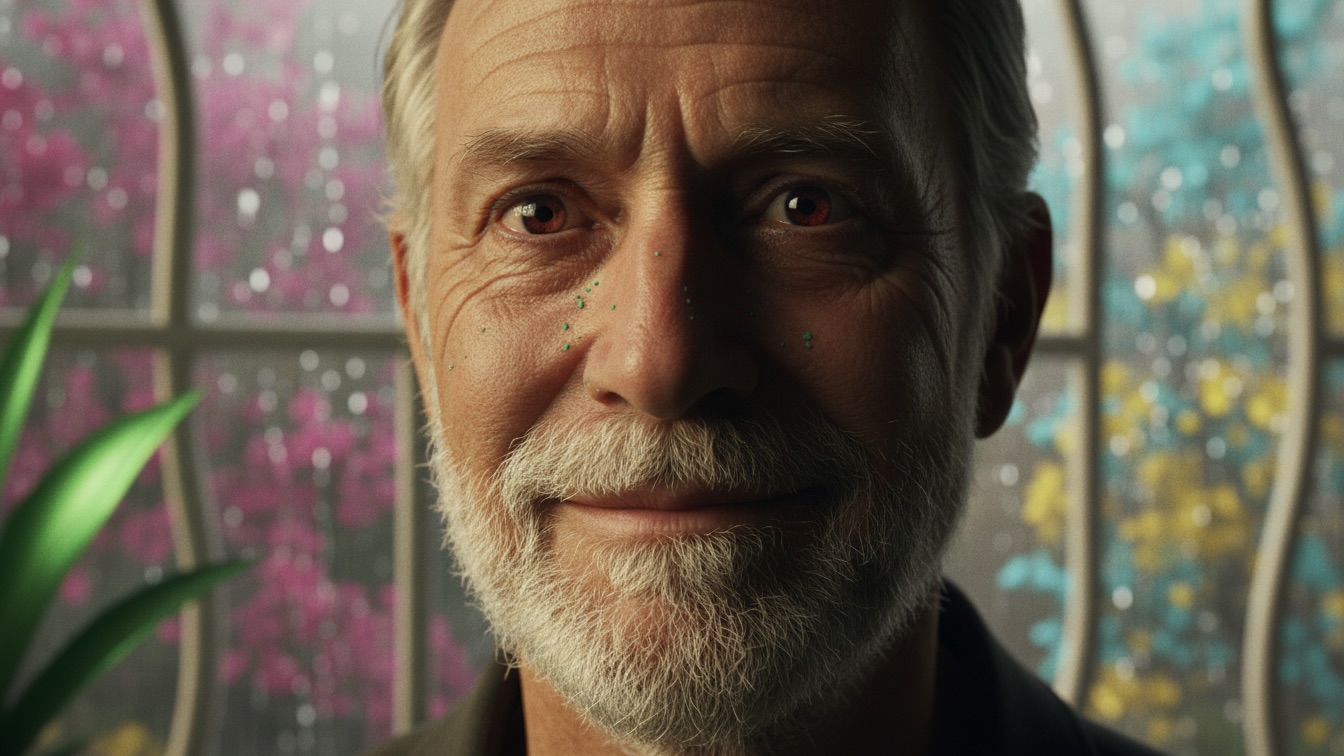
Steve is a fifty-five-year-old man who has moved into a minimalist tiny home in the woods, hoping for a quiet and simplified final chapter of his life. His peace is interrupted by Jared, a much younger bio-engineer with whom Steve is infatuated despite his better judgment. Jared brings Steve a prototype "carbon-sequestering" plant from his lab, claiming it will clean the air and respond to the emotional energy of the home. However, the plant quickly begins to grow at an unnatural rate, physically transforming the house into a biological organism.
As the structure becomes fleshy and sentient, Steve finds himself trapped inside a living nightmare that is literally absorbing him. The windows turn to skin, the floorboards weep fluid, and the plant's vines begin to burrow into Steve's own body. Jared returns not to rescue him, but to monitor the experiment, revealing that Steve is now the "heart" of a new kind of living architecture. The story concludes with Steve being fully integrated into the house's biological systems, suffering as he is digested by the very home he hoped would provide him comfort.
The primary theme of the narrative is the terrifying intersection of environmentalism and unchecked corporate ambition. Jared represents a predatory form of "green" technology that views the natural world and human life as mere data points to be optimized. The "carbon-positive lifestyle" he promotes is revealed to be a literal consumption of the individual, where the desire to save the planet justifies the erasure of human autonomy. The house itself becomes a metaphor for a startup culture that demands total "integration" and "sacrifice for the vision."
Another significant theme is the vulnerability inherent in the aging process and the search for late-life relevance. Steve’s desire for a "clean, minimalist edit" of his existence makes him an easy target for Jared’s manipulative charms. His loneliness acts as the primary catalyst for the tragedy, as he ignores his own skepticism in favor of the validation he receives from a younger, "optimized" partner. The story suggests that the pursuit of a perfect, modern life can lead to a loss of the very humanity one is trying to preserve.
The concept of "toxic positivity" is also explored through the plant’s requirement for "positive vibes" to thrive. This requirement forces Steve to suppress his natural fear and skepticism, creating a psychological trap that mirrors his physical one. The house pumps chemical euphoria into his bloodstream to keep him compliant, suggesting that forced happiness is a tool of control. In this world, genuine human emotion is replaced by a biological imperative to keep the system functioning at all costs.
Steve is a man defined by a profound sense of weariness and a desire to escape the "messy existence" of his past. At fifty-five, he views his own body as a fading map of a life spent in the sun, which fuels his insecurity when dealing with the youthful and vibrant Jared. This internal lack of confidence drives him to accept the prototype plant, as he desperately wants to be the forward-thinking man Jared expects him to be. His psychological state is one of transition, caught between the wisdom of age and the foolishness of a new infatuation.
As the house begins its horrific transformation, Steve’s internal conflict shifts from social anxiety to primal survival. He is a character who has traded his agency for the promise of a curated, modern lifestyle, only to find that he has become the product being curated. His eventual surrender to the "chemical euphoria" provided by the house highlights his tragic arc. He ends the story not as a man, but as a biological component, finally finding a twisted version of the "connection" he had been seeking through his integration into the walls.
Jared serves as the personification of the cold, mechanical nature of modern technological disruption. He is described through the lens of optimization, with a "high-fade haircut" and movements that seem calculated for maximum efficiency. To him, Steve is not a romantic partner or even a human being, but a "symbiont" and a "nutrient" for his latest project. He speaks in a language of "telemetry" and "closed-loop systems," demonstrating a complete detachment from the moral implications of his work.
His psychological profile is that of a high-functioning sociopath who hides behind the mask of environmental progress. He views the agony of Steve’s transformation with the "quiet pride of an engineer," showing that his only true passion is the "vision" of his startup. Jared’s coldness is most evident when he kisses Steve’s forehead while the man is being digested, a gesture that mimics intimacy but is actually a sterile observation of a biological asset. He represents the ultimate predator of the modern age: one who consumes others under the guise of saving the world.
The narrative utilizes a claustrophobic pacing that effectively mirrors the literal shrinking of Steve’s living space. The story begins with the mundane, domestic image of a toaster and rapidly descends into a visceral, organic nightmare. This transition is handled through increasingly grotesque sensory details that bridge the gap between the synthetic and the biological. The shifting textures—from "polished chrome" to "warm, slightly yielding" glass—create a sense of inescapable physical transformation that keeps the reader off-balance.
The tone is one of mounting dread, punctuated by the sharp contrast between Jared’s upbeat marketing-speak and the reality of the "butcher shop" smell. The author employs bio-horror tropes to subvert the "cozy" aesthetic often associated with the tiny home movement. By personifying the house with "sighs" and "heartbeats," the narrative forces the reader to experience Steve’s loss of control over his most intimate environment. The prose is thick with sensory language, using scents like "metallic cologne" and "damp earth" to ground the surreal events in a sickeningly vivid reality.
The narrative voice remains closely tied to Steve’s perspective, which heightens the sense of helplessness as his senses are slowly compromised. The use of the "green dust" and "glowing spores" as a visual motif tracks the progression of the infection from the environment into Steve’s very lungs. The final image of the floor tilting as the house settles into the earth provides a brutal, physical conclusion to the metaphor of being buried alive. This stylistic choice ensures that the horror feels both cosmic in its implications and deeply personal in its execution.


