The narrative opens in the midst of a high-stakes, surrealist car chase where the protagonist, Stacey, finds herself handcuffed to a mysterious man in a dilapidated sedan. As they flee from sentient, menacing wedding cakes across a highway made of blue velvet, the physical reality of their vehicle begins to transform. The rusted car dissolves into a transparent chariot of glass, symbolizing a transition from defensive concealment to terrifying vulnerability. Stacey struggles with her need for control and her confusion over the identity of her companion, who appears to be a composite of every significant man from her past.
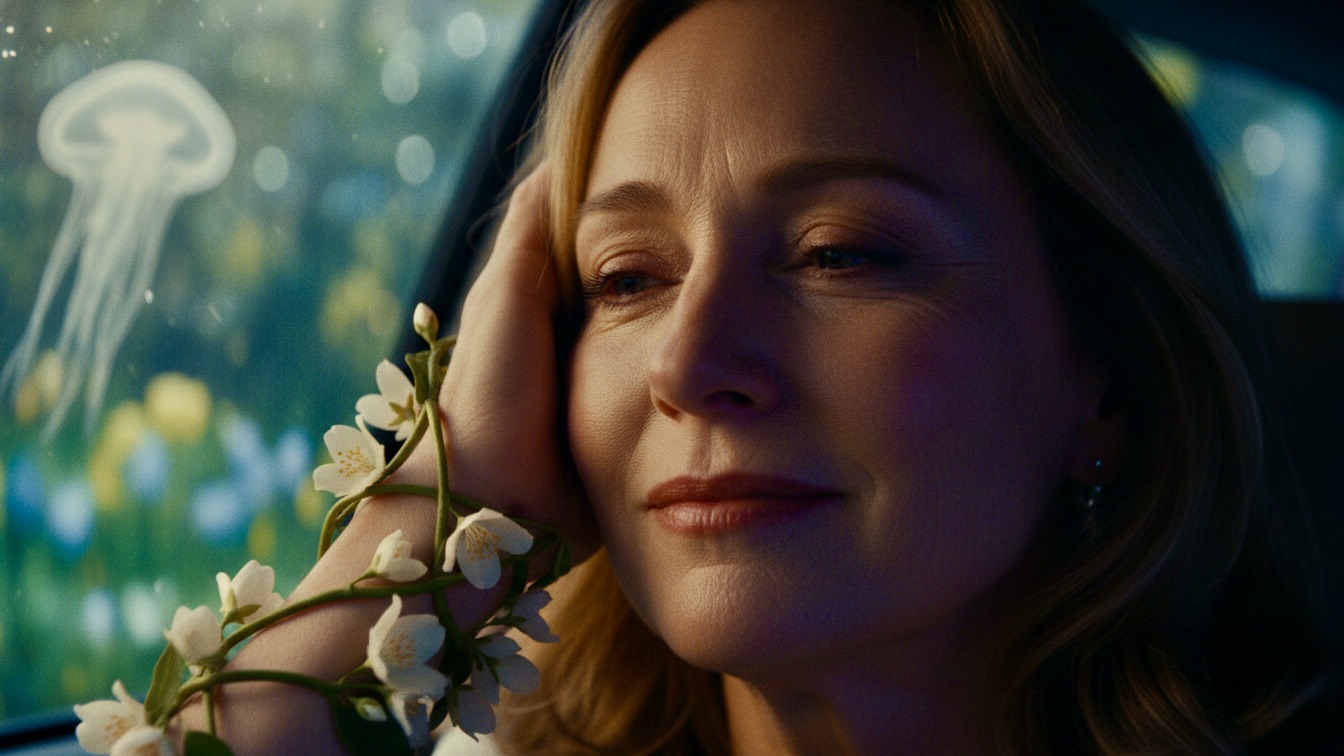
The journey reaches a literal and metaphorical precipice when the velvet road ends at a limestone cliff. Rather than plunging to their deaths, the car becomes buoyant, floating among house-sized, glowing jellyfish in a serene spring sky. During this suspension, the restrictive metal handcuffs morph into fragrant jasmine vines, binding Stacey to her companion through growth rather than force. Recognizing that she no longer needs to steer or flee, Stacey chooses to turn off the ignition. She accepts the uncertainty of their destination, finding a sense of peace and interconnectedness with the surreal world around her.
The central theme of the story is the tension between rigid control and the liberation found in surrender. Stacey begins the journey defined by her resistance to her circumstances, fixated on the cold metal of the handcuffs and the perceived danger of the "over-baked" pursuers. Her psychological state is one of chronic constriction, evidenced by her "half-collapsed" lungs and her defensive reaction to the glass car’s transparency. The shift from the iron handcuffs to the jasmine vines illustrates a transition from external entrapment to internal, organic connection.
Another prominent theme is the reconciliation of one’s personal history and the weight of romantic expectations. The wedding cakes serve as grotesque symbols of traditional milestones and the "malice" of societal pressure or failed domesticity. By being chased by these sugary monstrosities, Stacey is effectively running from the ghosts of her own expectations. The driver, acting as a "living scrapbook" of her past loves, forces her to confront the sum of her experiences. Only when she stops viewing her history as a series of "bad dates and broken promises" can she find the "sudden oxygen" required to breathe freely.
Finally, the narrative explores the concept of emotional transparency as a prerequisite for growth. The transformation of the car into a "chariot of glass" strips away Stacey's "walls" and "secrets," exposing her to the vastness of the world. This exposure is initially terrifying, yet it is the very thing that allows the jasmine to bloom and the jellyfish to provide a sense of calm. The story suggests that true peace comes not from reaching a specific destination or maintaining a perfect "paint job" on one's life, but from the willingness to be seen and to exist in a state of flux.
Stacey is a fifty-four-year-old woman who has spent decades constructing emotional barriers to protect herself from the disappointments of life. Her initial dialogue is sharp and defensive, reflecting a personality that equates safety with being the one behind the wheel. She is a woman who has been hardened by a divorce and a series of failed relationships, leading to a psychological state where she feels "trapped" within her own body. This internal claustrophobia is so profound that she has forgotten what it feels like to breathe deeply or to exist without a metaphorical map.
As the story progresses, Stacey undergoes a significant psychological evolution from a state of hyper-vigilance to one of mindful presence. Her concern for the "paint job" of the car even in the face of absurdity reveals her preoccupation with appearances and the preservation of her ego. However, the "clarity" of the glass chariot forces her to confront her nakedness and the "broken promises" she has carried. Her decision to turn the key to "off" represents the climax of her character arc, signaling her willingness to abandon the "scarcity mindset" of her past in favor of an unknown future.
The driver serves as a catalytic figure, acting more as a psychological mirror than a traditional antagonist or partner. He is a shapeshifting entity who embodies Stacey’s entire romantic history, appearing as a composite of her high school sweetheart and the man she almost married. His use of modern slang like "no cap" juxtaposed with his ancient, "older than the hills" wisdom highlights his role as a timeless guide. He does not offer Stacey answers or directions; instead, he offers her the "profound, quiet patience" she needs to find her own way.
By telling Stacey that she holds the key, he shifts the responsibility of her liberation back onto her shoulders. He is the personification of her "history, the good and the bad," and his presence allows her to integrate her past selves into a cohesive whole. His role is to facilitate her transition from the "highway" of driven, goal-oriented life to the "sky" of pure being. He does not lead her so much as he accompanies her, eventually merging with her through the jasmine vines as they both become part of the larger environment.
The narrative voice is characterized by a blend of gritty realism and ethereal surrealism, creating a tone that is both urgent and dreamlike. The author uses sensory details to ground the reader in Stacey’s physical experience, such as the "wet thud" of buttercream and the "silk on silk" sound of the jellyfish. These details serve as psychological anchors, making the absurd elements feel visceral and emotionally resonant. The pacing mirrors Stacey’s internal state, beginning with the frantic, rhythmic vibration of the velvet road and slowing down to a "soft sigh" as she finds peace.
Metaphorical language is the driving force of the prose, with the "velvet road" and "glass chariot" serving as powerful visual representations of Stacey’s journey. The transition of the handcuffs into jasmine flowers is a particularly evocative image that signifies the transformation of a burden into a blessing. The author’s choice to use wedding cakes as the primary antagonists adds a layer of dark humor and social commentary, contrasting the sweetness of the dessert with the "sugary malice" of the eyes. This juxtaposition highlights the protagonist's cynical view of romantic traditions.
The ending of the chapter shifts the narrative into a more atmospheric and contemplative mode. The repetition of "light" and "glowing" imagery creates a sense of transcendence, moving away from the "rust" and "metal" of the opening paragraphs. By focusing on the "jasmine vines" spreading toward the jellyfish, the author illustrates the dissolution of the boundary between the self and the universe. This stylistic shift effectively communicates the protagonist's newfound sense of belonging and the end of her isolation.


