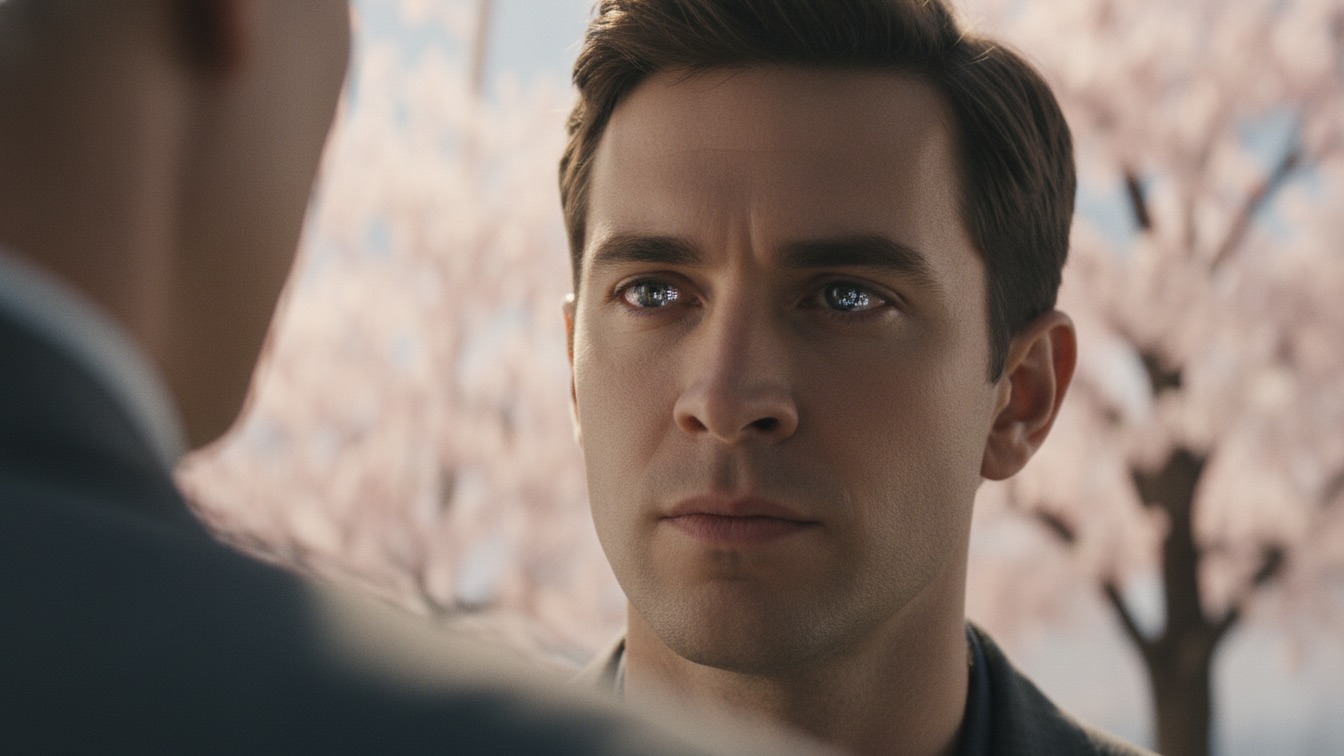
The chapter begins in a hyper-regulated, synthetic environment known as the Dome, where the protagonist, Bax, monitors the biometric data of a celebrity named Idol-7. While Bax believes his invasive surveillance is a form of protective intimacy, his rival, Pina, interrupts his session by hacking his visual feed and revoking his "color privileges." Pina mocks his primitive methods and proposes a high-stakes data heist to sell Idol-7’s most private neural patterns to an unscrupulous firm in the Undercity.
The two hackers attend the Spring Gala, an event defined by forced cheerfulness and sedative-breathing walls, to complete the data transfer via a proximity sniffer. Their plan is derailed when Idol-7 confronts them directly, revealing that she has been aware of their digital intrusions for months. Rather than turning them over to the authorities, she proposes a radical partnership to monetize her own exploitation. The chapter concludes with the three forming an unlikely alliance, intending to turn the city’s surveillance state into a profitable, subversive reality show.
The central theme of the narrative is the total commodification of the human experience within a late-stage capitalist dystopia. In the Dome, every biological function, from REM cycles to glucose levels, is treated as a tradeable asset. The characters do not merely live; they generate data packets that are harvested for social credit or advertising revenue. This environment suggests that privacy is not just a lost right but a forgotten concept, replaced by a world where intimacy is redefined as high-bandwidth data access.
Another significant theme is the performative nature of happiness and the criminalization of negative emotions. The Dome utilizes drones and "mood-stabilizing gummies" to enforce a state of perpetual joy, effectively lobotomizing the population’s emotional range. By threatening to turn Bax’s world grayscale or report him for "illegal sadness," the narrative explores how totalitarian regimes can use sensory and emotional regulation as a primary tool of social control. The sky’s "aggressive blue" serves as a constant reminder of this forced optimism.
Finally, the story examines the intersection of obsession and connection in a digital age. Bax’s belief that he is a "guardian angel" because he monitors Idol-7’s heart rate highlights a disturbing psychological shift where stalking is rebranded as care. The final alliance between the stalkers and their target suggests that in a world of total transparency, the only path to agency is to lean into the surveillance. They choose to weaponize their lack of privacy, turning their collective obsession into a brand that threatens the very system that created them.
Bax functions as a deeply lonely individual who has replaced genuine human interaction with digital voyeurism. He exhibits a classic savior complex, convincing himself that his invasive hacking is a benevolent act designed to protect Idol-7 from nightmares. This rationalization allows him to bypass the ethical implications of his actions, framing his felony as a "safety vibe." His psychological state is tethered to the data he consumes; when he loses his color privileges, his sense of self and motor coordination begin to fracture.
His relationship with technology is both an addiction and a crutch. He feels "vibrating" and "solid" only when connected to the grid, suggesting that his biological identity has been subsumed by his digital presence. Despite his technical prowess, he remains a romantic at heart, clinging to the "purity" of a pulse-sensor over the cold efficiency of Pina’s fridge logs. His eventual agreement to join Idol-7 and Pina reflects a transition from a passive observer to an active participant in his own commodification.
Pina serves as the pragmatic, ruthless foil to Bax’s deluded romanticism. She views the world through the lens of exploits and vulnerabilities, treating human beings as nothing more than complex sets of math to be solved or divided by zero. Her decision to revoke Bax’s color privileges demonstrates her need for dominance and her lack of empathy for those she considers "embarrassing" or "2024." She is driven by a desire for upward mobility, seeking the wealth necessary to "be miserable in a penthouse."
Psychologically, she is a high-functioning sociopath within the context of the Dome’s digital landscape. She does not seek connection; she seeks leverage. Her suit, shimmering with middle-finger emojis, is a visual manifestation of her contempt for the social credit system and her peers. However, her quickness to align with Idol-7 at the end shows that she is ultimately a creature of utility. She values the "insane numbers" of a scandal more than her own ego, proving that her primary loyalty is to the highest-trending outcome.
Idol-7 is the most complex figure in the narrative, embodying the exhaustion of a person who has become a living brand. While she appears to be the "ultimate happy citizen" to the public, her internal reality is one of sleep deprivation and profound boredom. She possesses a high degree of emotional intelligence and technical awareness, having tracked her own stalkers with more efficiency than they tracked her. Her character represents the "burnout" of the influencer era, where the pressure to be perfect has stripped her of her humanity.
Her proposal to Bax and Pina is a brilliant psychological pivot from victim to leader. Instead of seeking justice, she seeks a "polycule of aesthetic rebellion," recognizing that a scandal is more valuable than a pristine image. She is the true architect of the story’s conclusion, manipulating her stalkers into becoming her business partners. By choosing to "make the Dome look at its own reflection until it cracks," she displays a vengeful streak that is masked by the very "masterpiece of engineering" that is her smile.
The narrative voice is characterized by a sharp, cynical tone that mirrors the "bleached" and "aggressive" atmosphere of the setting. The author uses tech-heavy jargon—such as "lithium-ion battery," "haptic pulse," and "proximity sniffer"—to create a sense of immersion in a future where language has been colonized by engineering. This creates a cold, sterile feeling that is punctuated by moments of visceral disgust, such as the description of mood gummies tasting like "crushed dreams."
Pacing is managed through a shift from internal observation to external conflict. The opening paragraphs are slow and meditative, reflecting Bax’s focused state of surveillance, but the pace quickens significantly once Pina introduces the "grayscale virus." The transition to the Spring Gala introduces a sense of heist-like tension, which is then subverted by the dialogue-heavy confrontation with Idol-7. This shift from action to negotiation changes the story's energy from a thriller to a dark satire.
Sensory details are used effectively to highlight the artificiality of the Dome. The contrast between the "neon lime" grass and the "muddy, charcoal gray" of the virus provides a strong visual metaphor for the protagonist’s loss of status and control. Smells like "ionized air" and "expensive vanilla" are contrasted with the "battery acid" taste of hacked electrolytes, grounding the high-concept sci-fi elements in physical discomfort. These details reinforce the idea that in this world, even the most basic sensory experiences are programmed, manipulated, or sold.


