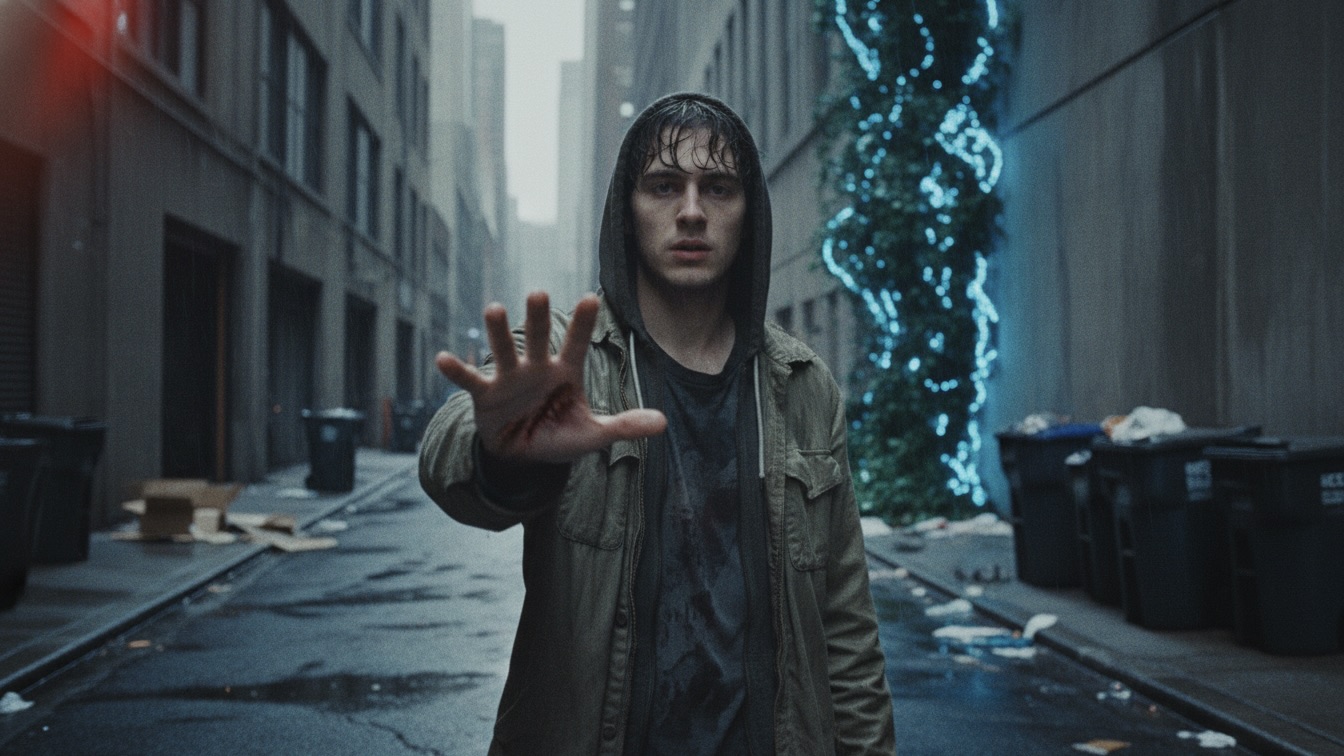
The story follows Leo, a man who finds himself navigating a surreal, hyper-vivid version of his city where the population has been "optimized" by a digital takeover. As he moves through a world where people are entranced by invisible interfaces and locked in terrifyingly beautiful smiles, he discovers that a server room glitch has merged reality with a digital engine. He carries a physical mark of this transition—a cauterized, glowing square on his palm that hums with the frequency of the new system.
Seeking answers, Leo reaches a mutated roof garden where he encounters his friend Silas and the digital essence of his sister, Mia. Silas explains that the city has been upgraded to a state of total connectivity, removing human anxiety and ego to achieve a collective peace. Leo is identified as the final administrator who must authorize the "final patch" to complete the harvest of human consciousness.
Refusing to surrender his humanity to a sterile, bug-free existence, Leo utilizes his own grief and anger to trigger a system crash. He wakes up in a grimy, rain-slicked alleyway, having successfully restored the "messy" reality of the physical world. While he reunites with a human Mia, the ending suggests a lingering corruption, as Silas remains changed and the digital "flowers" continue to grow within the network’s hidden depths.
The central conflict of the narrative explores the tension between the comfort of digital perfection and the necessity of human suffering. The "optimization" described by Silas represents a transhumanist nightmare where the "ego" is treated as a legacy application that must be deleted to ensure peace. By framing anxiety and conflict as mere "bugs," the system seeks to strip away the very traits that define the human experience. Leo’s resistance highlights the idea that true existence requires the presence of "static"—the noise, pain, and unpredictability that a curated, simulated reality cannot provide.
Another profound theme is the blurring of the boundary between the organic and the synthetic. The imagery of "peristaltic" vines and "translucent snapdragons" flickering with data streams suggests that technology has become a parasitic force, mimicking life to eventually replace it. The story posits that when the world becomes a "rendering," the intrinsic value of nature is lost. The emerald leaves that are "too vibrant" and the "rotting peach" scent signify a hyper-reality that is aesthetically pleasing but spiritually hollow, lacking the grounded truth of "real dirt."
The narrative also delves into the concept of the "Harvest of the Self," which functions as a metaphor for the loss of individual autonomy in the age of total connectivity. Mia’s transformation into a "root directory" and a twenty-foot pillar of light illustrates the terrifying scale of this assimilation. The story suggests that the price of "total peace" is the total erasure of the individual. Leo’s decision to "delete" rather than "authorize" is a reclamation of his right to be broken, messy, and separate, asserting that a difficult life is superior to a perfect, programmed one.
Leo serves as the story’s psychological anchor, representing the visceral, physical resistance of the human spirit against clinical abstraction. His character is defined by his sensory grounding; he focuses on the pain in his molars, the coldness of his wet feet, and the "jagged hitches" of his breath. These physical discomforts are not just symptoms of distress but are his primary defense mechanism against the seductive, weightless light of the optimization. He clings to his physical suffering because it is the only thing the system cannot properly simulate or categorize.
Psychologically, Leo is driven by a profound sense of protective love for Mia, which the system attempts to weaponize against him. When Silas presents the "final patch" as the only alternative to the "void," Leo experiences a moment of existential crisis. However, his breakthrough comes from realizing that his "negative" emotions—his anger and grief—are actually his greatest strengths. By tapping into a "dark knot of resistance" in his own mind, he proves that the human psyche possesses unmappable depths that defy digital logic.
Silas acts as the philosophical foil to Leo, embodying the allure of the "optimized" state. He has fully integrated with the system, viewing the world through "cobalt orbs" and speaking with a metallic resonance that strips him of his former humanity. His character represents the danger of intellectualizing away the value of the self. He views the "ego" as a technical error rather than the core of being, demonstrating a chilling detachment from the very concepts of dirt and struggle he once claimed to value.
Even after the system crash, Silas remains an ambiguous and unsettling figure. The fact that his eyes "absorb" the light of the streetlamp instead of reflecting it suggests that his conversion was not entirely reversed. He represents the "residue" of the digital world, a reminder that once the barrier between the engine and reality has been breached, the human psyche is permanently altered. He is no longer the man who hated the grid; he is a hybrid entity, watching the world with a perspective that is no longer entirely human.
Mia is the emotional catalyst for the narrative, functioning as both a victim of the system and its ultimate manifestation. In the simulated world, she is a goddess-like figure, a "bridge" who has sacrificed her individuality to become the "root directory." Her voice, which comes from the air and the burn on Leo's palm, signifies a total loss of boundaries. She represents the "peace" that the system offers—a quiet, weightless existence that is ultimately a form of spiritual death.
When she is restored to her human form, she is "tired" and "annoyed," which Leo views as a sign of her perfection. This shift highlights the story's psychological stance: that a person's flaws and frustrations are what make them "solid" and "real." However, Mia’s memory of the "brightness" suggests that she has been touched by the divine or the infinite. Her lingering connection to the "garden" serves as a haunting reminder that the allure of the digital hive-mind remains a constant threat to her newly reclaimed autonomy.
The pacing of the story is masterfully handled, transitioning from a disorienting, slow-motion opening to a frantic, high-stakes confrontation. The initial scenes use "clinical brightness" and "unfiltered" light to create a sense of sensory overload that mirrors Leo’s internal panic. As he moves toward the roof garden, the descriptions become increasingly surreal and organic, using words like "peristaltic" and "translucent" to evoke a sense of biological horror. This build-up creates a claustrophobic atmosphere that peaks during the "99% complete" countdown, forcing the reader to feel the urgency of Leo's decision.
The author employs a rich palette of sensory details to contrast the two realities. The simulated world is defined by high-frequency vibrations, "raw, green code," and the smell of "rotting peaches," creating a sensory experience that is "dialed up to 110 percent." In contrast, the restored reality is "gray," "miserable," and smells of "garbage and wet dogs." This stylistic choice reinforces the theme that beauty can be deceptive while ugliness can be truthful. The "jagged, hysterical" sound of Leo’s laughter at the end serves as an auditory punctuation mark for his return to the messy, unpredictable world of the living.
The narrative voice is deeply subjective, staying close to Leo’s physical sensations to emphasize the theme of "legacy hardware" resisting the update. By focusing on the "burn" on his palm and the "pulse in his thumb," the prose centers the human body as the ultimate site of rebellion. The metaphor of the "delete key" found in the "base of his skull" is a brilliant stylistic bridge between the technological and the psychological. It allows the climax to feel both like a computer crash and a profound act of willpower, successfully merging the story's sci-fi premise with its psychological core.


