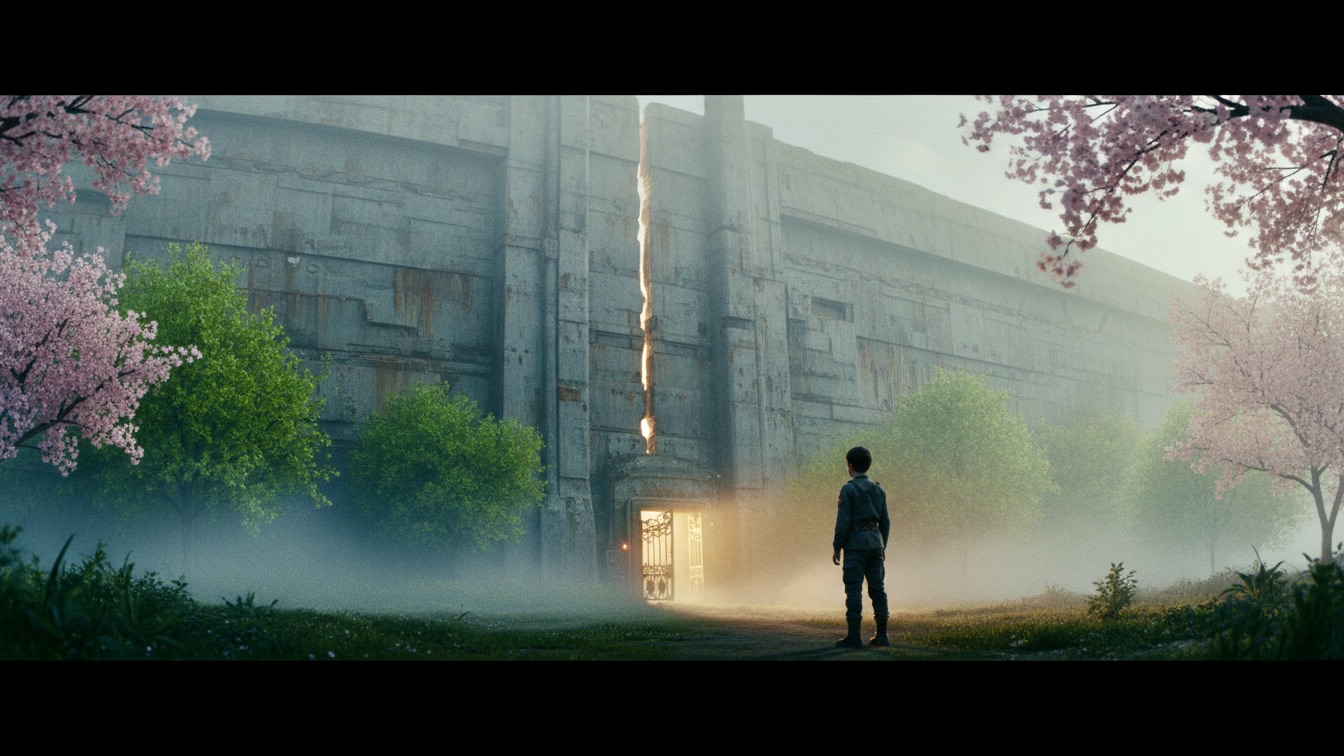
The narrative unfolds on a massive, atmospheric perimeter wall where two guards, Hamish and Kyle, are stationed during a humid spring night. The setting is a dystopian city isolated from a "forbidden" outside world by a giant gray cliff-like structure and an electrified fence. While Kyle attempts to maintain a facade of professional detachment and intellectual superiority, Hamish is drawn to the sensory experiences of the world beyond the wall. The tension escalates when the "Ghost Alarms" are triggered by the thick fog, leading to a visual dispute between the two men.
Hamish perceives a humanoid figure standing near the fence in the mist, while Kyle dismissively attributes the sighting to optical illusions and atmospheric interference. Driven by an irrepressible need for truth, Hamish defies protocol by deactivating his body camera and descending the ladder to the ground level. At the base of the wall, he discovers that the figure is not a ghost or a glitch but a living person. The chapter concludes with Hamish making the monumental decision to unbolt the gate, allowing the wild, forbidden air of the outside world to rush into the controlled environment of the city.
The central theme of the story is the conflict between institutional control and individual sensory truth. The wall serves as both a physical and psychological barrier that dictates what the citizens are allowed to perceive as "real." By labeling the outside world as "broken" and "dangerous," the authorities have created a vacuum of information that Hamish begins to fill with his own observations. The humming of the electric fence represents the constant, vibrating presence of state power, which claims to provide safety while actually enforcing isolation.
Another prominent theme is the transition from childhood obedience to adult autonomy. Hamish’s journey from the top of the wall to the ground level mirrors a psychological descent from the safety of abstract rules into the complexity of lived experience. When he turns off his body camera, he is effectively severing his connection to the "eye" of the state. This act of rebellion signifies his refusal to be a mere instrument of the city’s will, choosing instead to engage with the world as an independent agent.
The narrative also explores the theme of fear as a tool for denial. Kyle uses complex language and scientific jargon to mask his terror of the unknown, preferring the comfort of a "malfunction" over the terrifying possibility of an external reality. This reflects a broader human tendency to cling to established systems when faced with evidence that challenges a worldview. By dismissing Hamish’s sightings as "light refraction," Kyle attempts to maintain the integrity of his mental prison, whereas Hamish is willing to risk the "theatrical madness" of discovery.
Hamish is a character defined by his heightened sensory awareness and his burgeoning curiosity. Unlike his companion, he does not filter his experiences through the lens of official doctrine, instead noticing the "sugar and old dirt" smell of the forbidden woods. This physical connection to the environment suggests that he is poorly suited for the sterile, controlled life of the city. His internal conflict is characterized by a struggle between his duty as a guard and his innate human instinct to investigate the unknown.
His decision to descend the ladder is a pivotal moment of psychological individuation. By clicking off his body-cam, he experiences a metaphorical death of his social identity, feeling as though he has "turned off his own heart." This suggests that his role in the city was a fundamental part of his self-concept, and his choice to abandon it is both terrifying and liberating. He moves from being a passive observer of the "white soup" to an active participant in a world-changing event.
At the gate, Hamish exhibits a profound empathy that overrides his fear. When he sees the "long and pale" fingers of the person on the other side, he recognizes their humanity rather than seeing a monster. This realization is the final catalyst for his rebellion. He chooses to "pop the cork" on the city, demonstrating a preference for the "freedom and danger" of the outside over the suffocating, predictable safety of his previous life.
Kyle serves as a psychological foil to Hamish, representing the rigid adherence to hierarchy and the defensive use of intellect. He is older and holds a position of minor authority, which he uses to distance himself from the visceral reality of his surroundings. His speech is performative and overly formal, a linguistic armor designed to protect him from the "undignified" nature of his own fear. He views the environment not as a place to be experienced, but as a "tactical disadvantage" to be managed.
His refusal to acknowledge the figure in the fog is a classic example of cognitive dissonance. Kyle is so invested in the city’s narrative that he would rather believe his own eyes are failing him than accept that the "broken" world outside contains living people. His anger toward Hamish is fueled by the threat Hamish poses to his sense of order. If Hamish is right, then Kyle’s entire existence as a protector of the wall is based on a lie, a possibility he is not yet brave enough to face.
Even as Hamish descends, Kyle remains at the top of the wall, shouting muffled commands that no longer have any power. He is a "tiny toy man," diminished by his refusal to engage with the truth. Kyle’s character illustrates the stagnation that occurs when an individual prioritizes the "rules that matter" over the evidence of their own senses. He is a prisoner of the wall just as much as the people he is supposed to keep inside, but unlike Hamish, he is unwilling to seek the key.
The author employs a rich, sensory prose style that emphasizes the claustrophobia of the setting. The description of the humidity as a "wet sweater" and the fog as a "giant lightbulb" creates a palpable sense of discomfort and visual distortion. These metaphors serve to immerse the reader in Hamish’s perspective, making the transition to the "wild" smells of the outside world feel like a necessary relief. The use of onomatopoeia, such as the "clink-clank" of boots and the "bzzzzzt" of the fence, adds a layer of auditory tension to the narrative.
Pacing is used effectively to mirror the protagonist's rising heart rate. The story begins with slow, contemplative descriptions of the wall and the atmosphere, establishing a mood of weary routine. However, once the Ghost Alarms sound, the sentences become shorter and the action more immediate. The descent down the ladder and the walk to the gate are described with a focus on physical sensations—the cold rungs, the crunching gravel—which heightens the suspense as the climax approaches.
The narrative voice is deeply rooted in Hamish’s internal experience, allowing for a psychological depth that contrasts with Kyle’s externalized pomposity. The contrast between the "theatrical" dialogue of Kyle and the "small" voice of Hamish highlights the difference between artifice and authenticity. The final image of the "river of milk" pouring through the gate provides a visual representation of the boundary between two worlds dissolving. This stylistic choice underscores the story’s ultimate message about the power of a single individual to break through a monolithic system.


