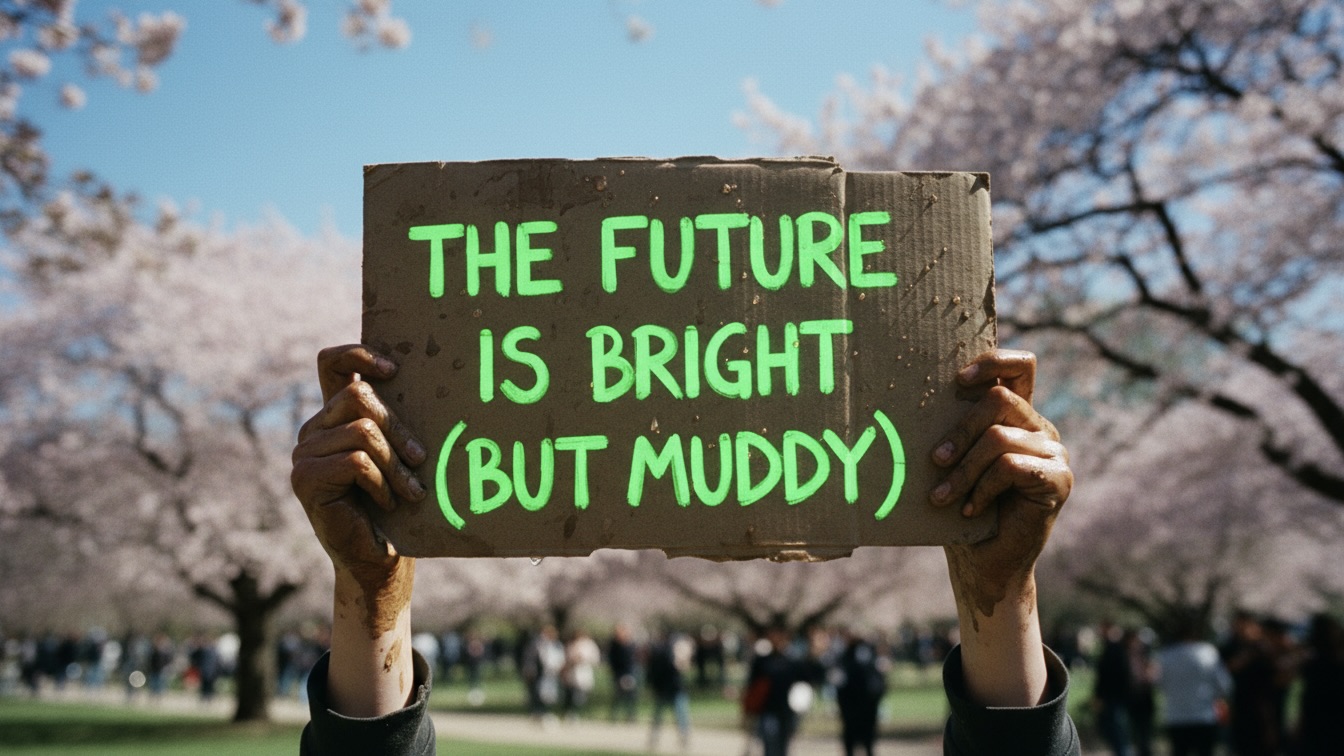
The story begins in the aftermath of a protest, where Javi discovers a discarded cardboard sign in a muddy park. Despite the cynicism of his friend Kayla, he investigates the object and discovers hidden coordinates revealed by a UV light. These clues lead the pair to an ancient oak tree containing a hidden key box, which in turn directs them to a specific microfiche record in the city library.
At the library, Javi and Kayla uncover a 1924 deed that legally prevents the city from selling the park land to a corporation called NexaCore. Their discovery is interrupted by a corporate representative who attempts to intimidate Javi by threatening his academic scholarship. Kayla successfully bluffs the man by pretending to live-stream the encounter to a massive audience, forcing him to retreat.
The teenagers race to City Hall and present the legal evidence just as the council is about to finalize the sale of the park. The revelation of the trust's conditions forces a legal recess, leading NexaCore to withdraw from the deal entirely. The narrative concludes with Javi and Kayla returning to the saved park, where Javi finally feels a sense of peace and belonging within his community.
The central theme of the narrative is the conflict between communal heritage and corporate expansion. The park serves as a physical manifestation of the "public commons," a space that belongs to everyone and no one simultaneously. NexaCore represents the encroaching "gray" of industrialization, seeking to replace organic life with the sterile heat and noise of a server farm. The discovery of the 1924 deed suggests that the past holds the necessary tools to protect the future, provided the current generation is willing to look beneath the surface.
Another prominent theme is the intersection of digital and physical realities. Kayla initially views the world through the lens of "clout" and social media metrics, dismissing real-world efforts as "mid" or unnecessary. However, the story demonstrates how digital tools—the UV light, the library's microfiche reader, and the threat of a live stream—can be harnessed to protect physical spaces. The resolution suggests that while "content is king," the tangible world provides the essential foundation for human connection and well-being.
The story also explores the concept of agency and the weight of systemic pressure. Javi feels the physical burden of the city's atmosphere, a psychological manifestation of his precarious social position as a scholarship student. By uncovering the truth, he transforms from a passive victim of urban decay into an active participant in the city's history. This transition highlights the idea that knowledge is a form of power that can level the playing field between marginalized individuals and multi-billion dollar entities.
Javi is a character defined by his deep sensitivity to his environment and a quiet, persistent sense of justice. He is introduced kneeling in the mud, literally grounded in the earth, which reflects his innate connection to the physical world. His psychological state is initially one of heaviness; he perceives the skyscrapers as pressing down on the city and the clouds as a weight. This suggests he suffers from a form of environmental anxiety, feeling the encroaching urbanization as a personal threat to his breathing room.
His motivation is driven by a need for permanence in a world that feels increasingly disposable. While others see "trash," Javi sees a message, showing a psychological predisposition toward finding meaning in the discarded. He is not naturally a confrontational person, as evidenced by his shaking hands when facing the NexaCore representative. However, his commitment to the "real" outweighs his fear, allowing him to overcome the intimidation of losing his scholarship for a greater communal good.
By the end of the story, Javi undergoes a significant psychological shift from alienation to integration. The "heartbeat" he hears in the basketball court and the "opening of a window" in his mind signify a release of the claustrophobia that plagued him. He no longer views himself as an outsider trying to survive the city’s pressures. Instead, he realizes he is a vital part of the city’s living fabric, gaining a sense of self-actualization through his successful defense of the park.
Kayla serves as a psychological foil to Javi, using cynicism and digital-age slang as a defensive shield against the harsh realities of her environment. Her home life, marked by the smell of her father’s constant smoking, suggests a background of neglect or stagnation that she attempts to escape through her online persona. By labeling Javi’s actions as "main character energy," she attempts to distance herself from the vulnerability of caring about something that might fail. This detachment is her primary coping mechanism in a city that feels "on edge."
Despite her performative apathy, Kayla is deeply loyal and possesses a sharp, tactical mind. She is the one who recognizes the psychological weakness of the corporate suit, understanding that his power relies on secrecy and control of the narrative. Her transition from a passive observer to an active accomplice shows a thawing of her cynical exterior. When she chooses not to record the moment at the tree, she is allowing herself to experience a "real" moment without the mediation of a screen.
Ultimately, Kayla represents the potential for the younger generation to weaponize their digital fluency for social change. While she claims that "content is king," her final actions prove that she values the physical park more than the twenty dollars she made from her video. She provides the necessary social courage that Javi lacks, standing beside him in the library and at City Hall. Her smile at the end is described as "real," indicating that she has found a sense of purpose that her digital followers could never provide.
The narrative employs a sensory-heavy style that emphasizes the contrast between the organic and the artificial. The author uses olfactory details, such as the smell of "rotting cherry blossoms" and "cheap coffee," to ground the reader in the setting. These descriptions often border on the visceral, such as the "sucking sound" of the cardboard in the mud or the "arthritic fingers" of the oak tree. This creates a tone that is both gritty and slightly magical, mirroring the transition from a mundane park to a place of hidden secrets.
Pacing is managed through the shifting descriptions of the atmosphere and Javi’s internal physical responses. The story begins with a "bad kind of quiet," creating a sense of dread and stagnation that slows the narrative down. As the characters move from the tree to the library and finally to City Hall, the prose becomes more kinetic. The repetition of the phrase "They ran" emphasizes the urgency of their mission, while the description of the library as a "stone fortress" adds a sense of gravity and historical weight to their quest.
The narrative voice uses symbolism to reinforce its themes, particularly through the motif of the "heartbeat." At the start, Javi’s heart beats in his throat like a drum of anxiety, but by the conclusion, the sound of a basketball on the court becomes the city’s healthy pulse. The change in the weather also mirrors the plot's resolution; the story moves from gray, pressing clouds to a blinding, clear sun. This pathetic fallacy serves to externalize Javi’s internal relief, signaling a new beginning for both the character and his community.


