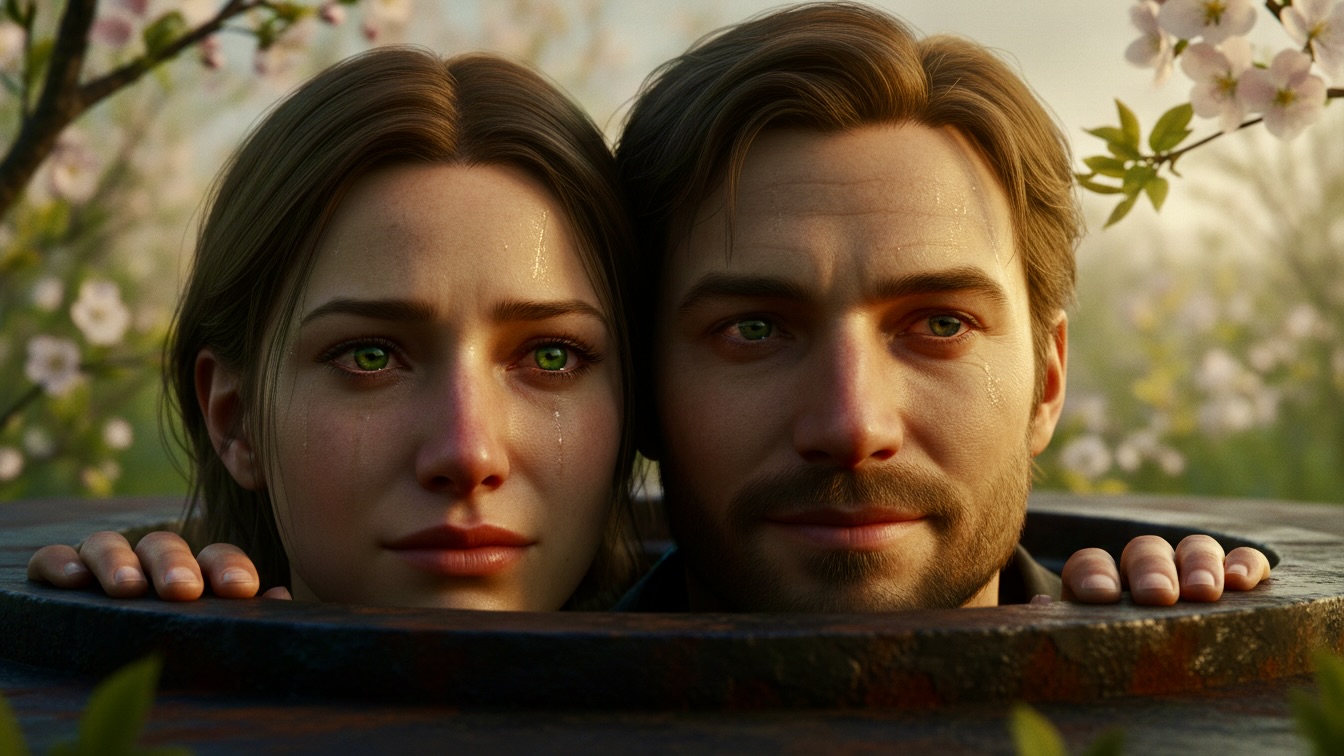
The story follows Edmund, a weary maintenance worker in a decaying subterranean bunker known as Sector 4. He meets Sandy, a woman driven by a desperate hope for a life beyond the recycled air and metallic confines of their station. Sandy reveals that the authorities are cutting off air supplies to the lower levels, an act she correctly identifies as state-sanctioned murder. She presents an ancient brass key, a relic of the old world that promises a way out through the manual overrides of the station’s ventilation system.
Driven by a mix of exhaustion and a sudden, sharp need for genuine air, Edmund guides Sandy through the labyrinthine guts of the facility. They navigate through sweating pipes and rusted seals, eventually reaching a massive emergency hatch that leads to the surface. After a violent struggle to break the locking bolts, they emerge into a world that is not the wasteland they were taught to fear. Instead, they find a vibrant, green landscape undergoing a seasonal rebirth. While the beauty of the surface is undeniable, the story concludes on a somber note as they realize their escape may lead to a slow death in the wild rather than a quick one in the dark.
The central theme of the narrative is the conflict between sterile security and the volatile nature of true freedom. The bunker represents a psychological and physical cage where life is reduced to "efficiency measures" and every breath is a recycled commodity. This environment has stripped the inhabitants of their humanity, leaving Edmund to view himself and Sandy as "two gears with different pitches" grinding each other down. The transition to the surface illustrates that freedom is not a panacea but a different, more beautiful set of challenges.
Another prominent theme is the restorative power of nature versus the entropic decay of technology. The station is described through its failures—cracked watch faces, rusted bulkheads, and flickering lights. In contrast, the outside world is depicted as "vibrant" and "aggressive," with vines reclaiming the husks of human civilization. This suggests that while human structures eventually succumb to rust and stagnation, the natural world possesses an inherent resilience that persists even after the collapse of the systems meant to contain it.
Finally, the story explores the concept of "hope as a burden." For Edmund, Sandy’s hope is a "desperate kind of hope" that makes him want to look away because it demands action and risk. He initially prefers the predictable misery of his mechanical life to the terrifying uncertainty of the surface. The resolution of the story reinforces this by suggesting that their escape is not a traditional happy ending. It is a choice to die with dignity and clarity rather than to live in a state of perpetual, suffocating compromise.
Edmund is a man defined by chronic psychological fatigue and a deep-seated cynicism born from a decade of maintaining failing systems. As a mechanic, his worldview is entirely mechanical; he understands human relationships through the lens of friction and metal shavings. He has internalized the bunker’s claustrophobia to the point where his own lungs feel "small," suggesting a psychosomatic response to his environment. He lacks the visionary qualities of Sandy, relying instead on his intimate knowledge of "rust" and "bulkheads" to navigate his reality.
His decision to follow Sandy is not motivated by a sudden burst of heroism, but by a profound exhaustion with the status quo. He is a man who has reached the end of his endurance, choosing the "violent shift" of the surface because he can no longer bear the "recycled soup" of the bunker. Even when he reaches the surface, his psychological trauma manifests as a brief moment of missing the "safety of the walls." He is a realist who understands that their survival is unlikely, yet he chooses the "aching violet" of the sky over the gray tomb of his past.
Sandy serves as the emotional and ideological catalyst for the narrative. She is a "dreamer" who possesses a resilience that is both inspiring and dangerous to those around her. Unlike Edmund, she refuses to accept the "efficiency measures" of the state as an inevitable reality. Her physical appearance—matted hair and a bruised cheekbone—testifies to her willingness to endure physical suffering in exchange for a chance at liberation. She represents the human spirit's refusal to be mechanized or managed by a cold, bureaucratic authority.
Psychologically, Sandy is driven by a profound faith in the readings of the probes and the possibility of "Spring." This faith allows her to see the brass key not just as a tool, but as an "anchor" in a world of digital shadows. She is the one who pushes through the physical resistance of the rusted doors and the psychological resistance of Edmund’s doubt. While she acknowledges the sadness of their situation at the end, her focus remains on the "light," indicating a personality that prioritizes the quality of an experience over its duration.
The narrative voice is heavy with sensory details that emphasize the contrast between the subterranean and the celestial. The author uses olfactory imagery—the taste of "old pennies and wet wool" versus "wet stone and something green"—to ground the reader in Edmund's physical experience. The pacing of the story mirrors the characters' journey, beginning with a slow, rhythmic tension in the dark and accelerating into a frantic, breathless climax during the climb. This creates a visceral sense of urgency that matches the characters' desperation.
The tone shifts from a gritty, noir-like cynicism to a more lyrical, almost elegiac beauty once the characters reach the surface. The description of the air hitting Edmund as a "violent shift" rather than a transition highlights the trauma of his liberation. The author uses the metaphor of the "brass key" as a symbol of tangible reality in an increasingly artificial world. By tossing the key away at the end, the narrative signals that the tools of the old world are no longer relevant in the vast, indifferent landscape they have entered.
The narrative also makes effective use of sound to build atmosphere. The "hum in my teeth" and the "screaming steam valves" create a sense of constant, underlying anxiety within the bunker. When they emerge, this mechanical noise is replaced by the "low, constant hum" of life, a subtle but powerful linguistic shift. This auditory transition reinforces the idea that the characters have moved from a world of manufactured noise to a world of natural resonance, even if that new world offers no guarantee of safety.


