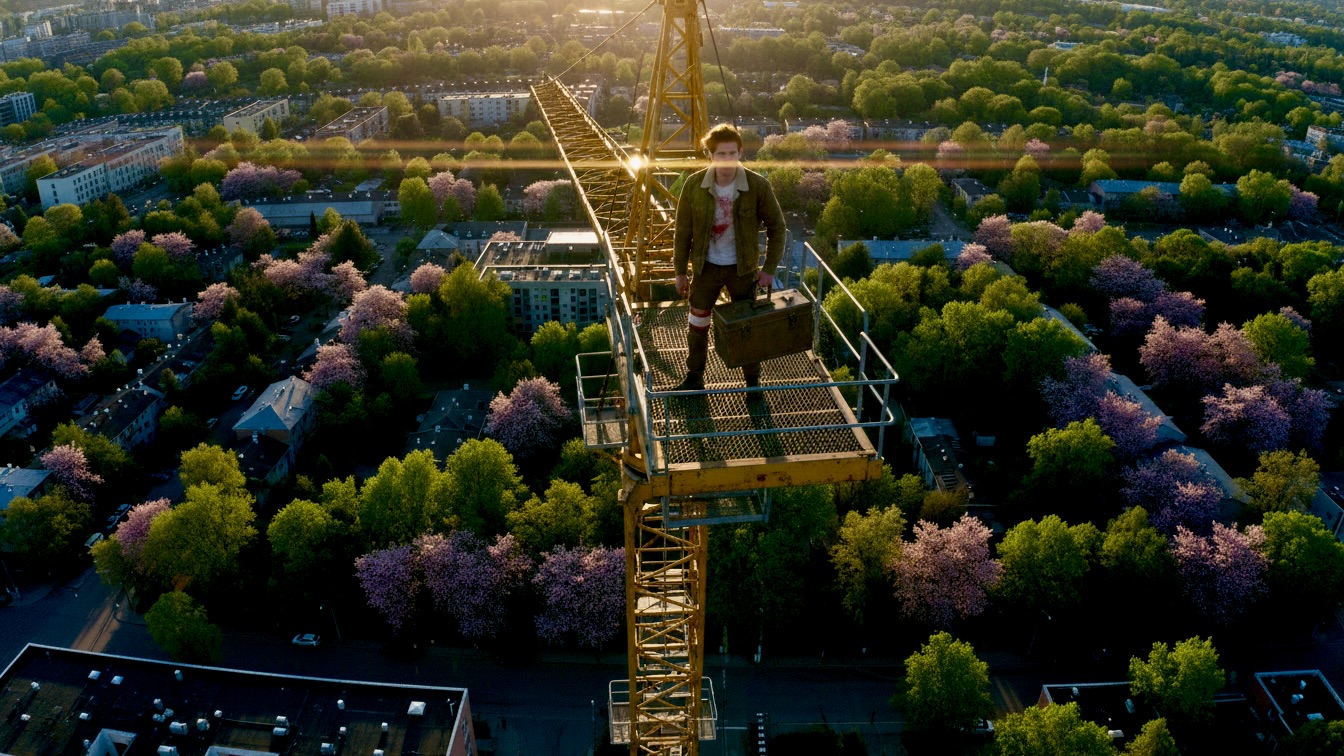
The story follows Glenn and Sam as they infiltrate a condemned community center to retrieve a historical charter that could prevent a corporate entity known as DevCorp from demolishing their neighborhood. After successfully navigating the ruins and avoiding high-tech drone surveillance, Glenn discovers a map that leads him to a massive construction site. He scales a dangerous industrial crane to retrieve a lockbox held by a corporate fixer named Edgewhite. Following a life-altering confrontation on the crane, Glenn saves Edgewhite from falling, which results in the fixer allowing him to keep the evidence. The chapter concludes with the neighborhood celebrating its legal victory, only for Glenn and Sam to discover a hidden compartment in their original find, pointing them toward a new mystery.
The narrative functions as a classic struggle between the preservation of communal history and the dehumanizing force of corporate expansion. The community center, described as a cracked-open dollhouse, serves as a physical manifestation of the neighborhood’s vulnerability and fading memory. By seeking the block charter, Glenn attempts to anchor the future of his home in the legal legitimacy of the past, suggesting that identity is tied to the physical land one inhabits.
The presence of drones and jamming technology highlights a thematic preoccupation with the loss of privacy and the overwhelming power of surveillance capitalism. Glenn’s reliance on parkour and physical ingenuity stands in direct opposition to the cold, automated efficiency of the machines tracking him. This contrast emphasizes the importance of human agency, suggesting that even in an era of technological dominance, personal risk and physical endurance remain the primary tools for resistance.
The ending introduces a shift from a local mystery to something potentially grander, signaling a transition from defensive preservation to an offensive exploration. The discovery of the Second Vault suggests that the history of the city is layered and perhaps more dangerous than Glenn initially realized. This cycle of discovery implies that the fight for one’s home is never truly finished, as every answer reveals a deeper, more complex set of questions.
Glenn is driven by a profound sense of duty to his community, which manifests as a reckless disregard for his own physical well-being. His motivation is rooted in a nostalgic desire to protect the status quo, yet his actions demonstrate a high level of adaptability and grit. Throughout the story, he experiences intense physical pain, from his injured knee to his exhausted muscles, which serves to ground his heroism in reality rather than fantasy. He is not a polished action hero, but rather a desperate individual willing to endure significant suffering to achieve a moral goal.
His interaction with Edgewhite reveals a latent capacity for empathy that surprises even himself. By choosing to save his enemy from a fatal fall, Glenn demonstrates that his commitment to his neighborhood does not require the sacrifice of his humanity. This moment of mercy is the turning point of his character arc, as it transforms him from a simple trespasser into a figure of genuine moral authority. By the end of the chapter, he is clearly changed by his experiences, moving from the exhaustion of the struggle to a renewed, almost addictive hunger for the next challenge.
Sam serves as the grounded, pragmatic counterweight to Glenn’s impulsive nature. While she is clearly committed to the mission, her primary role is to provide logistical support and a necessary voice of caution. She is observant and intelligent, evidenced by her ability to spot the discrepancy in the weight of the brass cylinder. Her skepticism acts as a tether, ensuring that Glenn remains focused on the reality of the danger they face rather than becoming lost in his own fervor.
The narrative employs a visceral, sensory-heavy style that effectively places the reader inside the decaying environment of the community center. The author utilizes sharp, evocative descriptions of the cold, wet, and ruined setting to create a sense of claustrophobia and urgency. This sensory focus extends to the action sequences, where the reader can feel the physical impact of Glenn’s jumps and the strain on his muscles, making the stakes feel tangible and immediate.
The pacing of the chapter is deliberate, alternating between moments of high-tension stealth and bursts of frenetic, high-stakes movement. The shift from the quiet, dark interior of the rec center to the height and wind of the crane creates a dynamic reading experience that mirrors the protagonist’s own escalating desperation. By keeping the narrative voice focused closely on Glenn’s perspective, the author ensures that the reader shares his confusion, his fear, and his eventual triumph.
The dialogue is sparse and functional, reinforcing the idea that these characters are accustomed to operating under pressure. There is a distinct absence of unnecessary exposition, which forces the reader to piece together the world through the character’s actions and the environment. This stylistic choice keeps the momentum high and emphasizes the mystery, ensuring that the revelation of the Second Vault feels earned rather than forced.


