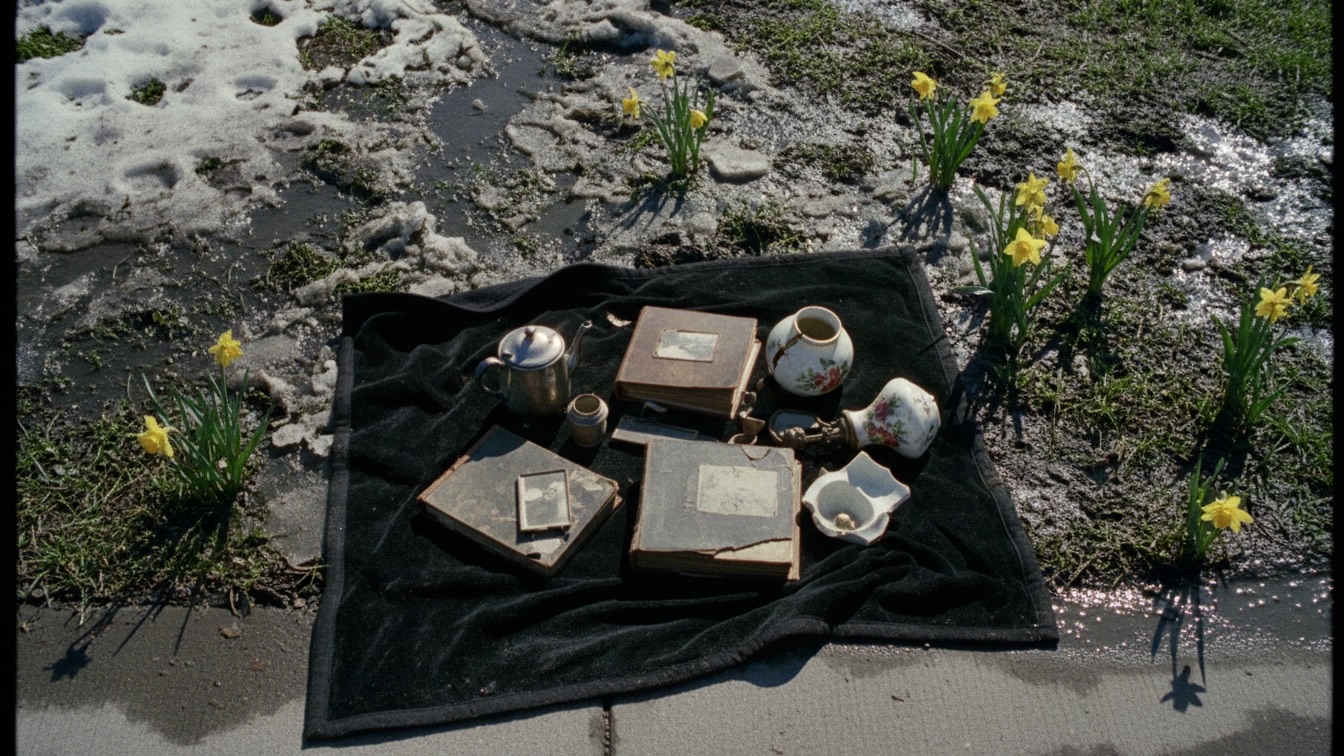
The story unfolds on a bleak Easter Sunday in a household simmering with unspoken trauma and mounting tension. Margot watches through a grime-streaked window as her neighborhood obsessively monitors a mysterious, dark object partially buried in a melting snowbank. Inside, her mother, Evelyn, is in the throes of a manic episode, desperately trying to prepare a massive twelve-pound ham for a family gathering that is clearly not going to happen. Margot’s brother, David, remains emotionally withdrawn, burying himself in a handheld video game to escape the domestic decay.
As a late-season blizzard yields to a miserable, gray thaw, the physical environment mirrors the family’s internal collapse. The power grid eventually fails, plunging the house into darkness and causing Evelyn to drop the raw meat onto the kitchen floor in a scene of visceral desperation. This domestic breaking point is interrupted by a frantic call from the HOA president, Gary. He leads the family outside to the mysterious lump in the snow, which is revealed to be a hoard of discarded family heirlooms. The narrative concludes on a surreal note when Margot discovers a duplicate of the locket she is currently wearing among the waterlogged trash, suggesting a profound fracture in reality.
The central theme of the narrative is the frantic performance of domesticity in the face of inevitable collapse. Evelyn’s insistence on a "traditional flavor profile" and her obsession with the "good silver" represent a desperate psychological defense mechanism against the abandonment of her husband and the fragmentation of her family. The twelve-pound ham serves as a grotesque totem of this forced normalcy; it is an oversized, "dead" thing that she tries to imbue with the weight of "rebirth." The failure of the power grid symbolizes the ultimate futility of her efforts, as the external world refuses to support her internal delusions.
Another prominent theme is the intersection of physical and psychological decay. The setting is described in visceral, repulsive terms: "greasy" condensation, "dirty bathwater" slush, and "rotting meat." This environmental rot serves as an externalization of the family's grief and the mother's deteriorating mental state. The neighborhood watch’s obsession with the "body" in the snow reflects a collective anxiety about what lies beneath the surface of their suburban lives. When the object is revealed to be family memories rather than a corpse, it suggests that the death of a family’s history is just as haunting as a physical death.
The final theme explores the "uncanny" and the fragmentation of identity. The discovery of the duplicate locket at the story’s end shifts the narrative from a grounded domestic drama into the realm of psychological or metaphysical horror. This duplicate object suggests that the characters are trapped in a cycle of repetition or that their identities have been discarded and replaced. The locket, typically a vessel for a single, cherished memory, becomes a symbol of a fractured reality where the past and present are indistinguishable and equally discarded.
Margot functions as the story’s grounded but increasingly overwhelmed protagonist. She occupies the role of the reluctant realist, forced to navigate her mother’s delusions while managing her own simmering resentment toward her absent father. Her hyper-fixation on the neighborhood watch group chat serves as a psychological buffer; by focusing on the mystery outside, she avoids fully confronting the "carcass" of her family life inside the kitchen.
Her internal conflict is defined by a tension between empathy and exhaustion. She speaks to her mother with the caution one might afford a "stray dog," indicating a complete breakdown of the traditional parent-child hierarchy. Margot’s snapping point in the kitchen reveals a woman who can no longer sustain the weight of her mother’s denial. However, her immediate surge of guilt after her outburst shows that she remains tethered to the very dysfunction she despises.
Evelyn is a character defined by manic denial and the terror of obsolescence. From a psychological perspective, her behavior suggests a profound reaction to the trauma of her husband’s departure. By fixating on the "perfect" Easter dinner, she attempts to exert control over a world that has become unrecognizable. Her physical tremors and her "artificial cheerfulness" are the outward manifestations of a psyche under immense pressure, struggling to maintain a facade of maternal competence.
Her relationship with the ham is almost ritualistic, as if the act of "scoring the fat" could somehow repair the rifts in her life. When the power fails and the ham falls, Evelyn’s collapse into the "puddle of juice and brown sugar" signifies the total disintegration of her ego. She is reduced to a "hollowed-out shell," unable to reconcile her desire for a "nice day" with the reality of her discarded history. Her presence at the end of the story, standing in the slush in her slippers, highlights her complete disconnection from her own agency.
David represents the theme of emotional checked-outness as a survival strategy. At twenty-two, he is physically present but psychologically absent, using his gaming console as a digital fortress against his mother’s instability. His refusal to participate in the "silver" ritual is a form of passive resistance, a way of acknowledging the truth that Margot and Evelyn are both struggling to face. He is the observer who sees the "wreckage" but chooses not to engage with it, perhaps because he knows he cannot fix it.
His silence in the archway after the ham falls is a poignant moment of shared trauma. He does not offer comfort or help; he simply watches, highlighting the profound isolation felt by each family member even when they are in the same room. David’s reliance on the "blue glow" of his screen suggests a generation that copes with domestic horror through disconnection. He serves as a foil to Margot’s active engagement and Evelyn’s manic performance, representing the cold apathy that often follows prolonged exposure to dysfunction.
The narrative style of the story is characterized by its oppressive atmosphere and visceral sensory details. The author uses "gross" imagery—such as the "slick sheen of pink water" on the meat and the "sticky, grotesque claws" of Evelyn’s sugar-covered hands—to create a sense of physical revulsion in the reader. This mirrors the characters' emotional disgust with their current situation. The contrast between the "suffocatingly hot" kitchen and the "brutal, stagnant gray" of the outdoors creates a claustrophobic tension that builds steadily throughout the chapter.
Pacing is managed through the rhythmic "buzzing" of the phone, which acts as a countdown to the final revelation. Each text message from the neighborhood watch interrupts the domestic drama, bridging the gap between the internal and external worlds. The sudden shift from the "relentless, stuttering vibration" of the phone to the "absolute silence" when the power cuts is a masterful use of auditory contrast. It forces the characters and the reader to sit with the weight of the situation without any distractions.
The narrative voice is third-person limited, staying close to Margot’s perspective, which allows for a cynical and sharp-edged observation of the world. The prose is lean but evocative, particularly in its descriptions of the "violent yellow" daffodils and the "spiderweb of shattered glass" on the phone screen. This stylistic choice emphasizes the fragility of the characters' lives. The final transition from a realist domestic scene to the surreal discovery of the duplicate locket is handled with a cold, clinical tone that makes the impossible nature of the object feel even more unsettling.


