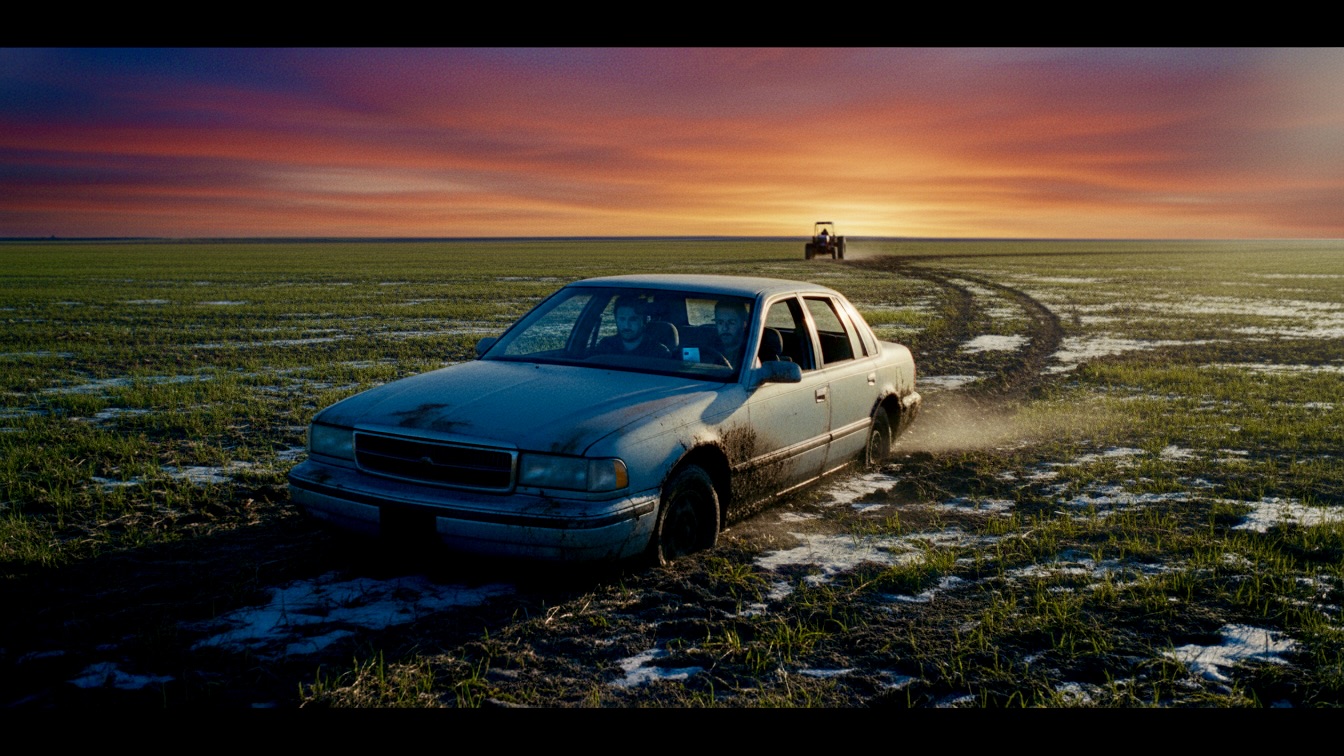
The story follows two men, Jae and Marty, who are stranded in a broken-down sedan during the bleak, muddy transition of a Manitoba spring. Marty, a delusional livestreamer, refuses to call for help, insisting that their life-threatening predicament is essential content for his "Alpha-Grind" brand. He views their suffering as a necessary narrative arc for his digital audience, while Jae experiences the brutal physical reality of the cold and dehydration.
As the temperature fluctuates, Jae attempts to find warmth by burning trash, leading to a tense confrontation over the last remaining energy drink. Their struggle causes the vehicle to shift as the surrounding ice melts, revealing that they have been parked atop a decomposing deer carcass. The chapter ends with a silent local farmer witnessing their pathetic state before driving away, leaving them to sink further into the rot of the physical world while Marty continues to film for his virtual one.
The central theme of the narrative is the toxic commodification of human suffering within modern digital culture. Marty represents the extreme end of the "hustle culture" spectrum, where every private moment of pain is transformed into a marketable asset. To him, reality has no value unless it is mediated through a screen and validated by a scrolling chat of strangers. This creates a terrifying disconnect between the biological needs of the body and the performative demands of the "grind," leading to a state of self-imposed peril that Marty rebrands as discipline.
Another profound theme is the clash between metaphysical delusion and the indifference of the natural world. Marty speaks in the jargon of manifestation and "metaphysical physics," suggesting that his internal state can alter the external environment. However, the story repeatedly grounds the reader in the visceral, unyielding reality of the Manitoba landscape. The "perma-slush" and the rotting carcass serve as grim reminders that nature does not respond to human willpower or digital metrics. The environment is not a "map" or a "prop" for Marty’s story; it is a physical force that consumes those who refuse to respect its lethality.
The story also explores the concept of the "witness" versus the "audience." The four hundred concurrent viewers on Marty’s stream are a faceless, voyeuristic mass that encourages his self-destruction for entertainment. In contrast, the man on the tractor represents a silent, objective witness to the truth of their situation. He sees the reality that Marty tries to hide: two men losing their minds in a rusted car. His eventual departure signifies the ultimate abandonment of the performers by the real world, leaving them trapped in a digital echo chamber that cannot save them from the encroaching rot.
Marty is a chilling study in digital narcissism and the psychological dissociation required to maintain a "personal brand" in the face of failure. He has completely internalized the language of predatory self-improvement, using terms like "momentum," "metrics," and "agency" to mask the fact that he is a man freezing to death in a ditch. His refusal to call a tow truck is not an act of bravery, but a symptom of his pathological need for external validation. He has replaced his own survival instinct with a narrative script, viewing his own life as a "second act" that must be performed to completion regardless of the cost.
Psychologically, Marty exhibits a form of "gamification" of reality, where he views other human beings as "NPCs" or background assets. This defense mechanism allows him to ignore the suffering of his companion, Jae, and the judgmental gaze of the farmer. By devaluing the physical world as a mere "map," he protects himself from the shame of his actual circumstances. His obsession with the "white balance" and the "optics" of the stream over the literal freezing of his limbs suggests a profound break from his own corporeality. He is no longer a man; he is a ghost haunting his own digital footprint.
Jae serves as the narrative’s sensory anchor, representing the desperate, grounded reality of the human animal under stress. Unlike Marty, he cannot escape into the blue light of the screen; he is acutely aware of the "dull, vibrating ache" in his molars and the loss of feeling in his toes. His actions are driven by basic biological imperatives, such as the need for fire and hydration. He perceives the world through its textures and smells—the "sour stink" of unwashed clothes and the "acrid smoke" of burning Wendy’s bags—which highlights the futility of Marty’s digital posturing.
Despite his pragmatism, Jae is trapped in a codependent cycle with Marty, unable to break away from the "slow-motion suicide" of their partnership. His frustration manifests as physical aggression when he lunges for the energy drink, a moment that strips away the last vestiges of their civilized facade. Jae’s tragedy lies in his awareness; he knows the man on the tractor is real and that the "Viper" drink is poison, yet he remains confined within the "rusted refrigerator" of the car. He is the unwilling witness to Marty’s descent, forced to endure the physical consequences of a delusion he does not share.
The prose is characterized by its heavy, oppressive sensory detail, which effectively mirrors the "thick, gray paste" of the Manitoba spring. The author uses a palette of grays, blues, and neon greens to create a visual contrast between the bleakness of the landscape and the artificiality of the digital world. Descriptions like the sky looking like a "wet sheet of cardboard" or the smell of "burnt salt and chemicals" evoke a sense of decay and industrial exhaustion. This sensory layering ensures that the reader feels the claustrophobia of the sedan and the biting sharpness of the cold.
The pacing of the chapter is deliberate and sluggish, mimicking the "sucking" sensation of the mud that traps the characters. There is very little traditional action; instead, the tension is built through dialogue and the gradual revelation of the environment. The "low-frequency hum" of Marty’s voice and the "ragged plume" of Jae’s breath create a rhythmic, hypnotic quality that emphasizes their isolation. This slow buildup makes the final discovery of the deer carcass feel like a sudden, violent intrusion of reality, breaking the stagnant atmosphere with a "thick, sweet, heavy stench."
The narrative voice is deeply cynical, utilizing sharp metaphors to underscore the absurdity of the characters' situation. Comparing Marty to a "ghost with a gambling addiction" or the car to a "rusted, blue refrigerator" adds a layer of dark humor that prevents the story from becoming purely melodramatic. The use of "Alpha-Grind" jargon provides a satirical edge, mocking the linguistic gymnastics of modern influencers. This stylistic choice highlights the gap between the lofty language of the "hustle" and the pathetic, visceral truth of a car settling into a rotting corpse.


