The story begins with the sudden, violent end of a century-long winter, as temperatures skyrocket from freezing to eighty-five degrees in a single hour. Barb, the president of the Oak Creek Estates Homeowners Association, attempts to manage the resulting flood on her property while struggling to reconcile the sudden heat with her winter gear. During her labor, she discovers a vintage chocolate egg buried in the slush that vibrates with mechanical intensity. When the egg hatches into a predatory confection with rock-candy teeth, Barb is forced to defend herself with a spade, realizing that the suburban landscape is no longer safe.
The situation escalates when two neighborhood teenagers, Tyler and Lucy, encounter Barb during her moment of shock. Despite Barb’s warnings, Tyler steps onto the lawn and triggers a mass hatching of similar candy creatures. One of the monsters bites Tyler’s leg, prompting a desperate retreat into Barb’s garage. Lucy displays remarkable composure, using her lacrosse stick to fend off the swarm while Barb manages the heavy garage door. The trio eventually finds themselves trapped inside, surrounded by the cloying scent of artificial chocolate and the sound of thousands of tiny jaws gnawing at the wood.
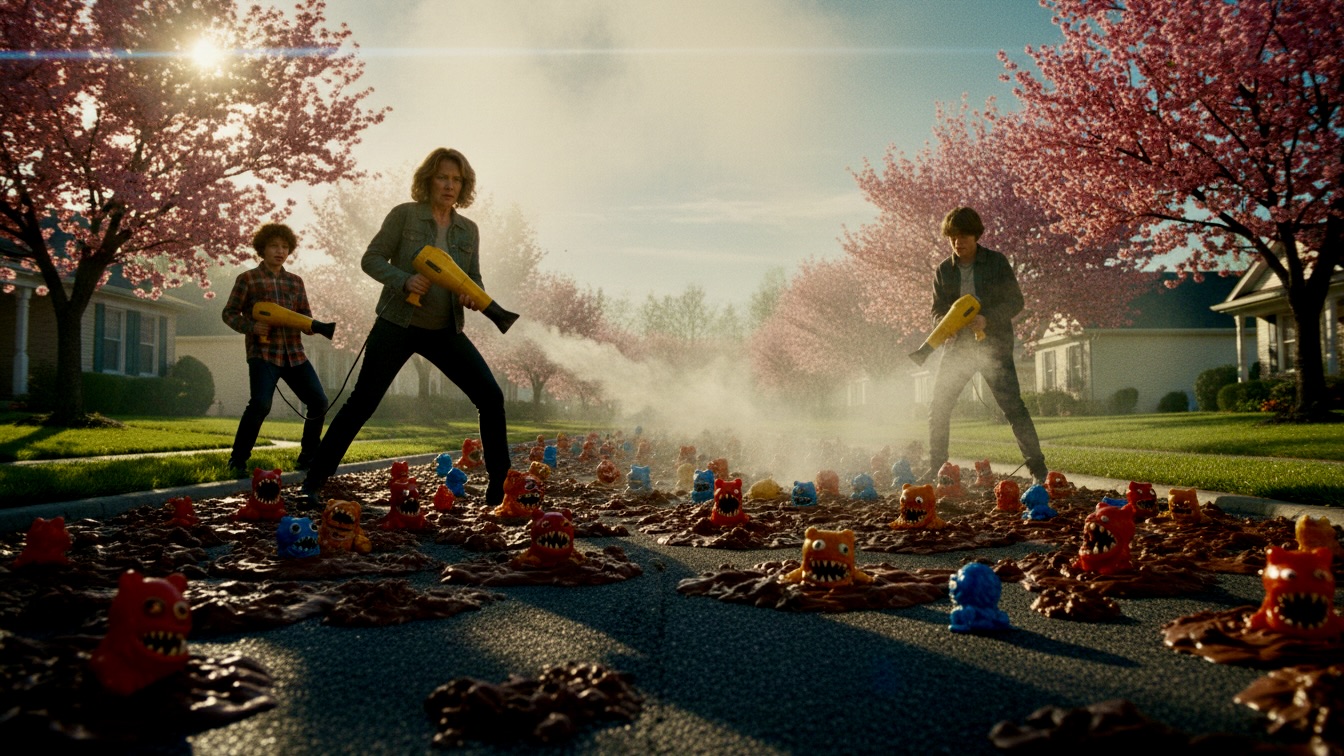
In a final stand, Barb organizes a counter-attack using industrial heat guns and rock salt. The group successfully melts and dehydrates the advancing swarm, pushing the creatures back to the edge of the property. Just as they begin to celebrate their hard-won victory, they witness a terrifying transformation at the neighborhood entrance. The giant, decorative papier-mache Easter rabbit begins to move, revealing a mouth filled with wooden stakes. This final image suggests that the "cursed ground chocolate" was merely the vanguard of a much larger, more sentient threat.
The primary theme of the narrative is the fragility of suburban order in the face of primordial or supernatural chaos. Barb, as the HOA president, represents the pinnacle of human attempts to regulate and sanitize the environment. Her obsession with mailbox heights and pristine cul-de-sacs is rendered absurd by the "hundred-year winter" and the subsequent "aggressive" thaw. The story suggests that no amount of regulation can truly suppress the rot or the "wrong" things buried beneath the surface of a manicured lawn.
Another significant theme is the perversion of nostalgia and childhood innocence. Easter eggs, typically symbols of rebirth and sweetness, are transformed into predatory, "cursed" entities. The chocolate is not nourishing but parasitic, using its "aggressively bright" colors to lure victims before revealing needle-sharp teeth. This subversion creates a sense of the "uncanny," where the familiar and the comforting become sources of visceral horror. The artificiality of the candy—its smell of "chemical vanilla" and "copper"—highlights a disconnect between the natural world and the synthetic environment humans have constructed.
The narrative also explores the theme of generational reaction to crisis. Barb approaches the threat with the weary pragmatism of a middle-aged homeowner, while Tyler and Lucy represent two different facets of youth. Tyler’s initial apathy and his eventual panic show the vulnerability of those who believe themselves insulated by modern comforts. Lucy, conversely, adapts almost instantly to the new reality, displaying a grim efficiency that suggests the younger generation might be better equipped for a world where the "rules of candy" have changed.
Barb is a woman defined by her need for control and her exhaustion with the responsibilities that come with it. At forty-four, she is the emotional and literal anchor of the neighborhood, yet her internal state is one of cognitive dissonance. She refuses to take off her fleece jacket despite the heat because her brain cannot process the rapid shift in her environment. This psychological rigidity is her greatest weakness, but her transition into a tactical leader shows her underlying resilience. She treats the supernatural threat with the same stern authority she uses for unapproved paint colors, which allows her to function under pressure.
Tyler embodies the "specific kind of teenage apathy" that serves as a shield against the world. He is more concerned with his "outfit" and his bag of chips than the literal environmental collapse happening around him. His psychological journey in this chapter is one of rapid, painful maturation. When he is bitten by the chocolate creature, his "cool" exterior shatters, revealing a terrified child. By the end of the encounter, he is forced to participate in the defense, though he remains the most physically and emotionally shaken member of the group.
Lucy is the most psychologically adaptive character in the story. While Barb is stuck in a state of disbelief and Tyler is paralyzed by apathy, Lucy immediately recognizes the danger and acts. She treats the lacrosse stick not as a toy, but as a weapon, showing a lack of sentimentality that allows her to survive. Her "slow, grim smile" when Barb suggests using heat guns indicates a personality that might actually thrive in a chaotic, high-stakes environment. She provides the necessary combat support that allows Barb to focus on the broader strategy.
The pacing of the chapter is masterfully handled, transitioning from a slow, heavy opening to a frantic, high-stakes battle. The initial descriptions of the "thick, brown sludge" and the "dull, heavy heat" create a sense of lethargy and physical burden. This atmospheric weight makes the sudden "vibration" of the egg and the subsequent "blind, sugary leap" feel even more jarring. The narrative voice maintains a dry, almost cynical tone that balances the absurdity of "candy monsters" with the genuine threat they pose.
Sensory details are used to evoke a sense of the "wrongness" inherent in the situation. The author focuses on scents that are cloying and artificial, such as "burnt caramel and sulfur" or "artificial vanilla extract," to create a nauseating atmosphere. The auditory descriptions, like the "brittle crack" of rock-candy teeth and the "hissing noise" of boiling chocolate, add a layer of body horror to the experience. These details ground the supernatural elements in a visceral, physical reality that makes the threat feel tangible rather than cartoonish.
The use of the HOA group chat and the mention of "mailbox heights" serves as a brilliant stylistic contrast to the unfolding horror. By grounding the story in the mundane details of suburban life, the author heightens the impact of the "cursed" elements. The dialogue is sharp and serves to define the characters quickly, such as Tyler’s concern for his parka or Barb’s frustration with the "sprint mode" of the garage door. This blend of dark humor and genuine tension keeps the reader engaged while building toward the final, ominous reveal of the giant rabbit.


