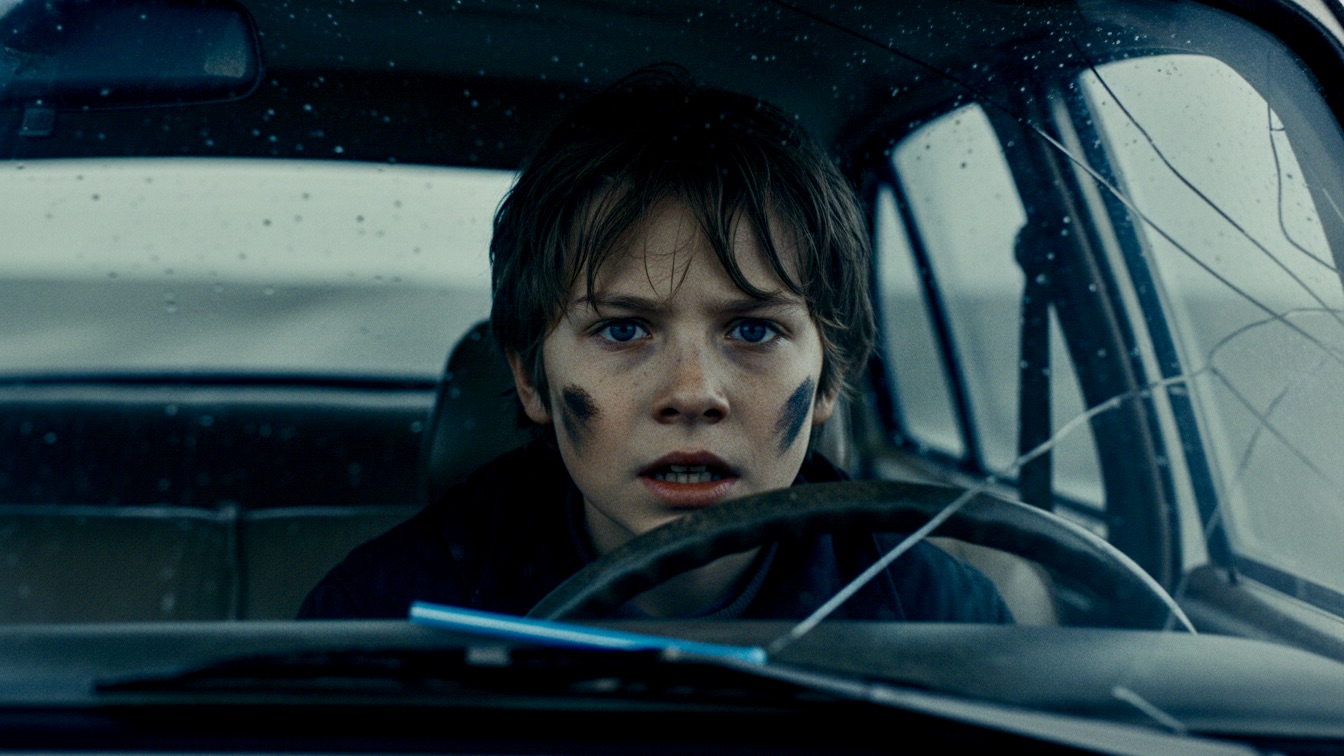
The story follows eleven-year-old Gerry and his nineteen-year-old mentor, Tyler, as they travel through a bleak prairie spring. Tyler, a self-proclaimed "Growth Architect," pressures Gerry into stealing a cup of coffee from a blind man at a gas station under the guise of a leadership lesson. This act of senseless cruelty haunts Gerry as they continue their journey through a worsening ice storm. The tension peaks when the car's windshield wiper snaps, forcing the pair to seek refuge in a dilapidated diner.
At the diner, the consequences of their actions catch up to them when they encounter the brother of the man they robbed. Tyler attempts to use his pseudo-intellectual business jargon to deflect blame, but he is met with physical intimidation and moral clarity from the stranger. Humiliated and terrified, Tyler flees into the cold, leaving Gerry behind. In a final moment of self-actualization, Gerry rejects Tyler’s toxic influence, sabotages Tyler’s ability to follow him, and takes the wheel of the car to find his own way home.
One of the central themes explored in the text is the hollow nature of modern "hustle culture" and its detachment from human empathy. Tyler embodies this through his vocabulary, using terms like "variable," "data," and "equity" to sanitize a simple act of theft. By reframing a cruel prank as a "social experiment," he attempts to transcend traditional morality. This linguistic shield allows him to ignore the emotional weight of his actions, but it crumbles the moment he faces a reality that cannot be managed with a "pivot."
The narrative also examines the concept of authority and the corruption of the mentor-student relationship. Tyler is not a teacher but a parasite who feeds on Gerry’s youth and impressionability to bolster his own ego. He views Gerry as a "protege" to be molded into a replica of his own cynical self. The story suggests that true leadership is not about controlling variables or "disrupting the flow," but about the responsibility one has toward others. Gerry’s eventual rebellion is a rejection of a false prophet who values "content" over character.
Finally, the setting serves as a powerful metaphor for the harshness of truth versus the comfort of delusion. The "prairie spring" is described not as a time of rebirth, but as a period of mud, ice, and "dirty sidewalks." This environment strips away Tyler’s pretensions, revealing him to be a shivering, barefoot boy in the mud. The broken wiper blade represents the failure of Tyler’s vision; he claims to see the world clearly, yet he is blinded by the first sign of actual adversity. Gerry, conversely, learns to see through the "grey mist" by relying on his own moral compass.
Gerry is a child thrust into a world of adult cynicism, feeling "a hundred" years old despite being only eleven. He possesses a high degree of empathy, evidenced by the physical pain he feels when he hears the blind man’s confused "oh." This psychosomatic response, described as a hammer hitting a nail behind his eye, shows that his conscience is in direct conflict with Tyler’s demands. He is initially passive, paralyzed by the "wet sand" of anxiety in his stomach and his desire to please an older figure.
His transformation occurs when he realizes that Tyler’s "strength" is entirely performative. When Gerry hovers his hand near the steering wheel during the storm, he is already contemplating the seizure of his own agency. By the end of the story, he uses Tyler’s own logic of "disruption" to liberate himself. He moves from being a passenger in Tyler’s "vintage performance vehicle" to being the driver of his own life. This shift is not just about physical control of the car, but about the mental clarity he achieves when he discards the "blue straw" of Tyler’s influence.
Tyler is a deeply insecure young man who uses the language of venture capitalism to mask his lack of substance. He wears an expensive jacket and talks about "branding" to create an illusion of success that is betrayed by his "rusted sedan." His need to dominate Gerry and the blind man stems from a desperate desire to feel powerful in a world where he is actually insignificant. He views every human interaction as a transaction or a data point, which prevents him from forming genuine connections.
When faced with the large man at the diner, Tyler’s bravado evaporates instantly, revealing the cowardice beneath his "Growth Architect" persona. He is unable to handle a situation that he cannot control with a "shout-out" or a "social experiment." His fall in the mud is a moment of total ego death, stripping him of his shoes, his phone, and his dignity. By the end of the chapter, he is reduced to a pathetic figure shivering in his socks, a victim of the very "chaos" he claimed to master.
The author employs a gritty, sensory-heavy prose style to ground the reader in the story’s bleak atmosphere. Descriptions like the smell of "old hot dogs and cold rain" and the "soup of brown mud" create a visceral sense of discomfort. These details mirror Gerry’s internal state, making his anxiety feel tangible and heavy. The use of the "arg" sign at the diner is a clever bit of visual storytelling, succinctly capturing the frustration and exhaustion of the characters.
Pacing is used effectively to mirror the escalating tension of the storm and Gerry’s internal breaking point. The "thwack-thwack-snap" of the wiper blades provides a rhythmic buildup to the mechanical and emotional failure that follows. The dialogue is sharp and contrasting, pitting Tyler’s rapid-fire, jargon-filled speech against the gravelly, sparse words of the man at the diner. This linguistic divide highlights the gap between Tyler’s artificial world and the reality of the people he affects.
The narrative voice remains closely tied to Gerry’s perspective, allowing the reader to experience his sensory overload and eventual clarity. The "tiny hammer hitting a tiny nail" is a recurring motif that emphasizes the persistent irritation of Tyler’s presence. As Gerry takes control, the prose becomes more decisive and less cluttered with Tyler’s interruptions. The final image of Gerry looking for the sun amidst the icy gravel provides a hopeful, albeit cold, resolution to his journey toward independence.


