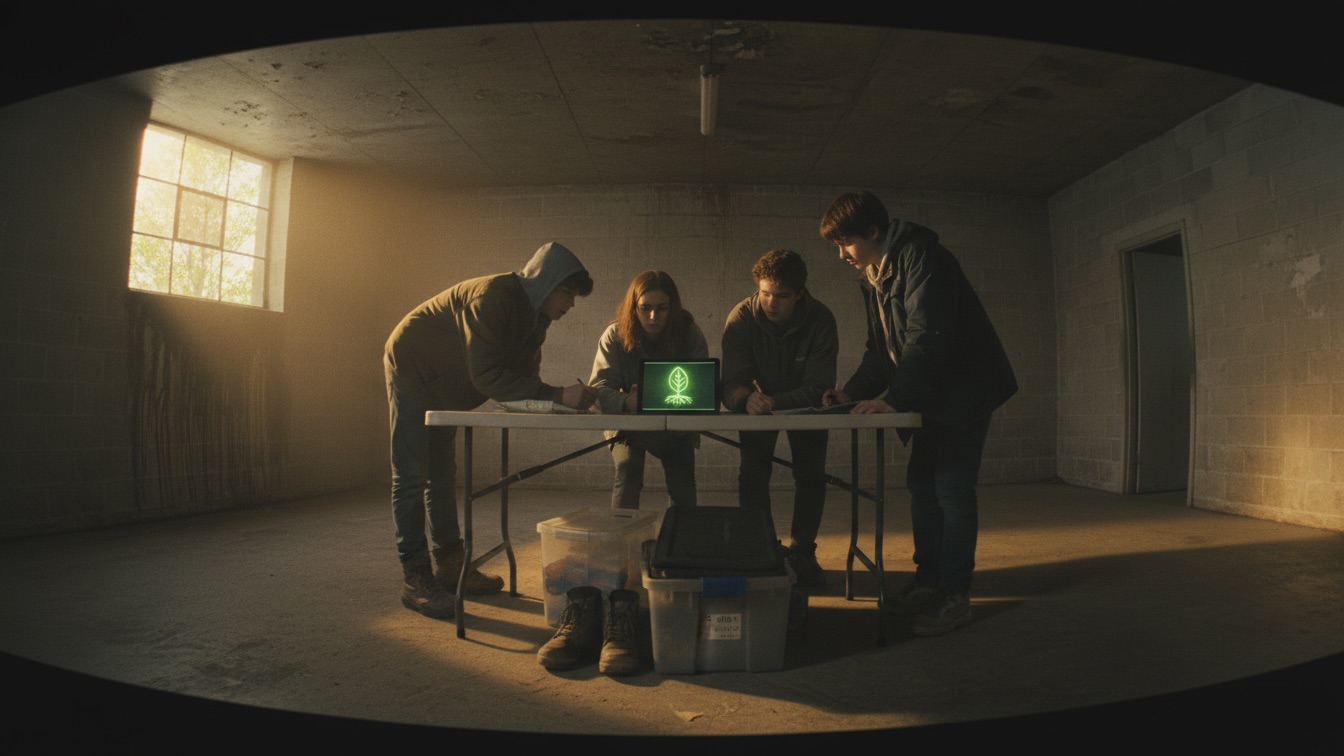
The narrative unfolds in the damp, dilapidated basement of the Melgund United Church during a bleak Northwestern Ontario spring. Four teenagers—Leo, Maya, Toby, and Sam—gather to formalize the Melgund Seed Bank, an initiative born out of a desire to combat the town’s economic and social stagnation. Leo, the group’s visionary, argues that the seed bank is essential for food security and community preservation, especially given the town's history of supply chain failures and the closure of the local mill years prior.
As the group discusses the logistics of their plan, they navigate their own skepticism and the harsh realities of their environment. They identify key local legends, specifically Mr. Henderson’s blight-resistant "Blue Potatoes," as the ultimate goal for their collection. Despite the cynicism of Toby and the weariness of Sam, the group eventually finds a shared sense of purpose. By the end of the evening, they have assigned roles and prepared their first batch of envelopes, transforming the church basement from a mere shelter into a makeshift laboratory of hope.
The primary theme of the narrative is resilience in the face of systemic decay. Melgund is presented as a "post-apocalyptic" setting where the traditional structures of industry and commerce have long since failed. The seed bank represents a grassroots effort to reclaim agency in a place that seems determined to fade away. By focusing on heirloom seeds, the characters are not just planning for a garden; they are attempting to preserve a cultural and biological lineage that is at risk of being lost to time and neglect.
Another significant theme is the concept of "social labor" and the necessity of human connection. Leo recognizes that the act of sharing seeds is a pretext for forcing a fragmented community to interact. In a town where residents are "siloed" in their homes, the seed bank acts as a bridge between generations. This exchange requires a specific kind of emotional work, such as listening to long-winded stories from elders like Mrs. Gable, which the narrative suggests is the true price of community survival.
The tension between irony and sincerity also permeates the text. The characters, particularly Toby and Maya, use irony as a defense mechanism against the bleakness of their surroundings. However, as the project gains momentum, this irony gives way to a "small, sharp spark" of genuine belief. The transition from mocking the "aesthetic" of their poverty to creating a professional-looking logo for the "Melgund Germination Initiative" marks a psychological shift from passive observation to active participation in their own future.
Finally, the narrative explores the symbolism of the "Blue Potato" as a metaphor for excellence and survival in a hostile environment. The potatoes are described as growing in soil made of "rocks and spite," mirroring the lives of the teenagers themselves. The quest for these tubers represents a search for something uniquely valuable and enduring within a landscape that often feels devoid of opportunity. It is a pursuit of a "Holy Grail" that is grounded in the dirt, suggesting that beauty and utility can be found in the most unpromising places.
Leo serves as the intellectual and emotional anchor of the group, driven by a desperate need to prevent his world from simply stopping. From a psychological perspective, his obsession with the seed bank suggests a coping mechanism for the "familiar tightness" of anxiety he feels regarding his environment. He uses the cracked tablet as a tool for order, attempting to digitize and categorize a world that is physically crumbling around him. His insistence on "social labor" reveals a high level of emotional intelligence and a deep-seated desire for communal belonging.
He is a character defined by a "stubborn hope" that borders on the defiant. Unlike his peers, who often retreat into irony or exhaustion, Leo leans into the practicalities of survival, such as collecting silica packets from jerky bags. This attention to detail demonstrates his commitment to a future he isn't entirely sure will arrive. He is the architect of the group's mission, providing the structure and the "bold" vision necessary to turn a collection of mismatched bins into a legitimate enterprise.
Maya is the group’s pragmatist and aesthetic guardian, using her sharp wit to navigate the group's dynamics. Her action of peeling a water bottle label with "surgical precision" indicates a need for control and order in a setting characterized by "wet drywall" and "gray slush." She is quick to identify the social barriers of the project, such as the technological gap between generations, showing her keen awareness of the town's social fabric. While she initially resists the idea of being a "19th-century peasant," her eventual commitment to the project’s branding shows her desire to elevate their work above its humble origins.
Her role in the group is to ground Leo’s idealism in reality while ensuring the project has a sense of dignity. By taking charge of the labels and the "social labor" of talking to neighbors, she positions herself as the group's communicator. She understands that for the seed bank to work, it must look and feel real to the people of Melgund. Her smile at the end of the meeting suggests that she finds a sense of identity in this work, moving away from her initial detachment toward a position of leadership.
Sam embodies the physical and emotional exhaustion of the town’s younger generation. At seventeen, he is already burdened by the weight of three part-time jobs and the looming threat of academic failure, making him a realist by necessity. His skepticism about the "success rate" of local gardeners stems from a life lived close to the dirt, where he has seen the discrepancy between boastful stories and "sad, lumpy" realities. He represents the "muscle" of the group, yet his reluctance to interact with figures like Mr. Henderson reveals a vulnerability and a lack of social confidence.
Despite his weariness, Sam finds a sense of belonging in the basement because it offers an alternative to the aimless boredom of the Canadian Tire parking lot. He is the character most attuned to the physical risks of their environment, such as the dampness that could lead to mold. His eventual acceptance of the project suggests that even the most exhausted individuals can find energy when given a clear, tangible task. His willingness to "scout the perimeter" at Henderson’s shows a burgeoning sense of duty toward his friends and their shared goal.
Toby is the group’s primary source of irony, using his phone as a shield against the "comfortable bleakness" of his life. He initially dismisses the seed bank as a "whole thing" about pooping out beans, a reductive view that masks his own lack of direction. His psychological stance is one of guarded observation; he stays on the periphery, literally sitting on a stack of hymnals, until he finds a way to contribute that fits his digital skill set. His transformation of the project’s name into something "official" reflects a desire for status and legitimacy in a town that offers neither.
As the chapter progresses, Toby’s irony shifts from a tool of dismissal to a tool of creation. By designing the logo of a sprout pushing through pavement, he subconsciously acknowledges the group’s own struggle to thrive in Melgund. He is the one who bridges the gap between their "post-apocalyptic" reality and the outside world via social media. His final enthusiasm for the "Melgund Germination Initiative" indicates that his cynicism was merely a mask for a latent desire to be part of something meaningful.
The narrative voice is characterized by a "comfortable bleakness," utilizing sharp, sensory details to ground the reader in the specific atmosphere of Northwestern Ontario. The opening description of the air tasting like "wet drywall and the ghost of a thousand potluck dinners" immediately establishes a sense of history and decay. This focus on sensory input, from the "heavy, metallic thud" of the furnace to the "salt-stained seams" of Leo’s boots, creates a visceral experience of the setting. The environment is not just a backdrop; it is an active participant in the story, shaping the characters' moods and motivations.
The pacing of the chapter reflects the slow, rhythmic nature of life in a small town while gradually building momentum as the characters' plan takes shape. The dialogue is snappy and realistic, capturing the specific cadence of teenagers who know each other intimately and use humor to navigate their shared hardships. The contrast between the high-stakes language of "generational crimes" and the "twelve dollars and a bag of silica packets" creates a tragicomic tone. This balance allows the story to feel both grounded in reality and elevated by the characters' aspirations.
Metaphor and imagery are used effectively to illustrate the theme of resilience. The "cracked iPad" and the "mismatched bins" serve as symbols of the characters' resourcefulness, showing how they repurpose the debris of their lives for a new purpose. The image of the "long, muddy light" of the sunset and the "dark silhouette of the boreal forest" at the end of the chapter provides a cinematic quality to their departure. This shift from the cramped, fluorescent-lit basement to the vast, cold night air emphasizes the scale of the challenge they have accepted, ending the chapter on a note of quiet, atmospheric resolve.


