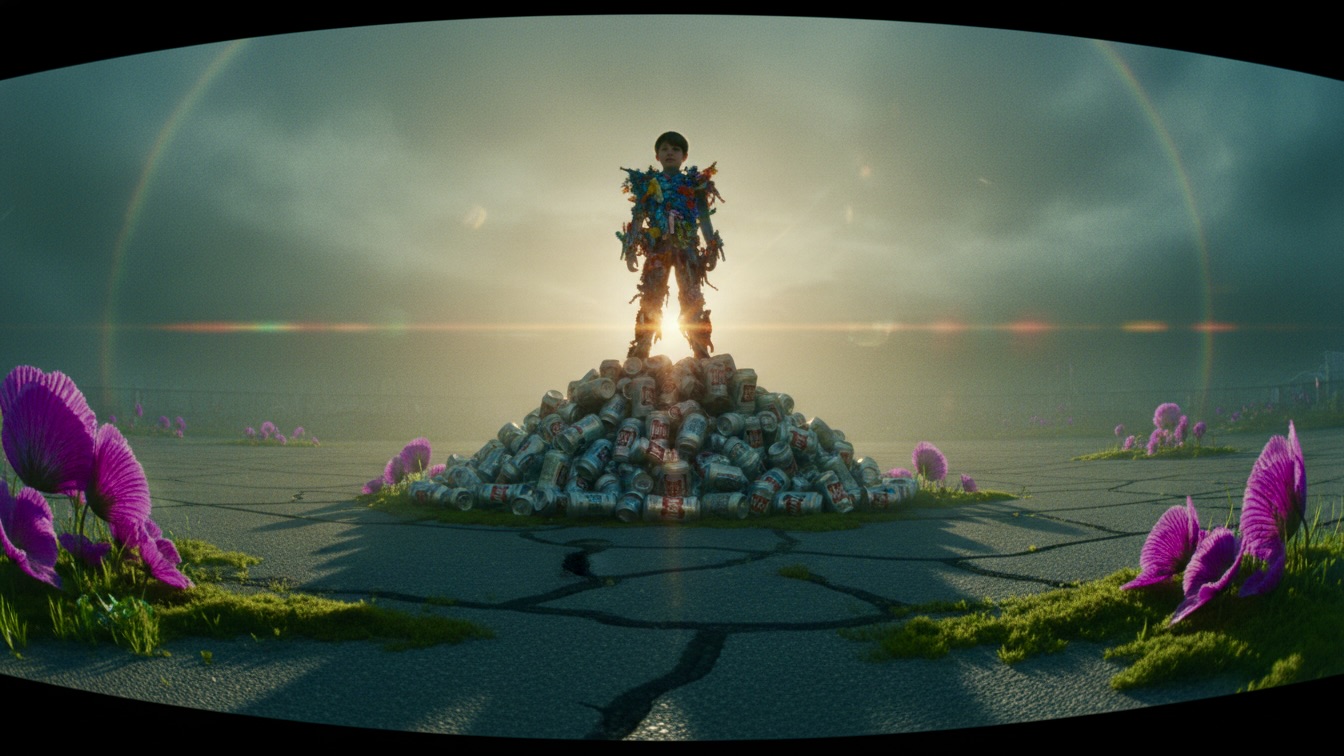
The narrative follows Lance, a father who brings his young son, Toby, and his wife, Sandi, to a local recycling depot on a damp Tuesday in April. Lance is driven by a rugged, utilitarian philosophy, believing that a child should witness the "guts" of the world rather than the sanitized environment of a playground. As he struggles to start a generator for a makeshift party, a thick, unnatural mist rolls in from the nearby lake, bringing with it a sense of profound stillness and dread.
The atmosphere shifts from a mundane industrial chore to a surreal nightmare as mutated fish begin to fall over the fence, fusing with discarded plastic toys and scrap metal. This biological and synthetic fusion centers around Toby, who becomes the focal point of a terrifying transformation. Instead of fleeing, the boy is drawn into the center of the waste, where the garbage and the rotting fish flesh weave together to form a suit of armor and a crown.
By the end of the chapter, the recycling depot has blossomed into a horrific new ecosystem of fleshy gills and twisted steel. Lance finds himself pinned beneath the weight of the very "grind" he championed, watching helplessly as his son is remade into the Blue Bin King. The story concludes with the realization that the old world is being swallowed by a sentient, vengeful manifestation of human waste, with Toby presiding over the birth of this terrible new season.
The central theme of the story is the toxic intersection of industrial decay and the Darwinian "grind" of modern existence. Lance views the world through a lens of utility, where life is defined by the process of using, discarding, and reclaiming. This philosophy, intended to build character in his son, manifests literally and catastrophically when the waste of society decides to reclaim the boy. The recycling depot serves as a temple to this ideology, but the "reclamation" that occurs is not a human-controlled industrial process, but a supernatural insurrection of the discarded.
There is a profound exploration of ecological blowback, where the consequences of human consumption return in a distorted, unrecognizable form. The pickerel, described with sickly green scales and dark fibrous interiors, represent a nature that has been irrevocably corrupted by runoff and pollution. When these creatures fuse with plastic gold coins and hockey trophies, the narrative suggests that humanity has created a new, monstrous biology. The "Blue Bin King" is the personification of this synthesis, a monarch born from the literal and metaphorical trash of the previous generation.
Finally, the story examines the failure of traditional masculine archetypes in the face of cosmic or environmental horror. Lance prides himself on his ability to handle the "guts" of the world and his mechanical skills with the generator. However, his insistence on exposing Toby to the harshness of reality backfires when that reality proves to be more predatory than he anticipated. His strength is rendered useless, and he is ultimately reduced to "mulch," trapped by the very structures of steel and refuse he believed he understood.
Lance is a man defined by a rigid, blue-collar stoicism that borders on the pathological. He rejects the "padded room" of modern safety, preferring to raise his son in an environment of grease, oxidized copper, and sour milk. His psychological state is one of defensive hardness; he views the world as a machine that necessitates a constant struggle or "grind." This worldview is a shield he uses to navigate a life that seems otherwise bleak and industrial.
His motivation is rooted in a desire to pass this perceived toughness down to Toby, ensuring the boy is equipped for a world Lance views as inherently hostile. He interprets Toby's lack of fear during the initial stages of the supernatural event as bravery, a projection of his own desires rather than an assessment of the boy's safety. This cognitive dissonance prevents him from acting until it is far too late. By the time he realizes the danger, his own philosophy has literalized around him, pinning him to the ground.
Lance's internal conflict arises from the realization that he is not the master of the "grind" but its victim. He spent his life believing he was the one doing the discarding and reclaiming, only to find that the system views him as just another component to be recycled. His final moments in the chapter are characterized by a crushing irony. He wanted his son to be strong and to understand the world's machinery, and he achieves this goal in the most horrific way possible as Toby ascends to power.
Toby begins the story as a silent, observant vessel for his father’s expectations. He is described as tiny against the mountain of cans, a visual representation of his vulnerability in the face of Lance’s harsh parenting. His psychological state is initially one of quiet compliance, as he stands with his hands in his pockets, absorbing the grim atmosphere of the depot. However, as the mist rolls in, his character undergoes a profound and eerie shift.
The boy does not react with the terror one would expect from a child; instead, he displays a hollow fascination that suggests he is being subsumed by a higher, darker power. When he speaks, his voice is no longer his own, sounding instead like it is coming from the bottom of a well. He adopts his father’s language, claiming he is "doing the grind," which signals the total corruption of Lance's teachings. Toby becomes the bridge between the human world and the sentient waste, accepting his role as the Blue Bin King with a chilling lack of resistance.
Sandi serves as the emotional and moral foil to Lance’s aggressive pragmatism. She represents the conventional desire for safety and normalcy, evidenced by her suggestion that they should have gone to the park instead of the depot. Her reactions are grounded in human instinct; she is repulsed by the smell and terrified by the unnatural events. While Lance is busy philosophizing about the nature of life, Sandi is the first to recognize the immediate physical danger to their son.
Her role in the narrative is to highlight the isolation of Lance’s worldview. She is trapped not just by the physical cage of metal at the end, but by Lance’s refusal to listen to her warnings earlier in the day. Her screams and sobs provide the human soundtrack to the supernatural transformation, grounding the horror in a sense of domestic tragedy. She is the witness to the loss of her child, a loss facilitated by her husband’s stubborn adherence to a brutal ideology.
The narrative voice is heavy with sensory details that emphasize decay and industrial grime. The author uses olfactory descriptions, such as the smell of sour milk and oxidized copper, to create an immediate sense of revulsion. These details serve to ground the story in a gritty realism before the supernatural elements are introduced. The "flat" light and the "blurred" edges of the scenery suggest a world that is already losing its structural integrity even before the mist arrives.
The pacing of the chapter is expertly handled, starting with a slow, dialogue-heavy scene that establishes the family dynamics and Lance’s philosophy. The introduction of the "slap" of the fish acts as a turning point, shifting the pace into a frantic, hallucinogenic nightmare. The transition from the mundane task of starting a generator to the cosmic horror of the "Blue Bin King" is seamless because the author uses the existing elements of the setting—the trash, the lake, and the metal—to build the monster.
The tone is one of mounting dread and inevitable catastrophe. The use of violet light and the sound of "crushed leaves" to describe the movement of the scrap mountain adds a surreal, almost psychedelic layer to the horror. The author’s choice to describe the fish as "long, pulsing tendons" that bind the waste together creates a visceral sense of body horror. This stylistic choice effectively communicates the idea that the boundary between the organic and the inorganic has been permanently erased.


