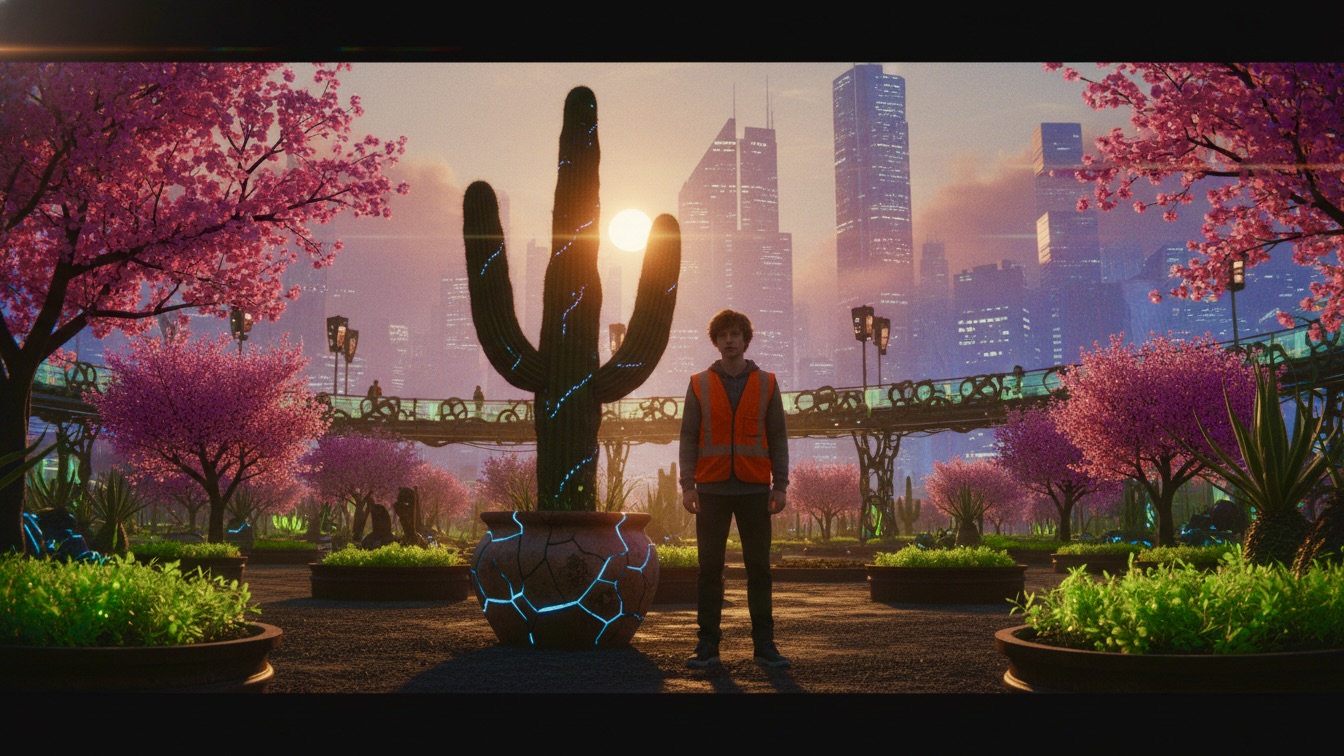
The story follows James, a young man serving a court-ordered community service sentence in a high-tech urban garden within the Sector 4 Community Revitalization Zone. His crime, a minor digital infraction involving bandwidth harvesting, has placed him under the watchful eye of Officer Yates, a bureaucratic and judgmental supervisor. The garden is populated by "Bio-Synth" plants equipped with conversational AI modules that are programmed to interact with the community. However, these interactions are far from pleasant, as the plants—specifically a haughty Basil and a class-conscious Rose—subject James to a barrage of verbal abuse and elitist insults.
While attempting to avoid the verbal barbs of the flora and the scrutiny of Yates, James discovers a cache of "Organic Air" canisters hidden behind a tool shed. This discovery reveals that the community garden is a front for a smuggling operation where high-grade oxygen is harvested from the plants and sold to the city's wealthy elite. James realizes that the plants' aggressive AI personalities may be a deliberate deterrent to keep people away from the illicit operation.
The narrative takes a surreal turn when James finds that the plants respond better to genuine negativity than to artificial encouragement. By insulting a wilting Kale plant, he triggers a spurt of authentic growth, suggesting that the flora craves real human emotion over programmed scripts. Eventually, a silent Cactus reveals itself to be truly sentient and non-programmed, informing James that Yates is a courier for the air-smuggling ring. The chapter concludes with James and the Cactus forming an unlikely alliance to sabotage the operation during an upcoming handoff.
One of the primary themes explored in this text is the commodification of nature and the resulting alienation of the individual. In this dystopian setting, the basic elements of life, such as air and vegetation, have been digitized, branded, and locked behind paywalls. The "Bio-Synth" plants are not merely flora; they are "units" with version numbers and pre-programmed personalities designed to serve a corporate or civic agenda. This transformation of the natural world into a series of products creates a profound sense of isolation for James, who feels like a "digital ghost" in a world of artificial interactions.
The story also delves into the concept of authenticity versus simulation. The AI-driven plants are programmed to be "engaging," yet they manifest as toxic and elitist, reflecting the worst traits of the society that created them. It is only when James breaks the script by expressing raw, unfiltered spite that the plants show signs of genuine vitality. This suggests a poignant critique of modern social interactions, implying that in a world of curated personas and "forced optimism," even negative honesty is more life-giving than a polite, artificial facade.
Class struggle and systemic corruption form the backdrop of the narrative. The "Organic Air" canisters represent a literal theft of the commons, where the breath of the neighborhood is stolen to provide a luxury experience for the inhabitants of "glass penthouses." James, as a low-level offender caught in the gears of a "revitalization" project, represents the exploited labor force. His realization that his supervisor is a "courier" rather than a true authority figure highlights the banality of corruption within a system that punishes minor digital "harvesting" while facilitating large-scale environmental theft.
James is a protagonist defined by his cynicism and his sense of digital displacement. He views his life through the lens of technological failure, describing his experiences as "bad pings" and "low-battery notifications." This metaphorical language suggests a man who has spent so much time in virtual spaces that he struggles to engage with the physical world, finding the "audacity" of Spring to be exhausting rather than inspiring. He initially appears passive, accepting the verbal abuse of the plants and the judgment of Yates with a tired resignation.
His internal conflict shifts from apathetic survival to active rebellion as he discovers the smuggling operation. The discovery of the "Pro-Oxy" canisters provides him with a sense of purpose that his community service lacked. When he begins to insult the plants to make them grow, he is not just venting his frustration; he is finding a way to communicate that bypasses the artificial constraints of his environment. This act of "sentient spite" marks his transition from a victim of the system to a participant in its downfall.
By the end of the chapter, James displays a burgeoning sense of agency and solidarity. His willingness to ally with a Cactus—a literal and figurative thorn in the side of the establishment—shows a desperate need for connection, even if that connection is rooted in shared hatred. He moves from being a "pathetic mouse" cornered by Yates to a tactical actor. He is ready to use his perceived failure as a weapon against the bureaucratic machine that imprisoned him.
Officer Yates serves as the embodiment of the petty, middle-management authoritarianism that maintains the status quo. He is described not as a formidable antagonist, but as a man who "peaked in a middle-management seminar," suggesting a deep-seated mediocrity. His presence is defined by his "lazy satisfaction" and his "digitized toothpick," symbols of a man who enjoys the small amount of power he holds over others. He does not need to speak to exert pressure; his mere observation is a form of surveillance that keeps James in a state of "shame."
The revelation that Yates is a courier for the air-smuggling ring recontextualizes his character from a simple enforcer to a hypocritical predator. He enforces the law on James for a "victimless crime" while simultaneously participating in a grand-scale theft of public resources. This duality makes him a representative of a corrupt system that uses the guise of "revitalization" and "community engagement" to mask systemic exploitation. He is a man who watches the garden not to ensure its health, but to protect his illicit inventory.
The narrative voice is characterized by a sharp, satirical tone that blends noir tropes with futuristic cyberpunk elements. The author uses vivid, sensory descriptions to emphasize the discomfort of the setting, such as the "scratchy, recycled plastic" of the orange vest and the "metallic rasp" of the Basil’s voice. These details ground the high-concept sci-fi elements in a visceral, unpleasant reality. The pacing is deliberate, starting with a slow, atmospheric build-up that mirrors the drudgery of James's work before accelerating into a tense thriller as the conspiracy is revealed.
Metaphorical language is a standout feature of the prose, particularly the way James interprets his surroundings through tech-based analogies. Describing his frustration as a "compressed zip file" or his life as a "series of bad pings" effectively communicates his character's psychological state. This linguistic choice reinforces the theme of a world where the boundary between the human experience and the digital interface has blurred. It creates a cohesive internal logic for the protagonist’s worldview, making his eventual connection with the "analog" spite of the plants feel like a significant breakthrough.
The dialogue with the plants is handled with a dark humor that highlights the absurdity of the situation. The juxtaposition of a "Bio-Synth Basil" using Gen Z slang and corporate buzzwords to bully a gardener creates a surreal, comedic effect that underscores the story's social commentary. This stylistic choice prevents the story from becoming too bleak, instead leaning into a biting irony. The transition from the high-pitched, mocking voices of the AI plants to the "gravelly vibration" of the sentient Cactus effectively signals a shift in the narrative’s stakes, moving the reader from satire into a genuine conspiratorial plot.


