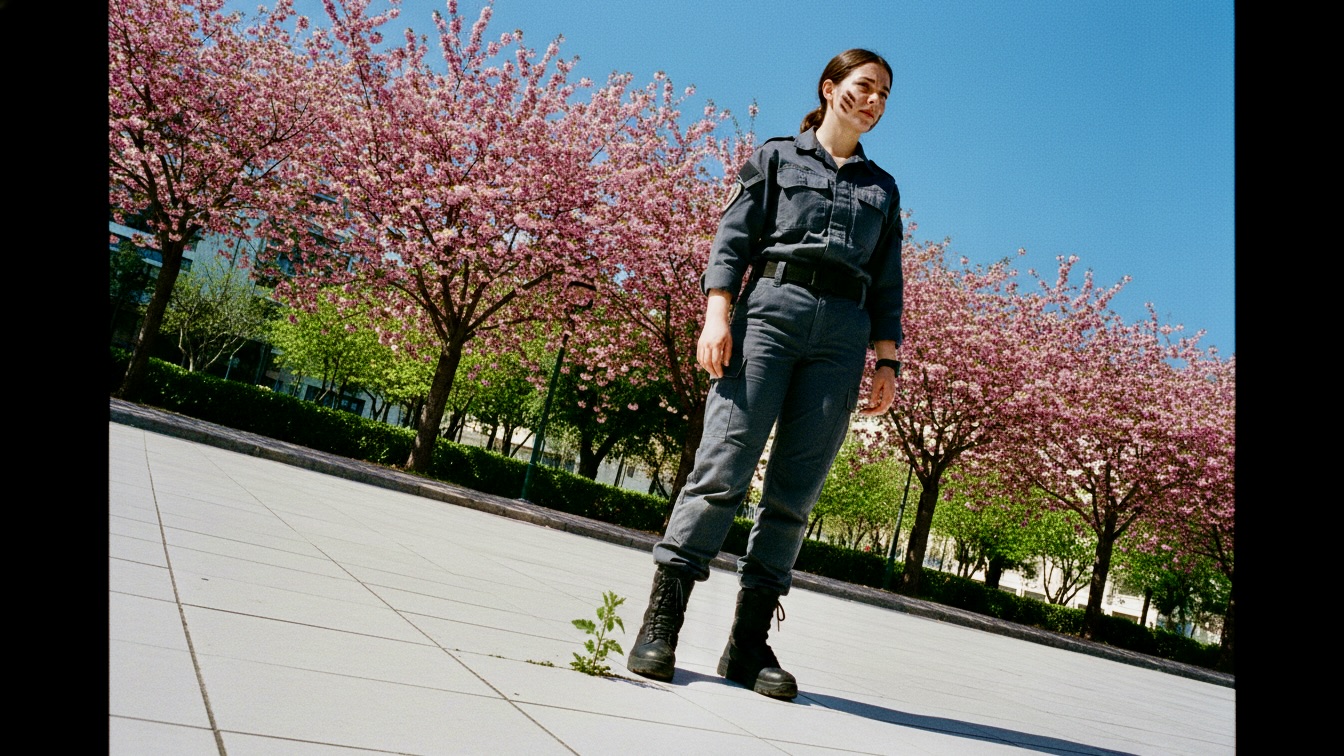
In the hyper-sterile city of Omonoia, Peacekeeper Lucy responds to a high-priority security breach at the Global Seed Vault. She discovers that a biological restructuring agent has been stolen by a mysterious figure known as the Glitch. After a high-speed pursuit through the meticulously controlled streets, Lucy corners the thief in a rare unmonitored alley. The city’s artificial perfection is maintained by a strict Council that views any deviation from their aesthetic standards as a catastrophic failure.
The Glitch reveals she is a former designer of the city’s artificial flora and intends to reintroduce wild, unpredictable life to the stagnant utopia. Faced with a choice between the sterile safety of the Council’s rule and the messy reality of nature, Lucy chooses to let the activation of the Catalyst complete. As the chapter ends, the pristine tiles of the city begin to crack, allowing the first real blades of grass to emerge. This act of defiance signals the end of the city's artificial stagnation and the beginning of a chaotic, living future.
One of the primary themes explored in this chapter is the suffocating nature of hyper-ordered perfection. Omonoia represents a peak of human engineering where every variable, from the rate of falling blossoms to the emotional output of its citizens, is managed by a central authority. This control has successfully eliminated physical discomfort but at the cost of the inhabitants' souls, leaving them in a state of wellness that is indistinguishable from catatonia. The narrative suggests that life requires friction, mess, and unpredictability to be truly authentic.
The "plastic trees" serve as a potent metaphor for this stagnation throughout the text. They are described as beautiful and efficient but ultimately dead because they do not change or decay. By introducing the Catalyst, the story posits that evolution and growth are inherently destructive to rigid systems but necessary for the survival of the spirit. The Glitch argues that the Council has optimized the life out of life, creating a world where even laughter is merely a recognized signal rather than an emotion.
Another significant theme is the conflict between aesthetic integrity and biological reality. Councilman West views the introduction of weeds as a horror because it disrupts the visual harmony he equates with safety and civilization. However, the protagonist eventually realizes that a world without weeds is a world without vitality. This highlights the danger of valuing the image of a thing over the living essence of the thing itself, suggesting that true peace cannot exist in a vacuum of control.
Lucy begins the story as a weary enforcer of a system she subconsciously detests. Her neglect of her HUD battery warning and her cynical observations about the city’s artificiality suggest a deep-seated dissatisfaction with her environment. She is a woman caught between her duty as a Peacekeeper and her repressed desire for something genuine. Her internal monologue reveals a person who is observant enough to see the flaws in paradise but initially lacks the agency to change it.
Her decision to lower her baton is the climax of her internal struggle and marks a significant psychological shift. By choosing to let the Glitch succeed, she rejects the gold star and a scheduled nap offered by the Council in favor of a terrifying, unknown future. This act of defiance marks her transition from a passive observer of the city’s decay to an active participant in its rebirth. She finds a strange, terrifying sense of peace in the destruction of the status quo.
The Glitch serves as the shadow archetype to Lucy, representing the chaotic potential that Lucy has suppressed within herself. She is a woman driven by the guilt of her own creations, seeking to dismantle the artificial world she helped build. Her shimmering skin and messy nest of dark curls stand in stark contrast to the sleek, beige-clad citizens of Omonoia. She represents the return of the repressed, acting as a gardener who plants seeds of rebellion.
She is not a traditional antagonist but rather a catalyst for change, much like the substance she steals. Her exhaustion and the dark circles under her eyes suggest the heavy toll of living with the truth in a world of lies. She views her actions not as terrorism, but as an act of mercy for a city that has forgotten how to breathe. Her disappearance at the end of the chapter leaves her as a ghostly figure of inspiration rather than a conqueror.
Councilman West embodies the psychological need for total control and the fear of the organic. He is a man who perceives a smudge on a window as an apocalyptic event, indicating a fragility that stems from his inability to handle the unpredictable. His voice, described as vibrating with anxiety, reflects the high-strung nature of those who attempt to micro-manage the world into submission. He represents the bureaucratic ego that prioritizes "aesthetic integrity" over human experience.
His reaction to the breach is one of panic rather than strategic concern, showing how dependent he is on the systems he oversees. To him, the "biological restructuring agent" is a weapon because it introduces variables he cannot map or schedule. He is the ultimate guardian of the "lawn," obsessed with the maintenance of a surface-level perfection that masks an underlying emptiness. His failure to stop the Glitch marks the collapse of his carefully curated reality.
The author employs vivid sensory imagery to establish the contrast between the artificial and the organic worlds. Descriptions of synthetic jasmine and high-grade floor wax create a visceral sense of the city’s sterile environment. These industrial scents are later juxtaposed with the sharp and damp smell of real dirt, signaling the return of the natural world through a sensory shift. The use of "aggressive" sunlight suggests that even nature has been weaponized by the city’s design.
The pacing of the chapter mimics the escalation of Lucy’s internal tension and the breakdown of order. It begins with a slow, oppressive heat and builds into a frantic chase that culminates in a moment of breathless stillness in the alley. This rhythmic change reflects the transition from the monotonous seventy-two degrees of the city to the unpredictable wind of the real spring. The countdown of the uplink adds a mechanical urgency that heightens the stakes of Lucy's moral choice.
The tone is one of cynical dystopianism that gradually shifts toward a cautious, blossoming hope. The narrative voice is grounded in Lucy’s perspective, utilizing her professional but weary observations to critique the environment. By the final paragraphs, the prose becomes more lyrical, mirroring the beauty of the stubborn blade of real, green grass that breaks through the tile. The final image of the cherry blossoms falling in an unscripted pattern serves as a powerful concluding symbol of liberation.


