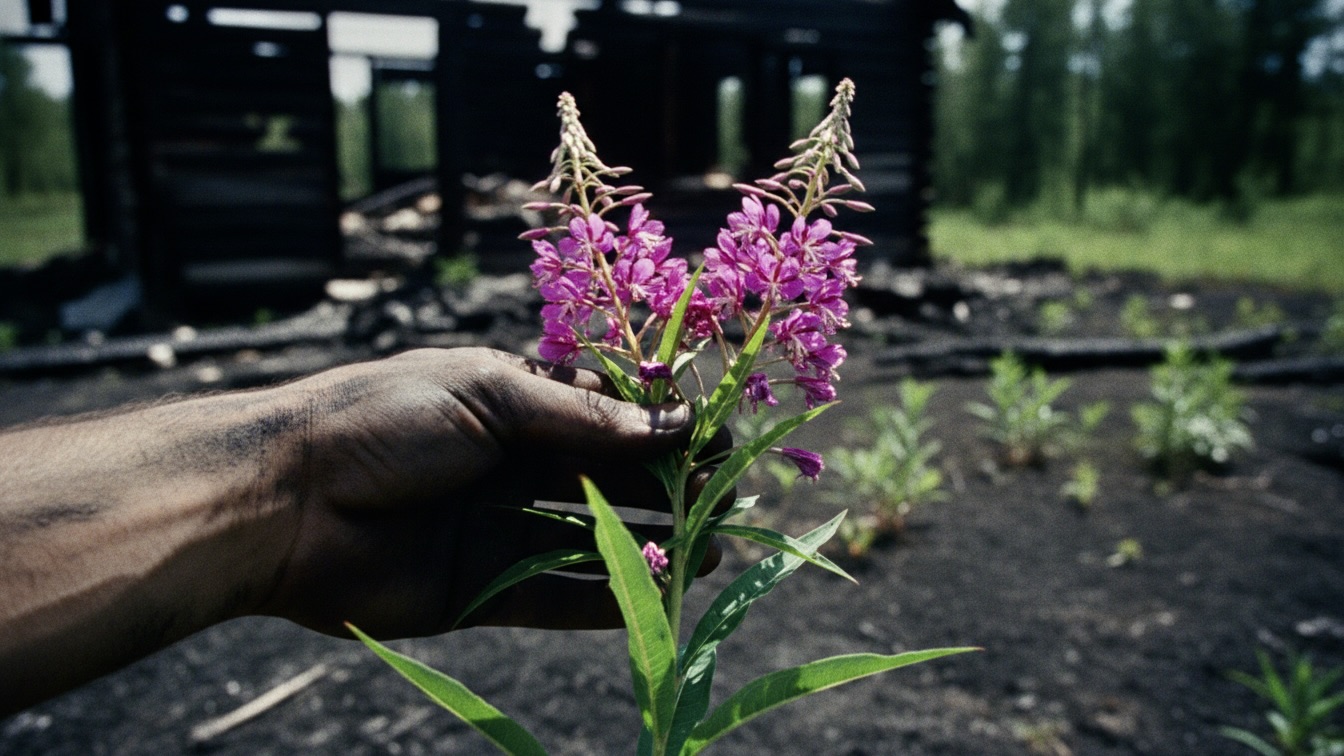
The story follows Max and his Uncle Ray as they survey the charred remains of a family cabin in the Kenora woods after a devastating fire. Max is overwhelmed by the loss of his physical possessions, particularly his laptop and journals which contained years of work for his legal career. This external destruction mirrors his internal sense of failure, as he recently struggled with his bar exams and feels his future has been erased. The environment is one of total desolation, characterized by grey ash, melted insulation, and the skeletal remains of trees.
Uncle Ray, a stoic and weathered figure, provides a different perspective on the ruin by pointing out the emergence of fireweed amidst the soot. He explains that these flowers require the heat and destruction of a fire to sprout, having waited decades in the soil for such an event. This observation serves as a psychological turning point for Max, who begins to reframe the loss of his past as a necessary clearing of "shade" that was preventing his growth. The chapter concludes with Max gathering the vibrant magenta flowers, moving from a state of paralyzed grief toward a cautious acceptance of a new beginning.
The central theme of the narrative is the necessity of destruction for the sake of rebirth. Through the metaphor of the fireweed, the story posits that certain types of growth are only possible once the existing structures of a life have been leveled. Max views the fire as a cruel ending, but the narrative suggests it is a "brutal necessity" that clears away the "shade" of his past anxieties and failed expectations. The fireweed serves as a biological proof that life persists beneath the surface, waiting for the right conditions to manifest.
Another prominent theme is the fragility of human identity when it is tethered to material objects and historical records. Max feels as though he no longer exists because his journals and academic notes have been reduced to slag. He suffers from the "heavy gift" of a clean slate, illustrating the psychological terror of losing one's narrative. The story explores how the absence of a recorded past can be both a source of intense mourning and a profound liberation from previous failures.
The relationship between humanity and the indifference of nature also plays a significant role in the text. Max initially interprets the lightning strike as a personal affront or a sign from the universe to stop trying. However, Uncle Ray’s perspective shifts the focus toward the cyclical and impersonal nature of the woods. By the end of the chapter, the theme of resilience emerges as Max realizes that the "soil" of his character remains, even if the "trees" of his former life have been consumed.
Max is introduced in a state of profound psychological weight, experiencing grief as a physical pressure against his sternum. He is a man caught between two worlds: the structured, rule-bound world of law and the chaotic, destructive world of nature. His internal conflict stems from a sense of total erasure, as he believes his identity was contained within the digital and paper records of his studies. He displays signs of clinical despair, viewing the landscape not just as a ruin, but as a reflection of his own perceived inadequacy after failing his exams.
As the narrative progresses, Max undergoes a subtle but significant cognitive shift. Initially, he identifies with the ash and the "stuff that got burned up," indicating a low sense of self-worth and a focus on what has been lost. However, through Ray's intervention, he begins to internalize the metaphor of the fireweed. By the end of the chapter, his movements change from heavy and aimless to deliberate and focused. He stops looking for ghosts and starts collecting survivors, signifying his transition from a victim of circumstance to an active participant in his own recovery.
Ray serves as the archetypal mentor and a psychological anchor for Max during a period of crisis. He is described with imagery that suggests he is a part of the landscape itself, with skin like "cured leather" and the stillness of a statue. Ray does not offer empty platitudes or emotional comfort; instead, he provides a blunt, almost clinical assessment of the situation. He acknowledges the "unmitigated wreck" of the cabin, which validates Max's pain while simultaneously forcing him to look beyond it.
His role is to facilitate Max's transition from mourning the past to recognizing the potential of the present. Ray uses his knowledge of the fireweed to provide a framework for understanding trauma as a catalyst for growth. He is the one who challenges Max’s self-pity by reminding him that his previous "forest" was actually keeping him in the dark. By handing Max the flower, Ray passes on the responsibility of recognizing life amidst death, acting as the bridge between the old world that burned and the new one that is beginning to sprout.
The author employs a stark, sensory-heavy prose style that mirrors the oppressive atmosphere of the burned clearing. The opening descriptions of the "old barbecue pit" and "grey sludge" create a visceral sense of decay that grounds the reader in Max's emotional reality. These grim olfactory and tactile details are set in sharp contrast to the "shocking, bright magenta" of the fireweed. This visual juxtaposition serves as the primary stylistic device to signal the shift from despair to hope, making the appearance of the flower feel like a genuine epiphany.
Pacing in the story is slow and methodical, reflecting the "lead" in Max's legs and the heaviness of his grief. The dialogue between Max and Ray is sparse and formal, which heightens the weight of each statement. Ray’s speech, in particular, carries a "theatrical weight" that elevates the conversation from a simple interaction between relatives to a philosophical discourse. This deliberate pacing allows the reader to feel the silence that Max finds "too loud," emphasizing the isolation of the setting and the internal nature of his struggle.
The narrative voice is a close third-person perspective that focuses on Max’s internal sensations, such as the "grit" in his throat and the "vibration" in his chest. This choice allows the author to explore the psychological nuances of trauma without the need for excessive exposition. The recurring motif of the "future"—first seen as a charred word in a journal and later represented by the flowers—provides a cohesive structure to the chapter. The final transition from the smell of ash to the "sharp, green smell" of the flowers provides a sensory resolution that mirrors Max’s internal change.


