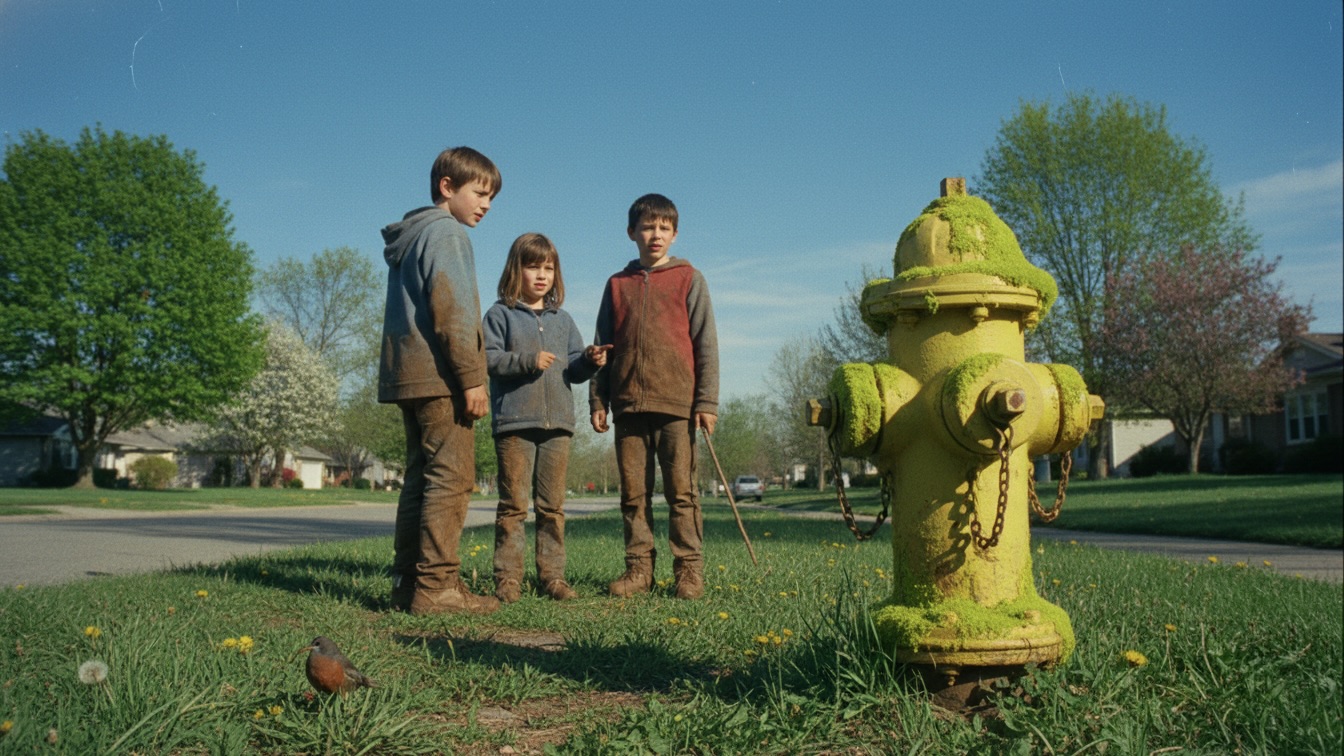
The chapter opens with the narrator waking up in a state of physical and psychological distress on the floor of his friend Konn’s apartment. He is covered in grime and still wearing a ruined suit, a remnant of a previous night that clearly ended in catastrophe. As he regains consciousness, he is forced to confront the traumatic memory of a "green face" and "yellow dust" that likely claimed his parents. To cope with the overwhelming grief, he mentally boxes up his emotions and tapes them shut, a survival tactic that allows him to function.
The three children, including a shell-shocked Harper, find themselves in a world that has gone eerily silent. Their phones are dead, and the apartment's food supply is nearly non-existent, forcing them to share a single box of dry Pop-Tarts. Realizing that no adults are coming to rescue them, the narrator suggests they head to the local elementary school, which serves as an emergency shelter. They leave the apartment and step out into a beautiful, sunny spring morning that stands in haunting contrast to the total lack of human or animal life.
As they walk through the abandoned neighborhood, they discover that a predatory, neon-colored moss has begun to consume the world. This fungus ignores metal but rapidly digests organic materials like wood, rubber, and human flesh. The chapter reaches a gruesome climax when they encounter Mrs. Higgins, their neighborhood crossing guard. She is standing at her post, but her body has been partially transformed into a pulsing mass of orange fungus. In the final moments, she reveals a horrifying spark of hijacked consciousness, turning to smile at the children with a face that is no longer human.
The most prominent theme in this chapter is the perversion of nature and the subversion of the "natural order." Typically, a bright spring morning with a clear blue sky signifies rebirth and hope, but here it serves as a cold, indifferent backdrop to an apocalypse. The fungus is described not just as a pathogen, but as a vibrant, pulsing entity that "breathes." This suggests that nature is not merely dying; it is being replaced by a more aggressive and alien form of life that finds human structures and bodies to be nothing more than fuel.
The loss of childhood innocence and the breakdown of the social contract are also central themes. The children look for the familiar landmarks of their lives—mail trucks, crossing guards, and school shelters—only to find them corrupted or abandoned. The narrator’s desire for an adult to walk in and "ground" them for staying up late highlights the desperate wish to return to a world governed by rules and safety. Instead, they are forced into a "survival situation" where the adults who were supposed to protect them have either vanished or become monsters.
Finally, the chapter explores the psychological mechanism of compartmentalization as a tool for survival. The narrator’s "cardboard box" metaphor is a poignant look at how the human mind handles trauma that is too large to process in the moment. By taping the box shut, he is able to walk, talk, and lead his friends, but the "cold, heavy rock" in his stomach suggests that this is only a temporary solution. The theme of internal vs. external horror is balanced throughout, as the characters face both the physical threat of the moss and the internal threat of their own breaking minds.
The narrator acts as the pragmatic anchor for the group, though his stability is clearly a fragile construction. He is acutely aware of his physical sensations, from the sandpaper feel of the carpet to the "handful of sand" in his throat, which suggests he is in a state of high hyper-vigilance. His decision to box up the memory of his parents shows a sophisticated, if subconscious, understanding of his own mental limits. He knows that if he allows himself to feel the full weight of his loss, he will never stop screaming, so he chooses action over mourning.
Throughout the journey, he takes on a leadership role, making the decision to leave the apartment and head for the school. He is the one who warns Konn not to touch the moss, demonstrating a cautious and observant nature that is essential for survival. Despite his fear, he maintains a level of curiosity, forcing himself to look at the horrors they encounter rather than turning away. This blend of terror and duty defines his character as he navigates a world where he can no longer be a child.
Konn serves as a foil to the narrator’s grim pragmatism, often attempting to process the horror through the lens of fiction. He compares their reality to a survival video game, a defense mechanism that allows him to distance himself from the actual stakes of their situation. This reliance on media tropes suggests that he is struggling to grasp the finality of the event. He is also the most physically expressive of the trio, his hunger and snoring grounding the scene in a gritty, uncomfortable reality.
Despite his attempts to act tough or knowledgeable, Konn’s vulnerability is frequently on display. He looks like a "tired raccoon" with soot on his face and reacts with genuine, childlike terror when he sees the transformed Mrs. Higgins. His defensive tone when challenged by Harper shows that he is clinging to any sense of control he can find, even if it is just "knowing" they need calories. He represents the part of childhood that tries to turn a nightmare into a game just to keep the heart from failing.
Harper is the most visibly traumatized member of the group, existing in a state of near-catatonic observation. She spends the beginning of the chapter staring out the window, obsessively rolling a piece of dirty gum, which indicates a high level of dissociation. Unlike Konn, she refuses to engage in the fantasy that this is a game, flatly stating that "this is real life." Her bluntness serves as a constant reminder of the gravity of their situation, stripping away any illusions the boys might try to maintain.
However, Harper also proves to be the most intellectually sharp member of the trio during their walk. She is the one who notices the specific behavior of the fungus, deducing that it only eats organic material. Her use of the ruler to test the moss shows a scientific mind at work, even in the midst of a breakdown. She does not scream when she sees the dead crossing guard, instead stating the fact with a chilling lack of emotion. Her character embodies the "freeze" response to trauma, turned into a sharp, observational tool.
The author utilizes a stark, minimalist prose style that mirrors the narrator's fractured and focused mental state. Short, declarative sentences create a sense of urgency and prevent the reader from finding comfort in flowery language. This "staccato" rhythm effectively conveys the feeling of a world that has been stripped down to its barest, harshest elements. The use of the present tense adds to the immediacy of the horror, making the reader feel as though they are trapped in the moment alongside the children.
Sensory details are employed with visceral precision to create a sense of "body horror" and environmental decay. The narrator describes the smell of "old meat and burnt plastic" and the "chalky" taste of the Pop-Tart, which grounds the sci-fi elements in a recognizable, unpleasant reality. The contrast between the "neon green" and "vibrant orange" of the fungus and the "dirty off-white" walls of the apartment creates a powerful visual palette. These bright, almost cheerful colors make the predatory nature of the moss feel even more unnatural and threatening.
The pacing of the chapter is masterfully handled, moving from the claustrophobic stillness of the apartment to the expansive, terrifying silence of the street. Each discovery—the dead phone, the dissolved ruler, the melted mail truck—builds the stakes until the final encounter with Mrs. Higgins. The author uses silence as a recurring motif, describing it as something "heavy" that "presses against the ears." This makes the few sounds that do occur, like the "sizzle" of the ruler or the "clicking" in the guard's throat, feel explosive and deeply disturbing.


