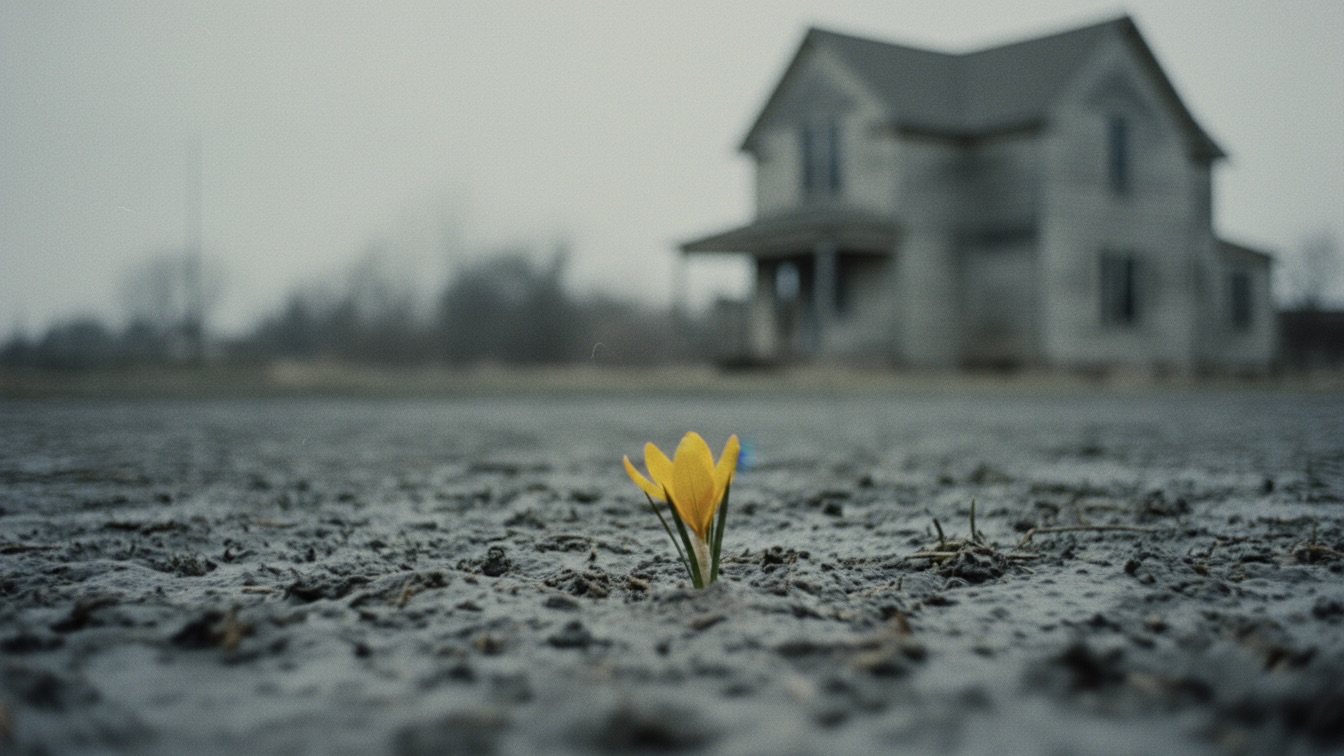
The narrative begins with Yuri, a coder or writer, trapped in the paralyzing grip of professional burnout within his dilapidated Victorian apartment. His environment is a graveyard of productivity, marked by empty caffeine cans and the oppressive glow of his monitor. As the sun sets, he observes a disturbing phenomenon in the muddy yard outside: a pale, elongated entity emerging from the earth to interact with a single, vibrant yellow crocus. This supernatural intrusion marks the beginning of a rapid descent into body horror and environmental collapse.
When his roommate, Sam, returns home, the two witness the creature drain the color and life from the flower, an act that physically affects Yuri’s own vitality. The apartment itself begins to transform, its walls weeping and its structure becoming organic and predatory. In a frantic attempt to escape the encroaching mud and the shifting house, the pair tries to exit through a window. While Yuri is propelled into the yard, Sam is violently consumed by a maw that opens within the house’s foundation.
The story concludes with a chilling metamorphosis. Yuri, rather than escaping, finds himself transformed into a creature identical to the one he first observed. His exhaustion is replaced by a predatory hunger and a newfound strength derived from the life force of the environment. He sits in the mud, cultivating a new yellow crocus to serve as a lure for the next tenant. The cycle of exhaustion and consumption is thus renewed, with Yuri now acting as the predator.
The central theme of the story is the parasitic nature of modern existence and the dehumanizing effects of extreme burnout. Yuri’s initial state of "static" and "dry sponge" brain suggests that his professional life has already hollowed him out before the supernatural elements even manifest. The "Blue Light" of the title refers not just to the monitor, but to the artificial, soul-sucking glow of a life lived entirely within digital and economic constraints. The house and the creature are physical manifestations of this exhaustion, literally consuming the inhabitants who are already "drowning" in debt.
Another significant theme is the subversion of nature and the "false promise" of renewal. Spring is traditionally a time of rebirth, symbolized here by the yellow crocus. However, in this narrative, the flower is merely bait in a predatory trap. The "natural" world is depicted as rotting, grey, and oily, suggesting that for those trapped in cycles of poverty and overwork, even the change of seasons offers no real escape. The beauty of the flower is a temporary illusion used to facilitate further extraction of life.
Finally, the story explores the cycle of victimization and the transition from the consumed to the consumer. Yuri’s transformation at the end is a dark commentary on how toxic environments perpetuate themselves. To survive the "burn," Yuri must become the thing that burned him. He loses his individual humanity to become a functional part of the predatory ecosystem of the house. This suggests a cynical psychological reality where the traumatized often adopt the traits of their environment to find a sense of power.
Yuri is introduced as a man at the absolute limit of his psychological and physical endurance. From a psychological perspective, he exhibits classic symptoms of depersonalization and severe clinical burnout. He perceives his own body as a "question mark" and his brain as "static," indicating a profound disconnection from his sense of self. His fixation on the crocus represents a desperate, last-ditch effort to find meaning or beauty in a life that has become entirely grey and transactional.
His transformation at the end of the story is the logical conclusion of his psychological state. Throughout the text, Yuri is portrayed as passive, someone to whom things happen rather than someone who acts. Even his escape is prompted by Sam’s shove. By becoming the creature, he finally moves from a state of passive suffering to one of active, albeit monstrous, agency. The "void" in his throat and the "translucent" nature of his skin symbolize the final loss of his human identity, replaced by a hunger that mirrors the demands of his former career.
Sam serves as the grounded, pragmatic foil to Yuri’s dissociative wandering. He is the one who brings food, flips the lights, and attempts to force a sense of normalcy onto their deteriorating situation. Psychologically, Sam represents the "survival" instinct that still clings to the social and physical structures of the world. He tries to rationalize the horror as a groundhog or a rat, demonstrating a common psychological defense mechanism of denial when faced with the incomprehensible.
Despite his pragmatism, Sam is equally vulnerable because he is part of the same economic and environmental trap. His death is particularly tragic because he is the one who actively tries to fight back and escape. The house’s consumption of Sam suggests that effort and pragmatism are insufficient defenses against a system that is fundamentally rigged. His role in the narrative is to highlight the stakes of their situation; while Yuri fades into the monster, Sam is physically destroyed by the environment they both shared.
The narrative voice is heavy with sensory decay, utilizing a "gritty realism" that transitions seamlessly into "cosmic horror." The author uses color—or the lack thereof—to establish a suffocating atmosphere. Descriptions like "expired milk" walls and "weak coffee" puddles create a visceral sense of nausea and stagnation. This palette of greys and browns makes the "brilliant yellow" of the crocus feel almost violent, heightening the contrast between the dying world and the predatory lure.
Pacing is expertly handled, beginning with the slow, rhythmic "blink" of a cursor and accelerating into a frantic, claustrophobic nightmare. The internal monologue of Yuri provides a sluggish, weighted feeling in the beginning, mimicking the heavy-limbed sensation of exhaustion. As the house begins to "wake up," the sentences become shorter and more percussive. This shift mirrors the characters’ spiking adrenaline and the breakdown of their rational world as the "organic" nature of the house reveals itself.
The use of metaphor bridges the gap between the mundane and the supernatural. The creature’s fingers are described as a "glitch in a video game," and the house’s foundation is compared to "teeth." These choices reflect Yuri’s digital-centric worldview, showing how his professional life has colored his perception of reality. By using tech-related metaphors to describe biological horror, the author reinforces the idea that Yuri’s work and his environment are two parts of the same destructive force.


