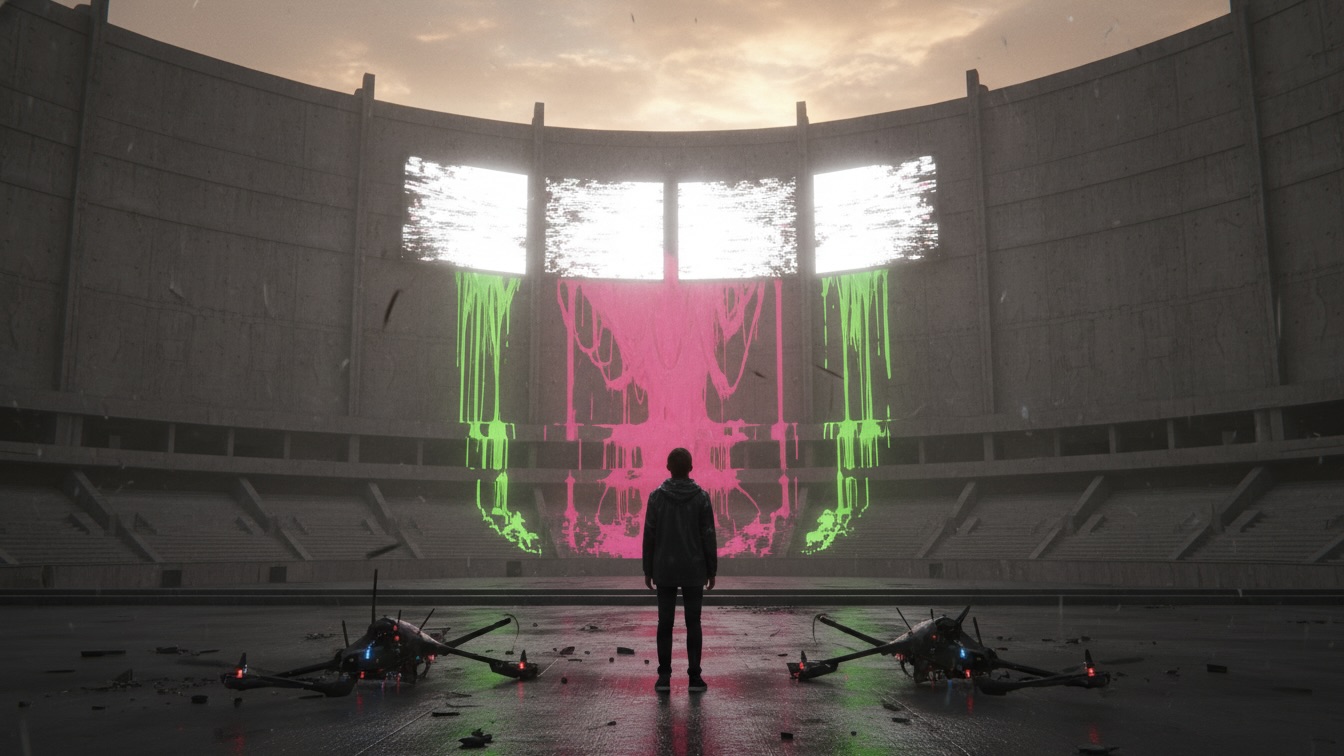
The story opens in a decaying, corporate-dominated Winnipeg where spring is described as an infrastructural failure rather than a season. Max and Lenny, two young men living in the shadow of the all-encompassing OmniCorp, scout an abandoned stadium to serve as the site for an unauthorized art exhibition. Their goal is to create a visual disruption that will be seen by corporate workers, reclaiming a piece of the city that has been left to rot.
To realize this vision, the pair must infiltrate an OmniCorp tech-dump to scavenge discarded light-canvases. Despite the presence of guards and the physical toll of the labor, they manage to secure four massive panels. This sequence highlights the desperate lengths to which they must go to acquire tools for expression in a world where everything is owned and monitored by a single entity.
The narrative culminates in a frantic, community-led effort to launch the exhibition. When the paint they salvaged proves too thick for traditional sprayers, Max pivots to a more aggressive, visceral method of application. As they prepare to go live, OmniCorp drones descend to suppress the gathering. Through a combination of physical bravery and technical improvisation, the group disables the drones and activates the display. The chapter ends with a triumphant, chaotic explosion of neon light and color that stands as a defiant middle finger to the approaching corporate security forces.
The central theme of the story is the reclamation of agency through creative rebellion. In a world where OmniCorp dictates every aspect of existence, from transit to the very colors people see, Max’s exhibition represents a psychological necessity to assert individuality. The stadium, described as a "dead zone" and a "toilet," is transformed from a symbol of failure into a sanctuary of human expression. This shift suggests that art is not merely an aesthetic choice but a vital survival mechanism for those crushed by systemic neglect.
Another prominent theme is the contrast between corporate sterility and human messiness. OmniCorp’s technology is sleek, black, and lethal, designed for surveillance and "pacification." In contrast, the art created by Max and his peers is described as "radioactive vomit," "glitching," and "violent." This aesthetic of the "glitch" serves as a metaphor for the protagonists themselves—they are the errors in the corporate code, the broken pixels that refuse to be discarded.
The narrative also explores the power of community and collective action in the face of overwhelming odds. While Max is the visionary, the project only succeeds through Lenny’s technical skill and Riya’s leadership of the local youth. The "mesh network" and the gathering of fifty kids illustrate how marginalized populations can organize horizontally to bypass vertical power structures. Their success is not found in perfection, but in the shared willingness to endure "slush and aerosol" for a moment of collective visibility.
Max is driven by a profound psychological need to be seen in a world that treats him as obsolete. He views the abandoned stadium not as a ruin, but as a canvas, reflecting a mindset that actively resists the despair of his environment. His rejection of logic in favor of "good vibes" suggests a character who understands that, in a rigged system, rationalism often leads to surrender. He acts as the emotional catalyst for the group, pushing through physical pain and fear to achieve a singular moment of transcendence.
From a psychological perspective, Max exhibits a high degree of resilience and a refusal to internalize the "gray" of his surroundings. His decision to throw the paint rather than spray it shows his ability to adapt his vision to the harsh realities of his resources. By the end of the chapter, he finds peace in the blinding glare of his own creation. He chooses the risks of fame and defiance over the safety of anonymous survival, signaling a core identity built on resistance.
Lenny serves as the pragmatic, cautious foil to Max’s idealism. He is the one who tracks the "red" in their bank accounts and worries about the "titanium teeth" of security dogs. His anxiety is a grounded response to the very real dangers of their world, yet he remains loyal to Max’s vision. This loyalty suggests that even the most cynical and fearful individuals in this society are hungry for the meaning that Max’s project provides.
Lenny’s technical expertise is the backbone of the exhibition’s success. He is able to manipulate the discarded corporate tech, turning tools of advertisement into weapons of visual disruption. His "daisy-chaining" of the power supply and his ability to bypass limiters reflect a character who finds power in the margins. While he complains and fears for his life, his actions prove that he is just as committed to the rebellion as Max, albeit through the lens of a weary survivor.
Riya is introduced as the "unofficial mayor of the block," a title that highlights her natural authority and social capital. She is decisive, physically imposing, and possesses a sharp tactical mind. When the paint consistency threatens the project, she does not panic but looks to Max for a solution, showing her ability to collaborate under pressure. Her presence gives the exhibition the organizational muscle it needs to move from a dream to a reality.
Her combat with the drones reveals a woman who is unafraid of physical confrontation with the state. She uses a heavy chain to bring down a high-tech Wasp drone, a symbolic victory of raw human strength over automated oppression. Riya represents the protective element of the community, ensuring that the younger kids have the space and security to express themselves. She is the bridge between the artistic vision and the street-level reality of their struggle.
The pacing of the story mirrors the escalating tension of an insurgent act. It begins with a slow, atmospheric description of the "gray paste" of Winnipeg, establishing a mood of stagnant misery. As the plot moves toward the tech-dump heist and the final confrontation at the stadium, the sentences become shorter and more action-oriented. This shift creates a sense of urgency that reflects the characters' own adrenaline and the looming threat of OmniCorp.
Sensory details are used effectively to highlight the dichotomy between the natural world and the synthetic corporate environment. The author frequently mentions the smell of "wet rust," "ozone," and "battery acid," grounding the story in a gritty, industrial reality. These unpleasant scents are eventually overwhelmed by the "toxic pink" and "radioactive green" of the paint. This sensory transition mirrors the plot’s movement from gray despair to vibrant, albeit chaotic, hope.
The narrative voice is colored by a cynical, hard-boiled tone that suits the dystopian setting. Descriptions like "infrastructural failure" and "giant concrete toilet" establish a world-weary perspective that makes the eventual explosion of color more impactful. By maintaining this grounded, often bleak voice, the author ensures that the final "glitch" of light feels earned rather than sentimental. The story successfully balances the harsh realities of poverty and surveillance with the soaring, sensory-overload of the artistic finale.


