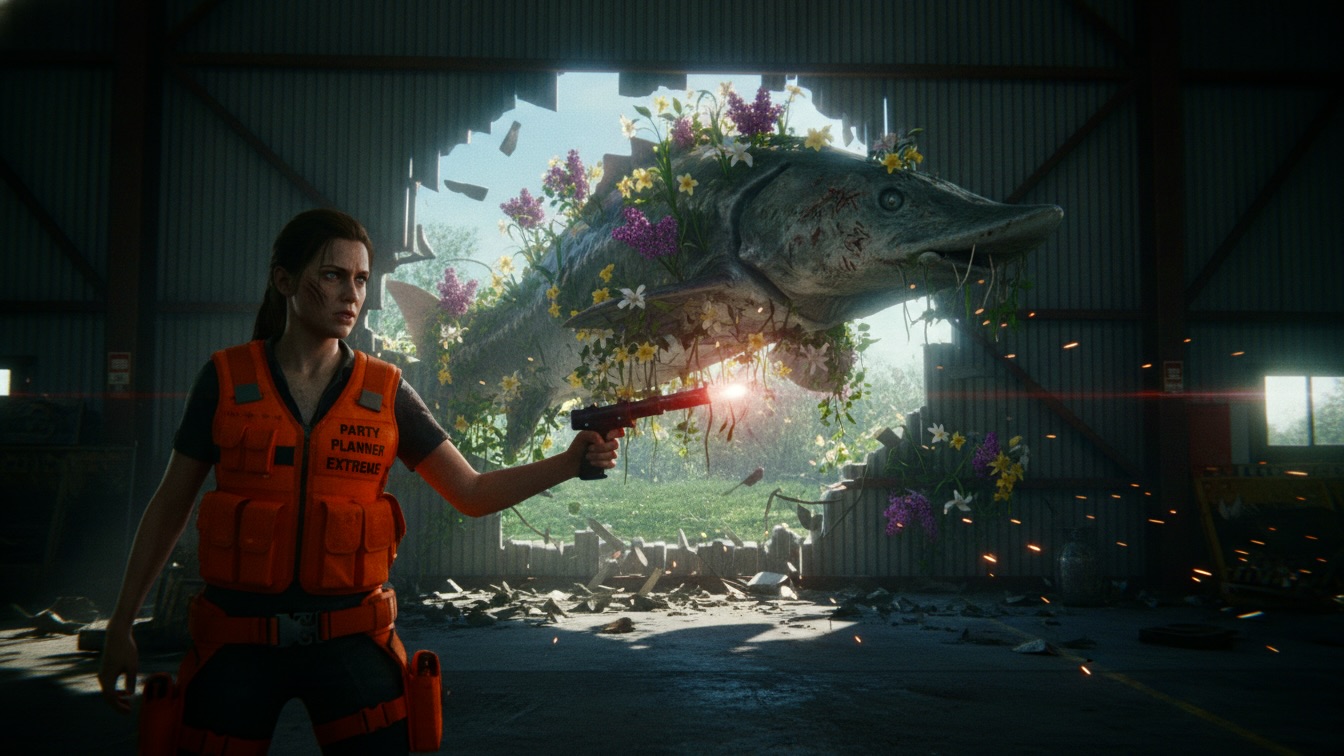
The story begins in the claustrophobic, sensory-heavy environment of a recycling center where two adults, Val and Mac, are tasked with managing twenty hyperactive eight-year-olds. Val is portrayed as hyper-prepared, donning a tactical vest filled with supplies, while Mac maintains a cynical distance, mocking the educational value of a "dump." The mundane tension of the field trip is shattered when the discarded plastic begins to animate. A mountain of water bottles assembles into a spindly creature, and the surrounding atmosphere shifts into a surreal, neon-green nightmare.
As the situation escalates, the recycling center is besieged by "zombie fish" and sentient plastic dinosaurs. Val reveals a hidden layer of her preparedness by producing a flare gun, while Mac assumes a leadership role by herding the terrified children into the safety of a garbage truck. The chaos reaches a peak when a massive, undead sturgeon crashes through the wall, sprouting beautiful flowers from its rotting scales. The chapter concludes on a cliffhanger as the protagonists attempt to escape in the truck, only to find the engine disabled by a swarm of sentient, singing confetti.
The central theme of the narrative is the violent reclamation of nature against human waste. The author personifies the "leftovers" of civilization, suggesting that the items humanity discards do not truly disappear but instead undergo a grotesque metamorphosis. The recycling center, intended to be a place of environmental stewardship, becomes a site of ecological judgment where the "inventory" rebels against its creators. This reflects a deep-seated cultural anxiety regarding the permanence of plastic and the consequences of a consumerist society.
Another prominent theme is the juxtaposition of the beautiful and the macabre. This is most vividly illustrated by the giant sturgeon, which is simultaneously a rotting corpse and a blooming garden. This imagery suggests that life and growth are inexorable forces that will persist even through the medium of decay and pollution. The "garden of the undead" serves as a metaphor for a world where nature has been forced to adapt to human filth, creating a new, surreal reality that is both enchanting and terrifying.
The narrative also explores the theme of preparedness versus the unpredictability of chaos. Val’s meticulously organized vest represents a human desire for control and safety in an inherently unstable world. However, the threats she faces—singing confetti and bottle monsters—are so absurd that her conventional preparations are rendered almost comical. This highlights the psychological struggle of maintaining order when the fundamental laws of reality begin to dissolve, suggesting that adaptability is more valuable than rigid planning.
Val is a character defined by high-functioning anxiety and a desperate need for structure. Her orange vest, overflowing with supplies for every conceivable minor emergency, serves as a psychological suit of armor against a world she perceives as threatening. From a psychological perspective, her obsession with being "prepared" suggests a history of trauma or disappointment where she felt helpless. The mention of the hiking trip she never took hints at a fractured relationship and a life where her careful plans frequently go awry.
Despite her rigid exterior, she demonstrates significant courage and a fierce protective instinct. When the supernatural threat emerges, she transitions from a harried chaperone to a tactical leader without hesitation. Her ability to operate a flare gun with "impressive and slightly scary" speed indicates a hidden depth of capability that Mac had previously overlooked. She is the moral and functional anchor of the group, using her need for control to ensure the survival of the children in her care.
Mac functions as the cynical foil to Val’s earnestness. He uses humor and sarcasm as a defense mechanism to mask his own discomfort with the environment and, perhaps, his past with Val. By labeling the recycling center a "dump" and mocking the "treasure hunt," he attempts to diminish the importance of the situation so he does not have to engage with it emotionally. His initial lethargy and lack of engagement suggest a man who has grown disillusioned with the roles he is expected to play.
However, Mac undergoes a rapid transformation when the children are put in genuine peril. He sheds his persona of detached irony and adopts a role of active responsibility, showing that his cynicism is a thin veil over a capable character. His "Get in the Truck" game shows a pragmatic, if blunt, way of managing panic in others. While he lacks Val’s foresight, he possesses the reactive strength necessary to execute her commands, highlighting a symbiotic, if strained, partnership between him and her.
The pacing of the chapter is expertly handled, moving from a slow, atmospheric build-up to a frantic, high-stakes climax. The author uses the initial sensory details of "old apple juice and wet cardboard" to ground the reader in a mundane reality before introducing the neon-green, surrealist elements. This shift creates a jarring effect that mirrors the characters' own disorientation. The transition from the "clinking" of bottles to the "thwack" of zombie fish accelerates the narrative heartbeat, keeping the reader in a state of constant escalation.
The tone of the piece is a unique blend of "eco-horror" and "absurdist comedy." The author manages to make the threats feel dangerous while maintaining a sense of the ridiculous, such as the security guard fighting plastic dinosaurs with a clipboard. This tonal balance prevents the story from becoming too grim, allowing the more fantastical elements—like the singing confetti—to land with a sense of dark whimsy. The use of the "beeping" sound for the bottle monster is a particularly effective stylistic choice, as it blends the mechanical nature of the waste with the biological movements of the creature.
Sensory imagery is the narrative’s strongest tool, particularly the contrast between smells and sights. The transition from the stench of rotting fish to the "overwhelming, sweet scent" of lilacs provides a powerful olfactory shift that underscores the theme of transformation. The visual of the neon-green slime and the glowing eyes of the fish creates a vivid, cinematic aesthetic. By focusing on these intense sensory inputs, the author forces the reader to experience the breakdown of the natural order alongside the characters, making the impossible feel visceral and immediate.


