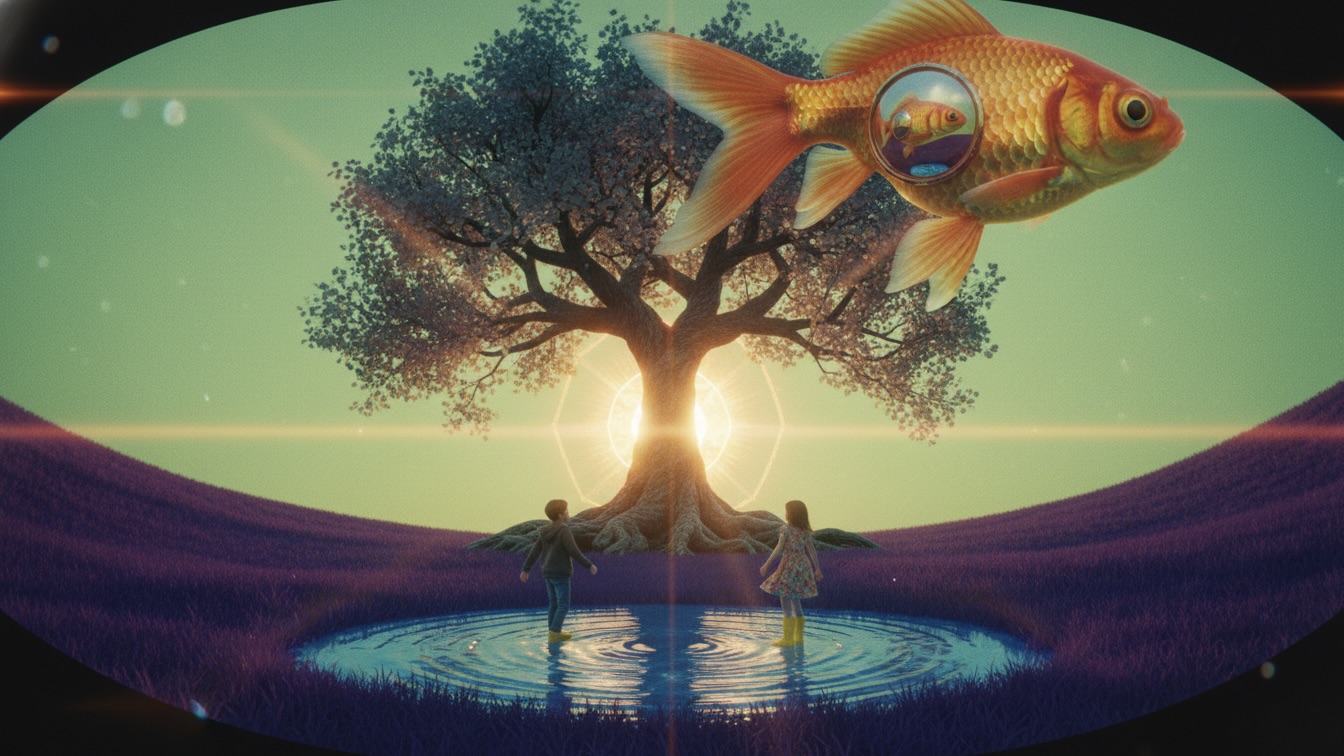
Toby is a ten-year-old boy whose ordinary Tuesday afternoon takes a surreal turn when his bicycle chain suddenly transforms into a strand of hot spaghetti. He is joined by his friend Maya, and together they witness their neighborhood park disintegrating into a digital-flavored nightmare. The sun becomes a square, the grass turns purple, and the laws of physics begin to fail as the world "glitches" around them.
The children discover a gravity puddle and an ancient brass key near a translucent glass tree that appears to be the center of the disturbance. A giant, telepathic goldfish descends from the lime-green sky to inform them that the world is "leaking" and failing a critical update. This celestial entity warns them that they have mere seconds to plug the leak before their reality is permanently deleted.
In a final, desperate act of heroism, Toby realizes that the "shadow" of a distorted playground slide is actually a door to the world's source code. Because the gravity puddle is pulling them away from the ground, Toby uses his momentum to swing Maya toward the door. As the park dissolves into white light and LEGO bricks, Maya soars through the air with the brass key, tasked with saving their existence.
One primary theme is the inherent fragility of reality and the human tendency to seek order within chaos. The story uses digital metaphors—lagging, glitches, and failing updates—to suggest that the world the characters inhabit might be a fragile simulation rather than a permanent, physical truth. This creates a sense of existential dread that is sharply contrasted against the mundane, comforting details of childhood, such as tater tots and yellow rain boots.
The narrative also explores the transition from childhood passivity to active responsibility. Toby and Maya are thrust into a situation where the adults, including Toby’s mother who is distant at a hospital, are entirely absent or unable to provide protection. They must rely on their own logic and mutual trust to navigate a landscape that no longer follows the rules of physics. This represents the terrifying metaphorical moment when a child realizes that the safety of the known world is not guaranteed by anyone but themselves.
Finally, the story highlights the theme of resilience through friendship. Despite the crumbling of the universe, the bond between Toby and Maya remains the only stable element in the narrative. Their shared history, like Maya’s kindness when Toby tripped in the cafeteria, provides the emotional foundation necessary for them to face a cosmic crisis. Their connection serves as a tether to their humanity even as the physical world transforms into spaghetti, glass, and light.
Toby is a ten-year-old boy who exhibits a precocious sense of responsibility and a burgeoning protective instinct. Despite his internal fear, which he describes as a "flutter in his chest," he consciously adopts the role of the leader to comfort Maya. He uses humor as a psychological defense mechanism, joking about "skill issues" to mask his genuine terror as the environment becomes increasingly unrecognizable.
From a psychological perspective, Toby is grappling with the sudden loss of environmental mastery. He is at a developmental stage where he is beginning to understand and master the laws of the physical world, so the sight of his bike melting challenges his foundational sense of security. The breakdown of these laws forces him to adapt with remarkable cognitive flexibility. He eventually shows emotional maturity when he decides to sacrifice his own proximity to the goal to propel Maya toward the shadow door.
Toby’s internal conflict stems from his desire to be a child who is looked after and his forced evolution into a savior. He thinks of his mother’s exhaustion and her work at the hospital, suggesting he already carries a burden of empathy for the adults in his life. This empathy translates into his bravery, as he seeks to fix the world not just for himself, but to ensure there is a "Tuesday" for his mother to return to. He represents the archetype of the reluctant hero who finds strength in the necessity of the moment.
Maya is a nine-year-old girl who serves as the emotional anchor and the observant counterpart to Toby’s action-oriented approach. She is characterized by her vulnerability, evidenced by her missing front tooth and her tight, silent grip on Toby’s sleeve. While she is openly afraid, she does not succumb to paralysis, instead offering insightful observations about the "lagging" world that help the pair categorize their experience.
Maya’s psychological state is one of transition between total reliance on others and the emergence of her own agency. Her initial reaction is to look for a "restart button," reflecting a modern child’s reliance on digital frameworks to solve problems and escape consequences. However, she shows deep emotional intelligence when she checks on Toby’s well-being, reciprocating the care he provides her. She acts as the "witness" to the absurdity, grounding the high-concept sci-fi elements in human emotion.
By the end of the chapter, Maya undergoes a significant transformation from a follower to the primary agent of change. When Toby tells her he is going to throw her, her initial protest is a cry of "I'm just a kid," which is a plea for the world to return to its natural order where children are not responsible for cosmic repairs. Yet, when she closes her fingers around the key, she accepts the heavy burden of the task. Her flight through the air symbolizes a literal and figurative leap of faith into a more adult-like role of responsibility.
The author employs a vivid, surrealist style that effectively blends domestic imagery with the bizarre. Sensory details are used to ground the reader in Toby’s perspective, such as the smell of laundry detergent clashing with the scent of ozone and burnt toast. By using concrete nouns like "spaghetti," "meatballs," and "LEGO bricks," the narrative makes the abstract collapse of reality feel tactile and immediate. This juxtaposition of the culinary and the cosmic creates a "dream-logic" tone that is both whimsical and threatening.
The pacing of the story mirrors the escalating stakes of the "glitch" itself. It begins with a slow, hypnotic quality where the children simply observe the strange changes, but it rapidly accelerates into a frantic race against time once the goldfish appears. The sentences become shorter and the actions more desperate, reflecting the characters' rising adrenaline. This shift in tempo ensures that the reader feels the same sense of urgency that Toby feels as he counts down the seconds to the world's deletion.
Narrative voice plays a crucial role in maintaining the story's balance between wonder and horror. The third-person limited perspective stays close to Toby's internal sensations, allowing the reader to experience his "tight and loose" feelings firsthand. The use of modern terminology like "app icon" and "dial-up modem" suggests a contemporary setting where technology has colored the way children perceive the universe. This stylistic choice makes the "Gravity Puddle" feel like a modern fairy tale, where the monsters are not dragons but system errors.


