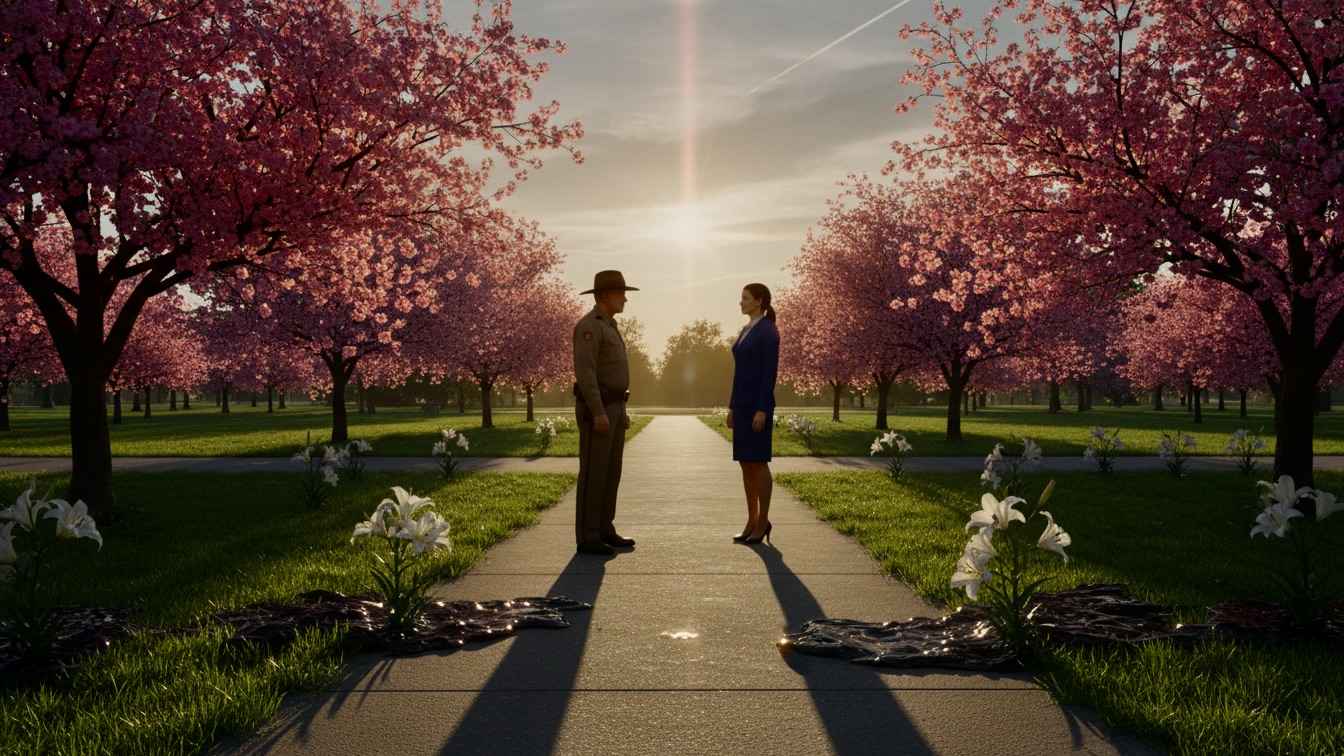
The story follows Sheriff Harris as he meets his political rival, Cissy Reed, in the deceptively beautiful Heritage Park. While the town views the park as a symbol of prosperity, Harris is acutely aware of its dark history as a former potter's field. Cissy arrives with news of a rediscovered physical ledger, known as the Third File, which proves that the influential Miller family covered up a series of disappearances in the nineties. She intends to use this information to dismantle the town's power structure and win the upcoming election.
As their conversation progresses, the environment begins to manifest supernatural horrors, with black ichor leaking from lilies and the ground becoming unnervingly soft. Harris reveals the terrifying truth that the town's peace is maintained through a literal blood debt to the earth. He explains that the role of the Sheriff is not to enforce the law, but to act as a "groundskeeper" who manages these dark sacrifices. Cissy is horrified to learn that her own campaign was funded by the Millers, making her a complicit part of the cycle.
The encounter concludes with Cissy leaving the park in a state of shock, her ambition replaced by a crushing sense of dread. Harris remains behind, witnessing the emergence of a monstrous form from the stagnant pond, representing his predecessor. He accepts his fate with a grim resignation, acknowledging that the hunger of the land is insatiable. The chapter ends with Harris returning to his routine, drowning out the sounds of the breathing earth with the mundane noise of a pop song.
The central theme of the narrative is the hidden cost of societal prosperity. Heritage Park serves as a physical manifestation of the "beautiful lie," where the manicured grass and vibrant cherry blossoms mask a foundation of rot and human sacrifice. This suggests that the stability of the community is not built on hard work or policy, but on a predatory exchange with a primal, hungry force. The story posits that every high-performing school or stadium in the town is paid for with a currency of blood.
Another prominent theme is the inescapable nature of historical trauma and the failure of erasure. The town council's decision to "forget" the potter's field in the nineties represents a collective psychological repression. However, the emergence of the physical "Third File" and the literal bleeding of the soil demonstrate that the past cannot be permanently buried. The transition of the file from digital back to physical ink and paper highlights the tangible, undeniable reality of these past sins.
The narrative also explores the corruption of power and the loss of agency. Harris and Cissy both believe they are players in a political game, but they are actually pawns in a much older, more sinister system. Power in this town is not an achievement but a "transfer of debt." The badge of the Sheriff is transformed from a symbol of justice into a tool for maintenance, forcing the individual to become a servant to the very darkness they are supposed to hold at bay.
Sheriff Harris is a man defined by profound cynicism and a weary sense of resignation. Psychologically, he appears to be in a state of "dull acceptance," a defense mechanism developed over decades of witnessing the town's true nature. He no longer views himself as a protector of the people, but as a "groundskeeper" for a graveyard. His internal clock and his constant checking of his watch suggest a man who is simply waiting for his time to run out.
He exhibits a high degree of cognitive dissonance, maintaining the outward appearance of a lawman while facilitating a supernatural cover-up. This split in his identity is visible in his grey skin and shaking hands, indicating the physical toll of his secret knowledge. He acts as a mentor of sorts to Cissy, though his guidance is cruel and fatalistic. He seeks to strip away her illusions, perhaps as a way to validate his own long-term complicity in the town’s horrors.
His final actions, such as tossing a coin into the pond and turning up his radio, show a man who has completely surrendered to the status quo. He understands that the system is too large and hungry to be fought, so he chooses to drown out the "breathing" of the park with the noise of normalcy. He is a tragic figure who has lost his moral compass to the literal and metaphorical ground he stands on. He is no longer a man of the law, but a part of the garden.
Cissy Reed begins the narrative as the embodiment of modern ambition and clinical detachment. Her perfume, described as smelling like a hospital or a new car, suggests a desire for sterility and a break from the "baggage" of the past. She represents the "tech-savvy" future, relying on tablets and digital files to exert her influence. Psychologically, she is driven by a need for power, which she masks as a desire for reform and modernization.
Her transformation throughout the chapter is a study in the collapse of the ego. As the supernatural elements of the park intensify, her "minimalist cool" evaporates, leaving her as "just a girl in a suit." The destruction of her tablet by the black acid symbolizes the failure of her modern tools against an ancient, visceral force. When she discovers that her own family and campaign are tied to the Millers, her sense of self-righteousness is utterly shattered.
By the end of the encounter, Cissy is a shell of her former self, moving "like a ghost" with "empty eyes." Her ambition has been replaced by a cold, hard dread that renders her silent and compliant. She realizes that winning the election would not be a victory but a sentence to a life of horror. Her nod to Harris at the end signifies her submission to the cycle, as she walks away with the weight of the "Third File" now residing within her own consciousness.
The pacing of the story is masterfully handled, beginning with a slow, atmospheric tension that gradually escalates into overt cosmic horror. The initial descriptions of the park create a sense of "uncanny valley" perfection, where the colors are too bright and the water is too still. This sets a foundation of unease that makes the subsequent supernatural occurrences feel like the inevitable breaking of a fever. The shift from political discourse to the "FEED" message on the tablet marks a sharp transition in the narrative's intensity.
The tone is one of pervasive dread, blending elements of Southern Gothic with Lovecraftian horror. The author uses sensory details to ground the supernatural events in a repulsive reality. The smell of "copper and rot," the "hissing" of the grass, and the "black ichor" create a visceral experience for the reader. These descriptions contrast sharply with the "clinical" scent of Cissy's perfume and the "pink" of the cherry blossoms, highlighting the conflict between the surface lie and the underlying truth.
The narrative voice is a third-person limited perspective that stays close to Harris, providing a jaded and experienced lens. This choice allows the reader to feel the weight of his history and the exhaustion of his role. The dialogue is sharp and flat, reflecting the transactional nature of the characters' relationship. The final image of the bright sun and the pop song provides a chilling irony, as the world returns to "normal" while the horror continues to breathe just beneath the surface.


