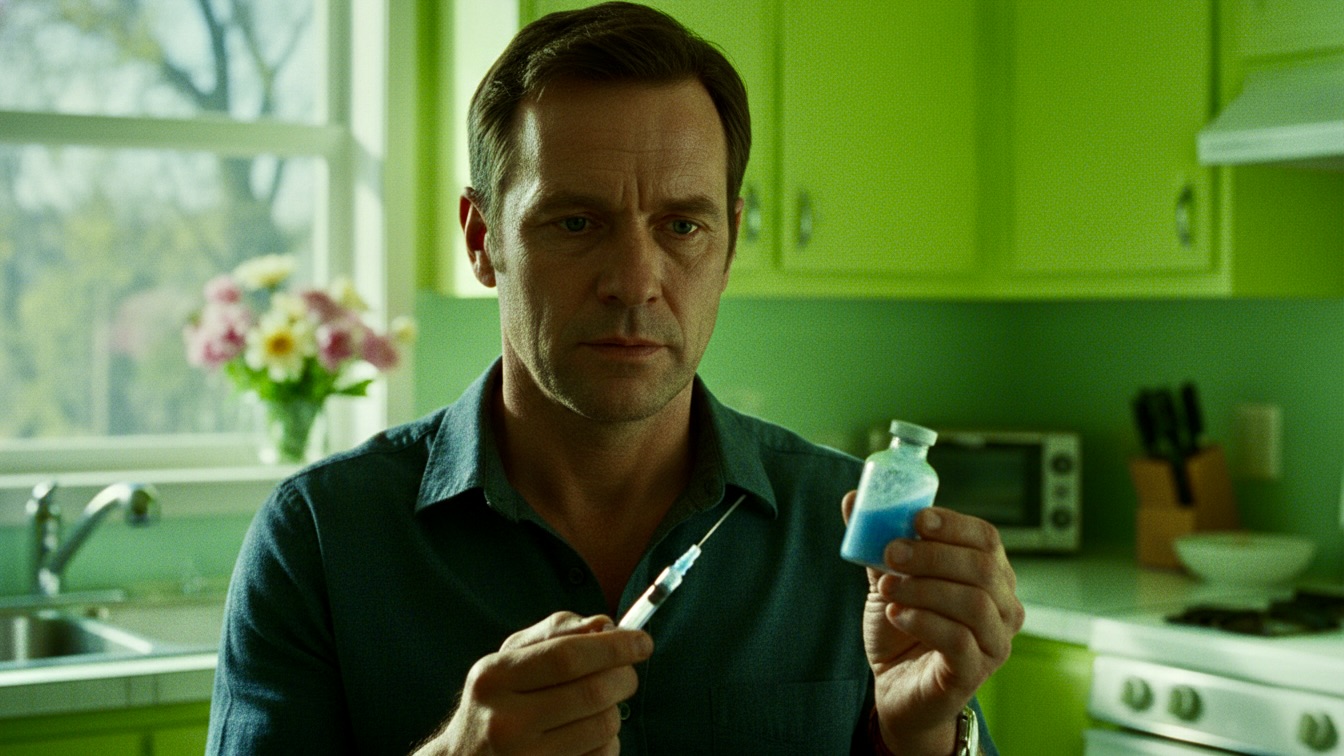
The story takes place in a dystopian neighborhood where the sun never sets and residents are governed by a rigid social credit system that demands constant, "peak" happiness. Stan, the protagonist, maintains a high score of 9.8 but is driven by the need to reach a perfect 10.0 to secure his son Toby’s future. When his neighbor, Mrs. Trent, suffers a psychological breakdown following the death of her cat, Stan intervenes not with comfort, but by surgically harvesting her "blue juice"—the concentrated cortisol of her grief. By draining her sadness into a vial, he restores her "aesthetic" and secures a valuable resource to boost his own family’s standing.
The narrative follows Stan’s family as they navigate the pressures of this artificial society, including a mandatory "Maypole Shredder" ceremony where they must publicly destroy remnants of the past. During this event, Stan’s wife, Martha, begins to crack under the strain of the eternal light, showing signs of a "leak" or emotional instability. After returning home, Stan is confronted by "scouts" who detect Martha’s falling score. He narrowly avoids her abduction by bribing the scouts with the high-grade sadness he harvested from Mrs. Trent. The chapter concludes with the revelation that Stan has already murdered a government inspector to protect his family, and he resolves to become a predator within the system, harvesting his neighbors' grief to ensure his family remains "peak."
The central theme of the story is the commodification of human emotion and the horror of "toxic positivity" taken to a literal, systemic extreme. In this world, happiness is not a state of being but a mandatory aesthetic and a measurable resource. The "Happiness Pipeline" suggests a capitalist structure where emotions are harvested, refined, and redistributed to maintain a facade of perfection. This turns human empathy into a liability and suffering into a currency, as seen when Stan views Mrs. Trent’s grief not as a moment for compassion, but as a "leak" to be plugged and a product to be seized.
Another prominent theme is the total loss of privacy and the subconscious through the symbol of the eternal sun. The sun, described as a "white plate" that never sets, represents the ultimate surveillance state where there is no "dark" place to hide one’s true feelings. This environment causes a psychological fracturing in the characters, as they are unable to experience the natural cycles of rest and reflection. The artificiality of the world—the polymer grass, silk roses, and neon-green soup—underscores the idea that when humanity is forced to be "perfect," it ceases to be real, leaving behind only a hollow, plastic imitation of life.
The story also explores the corruption of the paternal instinct within a totalitarian framework. Stan justifies his horrific actions—harvesting a neighbor’s soul and murdering an inspector—as necessary measures to protect his son, Toby. This highlights how oppressive systems turn individuals against one another by weaponizing their love for their families. Stan’s transition from a protective father to a potential "King" of the harvest shows how the desire for security can evolve into a predatory ambition when the only way to survive is to exploit the weaknesses of others.
Stan is a man who has fully assimilated the cold, transactional logic of his environment while maintaining a vestige of protective instinct. He functions as both a victim and an enforcer of the system, using his "stunner" and needle to perform emotional lobotomies on those around him. Psychologically, he exhibits a high degree of compartmentalization, viewing the death of a neighbor’s pet or the harvesting of her grief as mere "business." His primary motivation is the survival of his nuclear family, but this goal has twisted his moral compass until he views other human beings as nothing more than biological reservoirs of "blue juice."
As the narrative progresses, Stan’s internal state shifts from desperate maintenance to proactive predation. He is acutely aware of the "aesthetic" and the "Pipeline," showing a hyper-vigilance that is common in individuals living under constant surveillance. While he claims to love Martha and Toby, his "love" is expressed through control and the suppression of their authentic emotions. By the end of the chapter, he has embraced the role of a harvester, suggesting a descent into a messianic or tyrannical delusion where he believes he can dominate the system by being the most efficient exploiter of misery.
Martha represents the fragile human element that the system seeks to eradicate. She is the "leak" in Stan’s perfect life, struggling with a deep, existential depression triggered by the lack of darkness and the loss of the "Old Sad World." Her longing for the moon and her inability to maintain her "peak" score indicate a psyche that is rejecting the artificiality of her surroundings. She is a tragic figure, caught between the crushing expectations of the state and the ruthless protection of her husband, who is willing to "fix" her face by force if necessary.
Her psychological decline is evidenced by her "grey" skin and her fixation on the running water, a common sign of a mind seeking a rhythmic escape from an over-stimulating environment. Martha’s brief moment of authentic connection—the "real tear" she sheds—is the most dangerous thing she possesses. It is a sign of her remaining humanity, yet in this world, it is a biological failure that threatens her very existence. She is ultimately a passive participant in her own life, being led by Stan and the system toward a state of hollow, "perfect" non-existence.
Toby is a chilling portrait of a child being conditioned by a totalitarian regime. At only ten years old, he is already being taught to perform "Joy-Recitals" and to participate in the ritualistic destruction of history at the Maypole Shredder. His initial question about Barnaby the cat shows a lingering sense of empathy and curiosity, but these traits are quickly suppressed by Stan’s gaslighting. The transition Toby undergoes during the shredding ceremony—from hesitation to a "manic grin"—suggests the successful breaking of his natural emotional responses.
The "high, thin laugh" Toby emits after destroying the photo album is a sign of psychological trauma being masked as peak performance. He is learning that survival depends on the public performance of happiness, even when that happiness is clearly disconnected from reality. By the end of the story, Toby’s exhaustion and his silent compliance indicate a child who is becoming a "doll," a perfect product of the Pipeline. He represents the next generation of this dystopia, one that may eventually lose the ability to even recognize a "leak" when they see one.
The pacing of the story is relentless and claustrophobic, mirroring the "eternal spring" and the unmoving sun that define the setting. The narrative moves quickly from one unsettling event to the next—the cat’s death, the harvesting, the shredding, and the confrontation with the scouts—leaving the reader with the same sense of exhaustion the characters feel. This rapid succession of events emphasizes the pressure of the social credit system, where one must constantly be "doing" and "performing" to keep their score from dropping. The tone is clinical and detached, reflecting Stan’s own psychological state and the cold, plastic nature of his world.
Sensory details are used to create a profound sense of "uncanny valley" discomfort throughout the text. The author focuses on artificial textures and smells, such as "hot plastic," "silk roses," "neon-green soup," and "lemon and bleach." These descriptions contrast sharply with the visceral, organic descriptions of grief, such as the "wet, thin sound" of Mrs. Trent’s sobbing and the "thick, cloudy liquid" of the harvested cortisol. This sensory contrast reinforces the theme of a natural world being forcibly overwritten by a synthetic one, where even the "soft needles" of the grass are designed to mimic life without actually possessing it.
The narrative voice is a third-person limited perspective that stays close to Stan’s pragmatic, survivalist mindset. This choice allows the reader to see the horror of the world through the eyes of someone who has accepted its rules as absolute truth. The language is often sparse and direct, using short sentences to convey the tension and the lack of emotional depth allowed in the society. By using this voice, the author forces the reader to experience the world’s "aesthetic" as Stan does, making the occasional bursts of real emotion—like Martha’s tear or the "scream" of the shredding paper—feel all the more jarring and significant.


