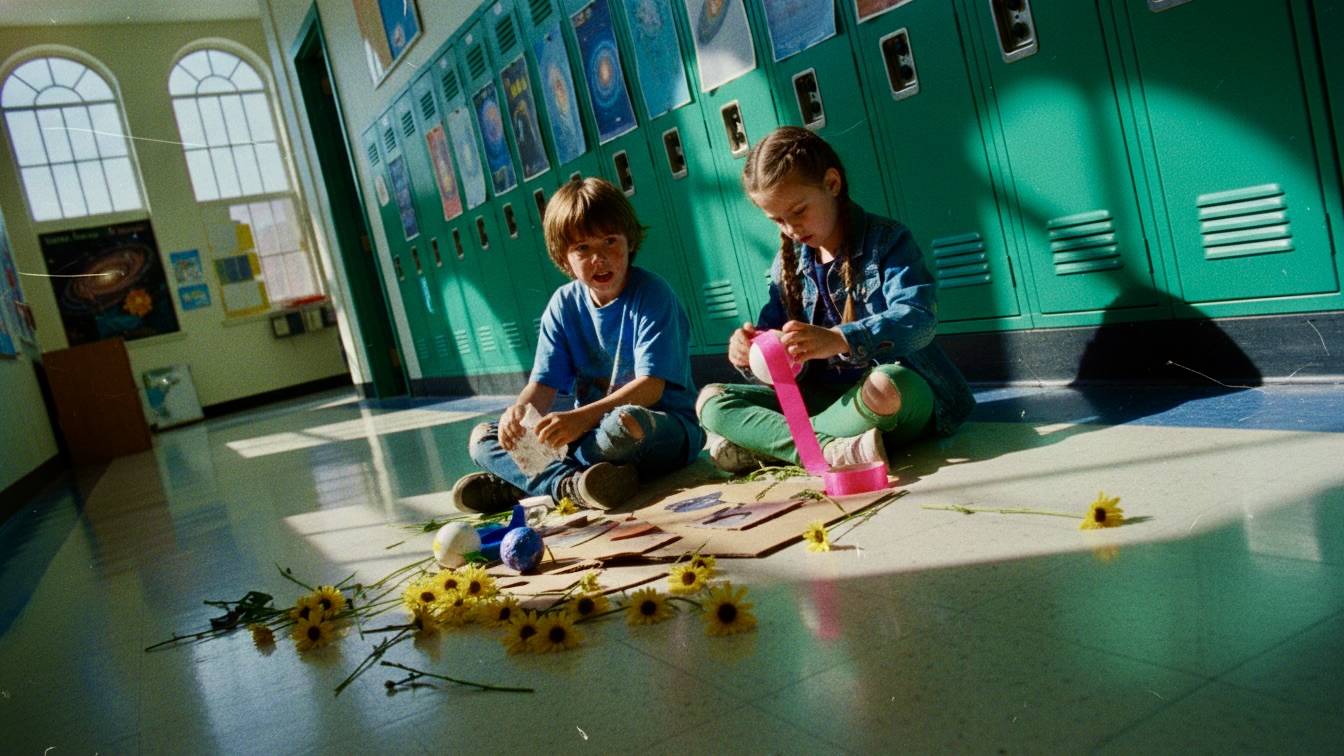
The story follows Toby, a student overwhelmed by the pressure of a looming science fair deadline. While rushing to the gymnasium with his fragile solar system project, his heightened anxiety manifests as a sensory distortion of his environment, leading him to collapse in the hallway. He is aided by a girl named Tanya, who helps him stabilize his project and his mental state with pragmatic, grounded support. After they repair the damaged model with neon tape, Toby manages to reach the gym just in time to present his work to his teacher. However, the chapter concludes with a jarring, surreal shift as the physical environment of the gym begins to dissolve, suggesting a reality far more unstable than simple school-day nerves.
The narrative explores the intersection of academic pressure and the fragility of human perception. Toby’s internal state suggests that when the weight of expectation becomes too great, the world ceases to be a reliable, objective space and instead becomes a projection of the subject’s own panic. The transformation of the hallway into a breathing, wiggling, and melting landscape serves as a metaphor for the way anxiety dismantles logic.
Furthermore, the story touches upon the theme of human connection as a stabilizing force in a chaotic world. Tanya serves as the anchor for Toby, representing the rational reality he is struggling to maintain. Her influence is not sentimental but practical; by providing the tape and demanding he regulate his breathing, she pulls him back from the brink of his psychological breakdown. The contrast between his frantic, internal sensory overload and her external, stoic composure emphasizes the importance of shared reality in overcoming personal crises.
The final twist introduces a darker, existential theme regarding the nature of the world itself. By having the gym floor turn transparent and the walls peel away, the author suggests that Toby’s earlier feelings of unreality were not merely symptoms of stress, but perhaps an intuitive awareness of a deeper, underlying instability in his environment. The story moves from a psychological drama about school-age anxiety to a speculative narrative about the precariousness of existence.
Toby is a young man defined by his intense perfectionism and his tendency toward internalizing stress. He views his project not as a simple school assignment, but as a high-stakes endeavor that validates his worth, hence his willingness to sacrifice sleep and basic needs to complete it. His internal world is vivid and volatile, prone to sensory hallucinations that reflect his lack of emotional regulation. When he fails, he immediately spiraling into feelings of inadequacy and helplessness, viewing himself as someone who is physically disintegrating.
His motivation is primarily driven by a fear of failure and the desire for external validation from authority figures like Mr. Harris. Throughout the chapter, he demonstrates a desperate need for a sense of control, which he initially tries to achieve through his project. Only through Tanya’s intervention does he learn that he must surrender his rigid expectations to survive the pressure of the moment. By the end of the chapter, his realization that he can accept a "bold" imperfection suggests a minor evolution in his character, though this growth is immediately challenged by the sudden shift in his physical reality.
Tanya appears as a grounded, pragmatic foil to Toby’s instability. She is characterized by her coolness and her ability to remain detached from the high-pressure environment of the school. Her actions, such as fixing the project with neon tape and offering direct, no-nonsense advice, indicate a person who values functionality over aesthetic perfection. She acts as a stabilizer for Toby, forcing him to confront the physical world rather than his own panic.
She displays a dry, modern wit that hints at a guarded emotional life, particularly in how she masks her kindness behind a joke about not wanting "Toby-bits" on her shoes. Her interactions with him suggest a level of maturity that exceeds his own. She is the one who provides the tools for recovery and the verbal instructions necessary to keep him moving. Her presence in the hallway, surrounded by the bright, chaotic energy of the flowers, makes her a beacon of clarity in Toby’s distorted vision.
The pacing of the story is intentionally frantic, mirroring Toby’s own state of mind. The early sections use short, staccato sentences to mimic his rapid heartbeat and scattered thoughts, effectively placing the reader inside his experience of the hallway. As the dialogue between Toby and Tanya takes over, the pace slows down, reflecting the gradual return of his composure. The author masterfully utilizes this shift to control the tension, moving from the chaotic "screeching" of his sneakers to the rhythmic, focused action of taping the model.
Sensory details are employed as a primary narrative device to establish the psychological tone. The author uses intense, primary colors—yellow, green, and neon pink—to create a sense of visual overstimulation. By describing the lockers as breathing and the floor as jelly, the prose blurs the line between metaphor and reality, forcing the reader to feel the same disorientation as the protagonist. This sensory-heavy approach makes the sudden, surreal ending feel earned, as the reader has already been primed to question the reliability of the physical world.
The narrative voice remains closely tethered to Toby’s perspective, which enhances the impact of his isolation and subsequent relief. The tone is sympathetic yet honest, acknowledging the absurdity of his behavior without mocking it. By maintaining this tight focus, the author ensures that when the final, inexplicable event occurs in the gym, the reader experiences the same sense of shock and violation that Toby feels, cementing the transition from a grounded school drama to something much more mysterious.


