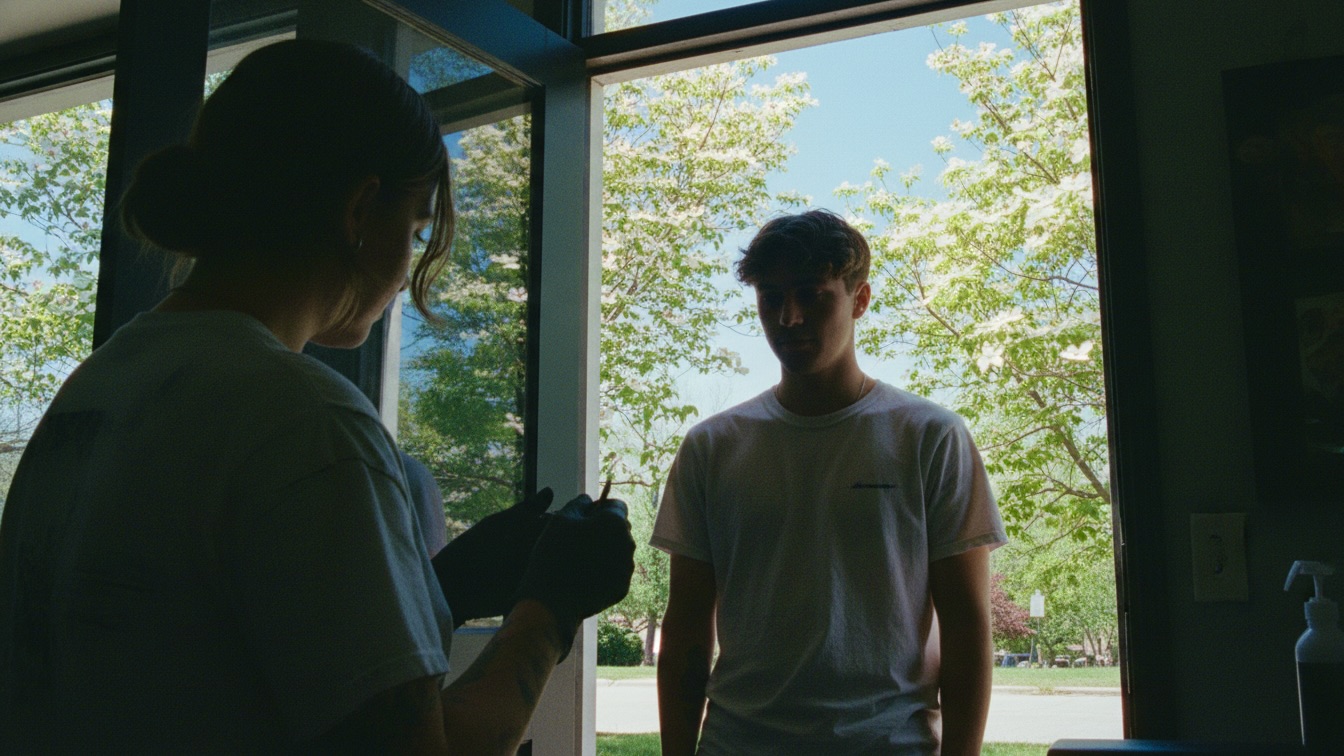
The story follows Cass, a tattoo apprentice struggling with the emotional aftermath of a recent breakup. She spends her days in the sterile, claustrophobic environment of a tattoo shop, obsessing over her ex-partner’s social media updates and feeling physically and mentally drained. Her routine is interrupted by the arrival of Shawn, a client seeking a complex cover-up for severe keloid scars resulting from a difficult recovery after top surgery.
As Cass and Shawn collaborate on the design, they find common ground in their shared experiences of "phantom pain." While Shawn’s pain is neurological and tied to damaged tissue, Cass realizes her own suffering is a psychological echo of a relationship that no longer exists. Through the grueling, multi-hour tattooing process, both characters undergo a form of ritualistic reclamation. The chapter concludes with the completion of the tattoo and a tentative invitation for a date, symbolizing a breakthrough for Cass as she finally steps out of her emotional "cave."
The central theme of the story is the reclamation of the self following trauma, whether that trauma is physical or emotional. This is most poignantly illustrated through the metaphor of the "bramble" tattoo. Instead of attempting to hide the jagged, necrotic scars on Shawn’s chest with a standard "coward’s cover-up," Cass chooses to integrate the scars into a botanical design. This suggests that healing does not require the erasure of the past, but rather the artistic and intentional restructuring of its remnants into something new and resilient.
Another significant theme is the concept of "phantom pain" as a bridge between the somatic and the psychological. Shawn experiences literal nerve endings firing into empty space, while Cass experiences the emotional equivalent by reaching for a partner who is no longer there. The narrative posits that both forms of pain are equally disruptive and require a "real" stimulus to override the "fake" signals. By the end of the session, the sharp, localized pain of the tattoo needle serves as a grounding force, replacing the haunting echoes of the past with a tangible, present reality.
The contrast between the industrial, sterile environment of the tattoo shop and the "aggressive" arrival of spring serves as a backdrop for the characters' internal shifts. Cass initially views the shop as a protective cave designed to keep the world out, reflecting her desire to hide from her grief. However, the "sudden oxygen" of the spring air and the organic nature of the tattoo design eventually force her to reconnect with the outside world. This transition from the mechanical and chemical to the organic and floral mirrors the characters' journey toward emotional health.
Cass is depicted as a woman on the verge of burnout, her internal state manifesting in her cracked, dry hands and the dark circles under her eyes. She is trapped in a cycle of "doomscrolling," which keeps her tethered to a dead relationship and prevents her from moving forward. Her environment—the black-painted walls and the chemical smells of the shop—reflects her self-imposed isolation. She views her work as an apprentice with a mix of professional pride and defensive insecurity, using her technical skills as a shield against her vulnerability.
Her encounter with Shawn acts as a catalyst for her psychological evolution. As she maps the ridges of his scars, she is forced to confront the "topography" of her own emotional wounds. The act of tattooing Shawn requires her to move from a state of passive wallowing into a state of "flow," where her focus is entirely on the present moment. By the end of the chapter, she has reclaimed her agency, choosing to delete her social media apps and accept a social invitation, signaling a move from the "unscarred version" of herself to a more integrated, resilient woman.
Shawn is a man who embodies pragmatic resilience in the face of physical adversity. Despite the "nightmare" of his surgical complications and the resulting keloid scars, he maintains a posture that is relaxed yet guarded. He does not seek pity for his condition; instead, he seeks a way to transform his "ruins" into something he can live with. His willingness to expose his chest, which he describes as looking like a "shark took a bite" out of it, demonstrates a significant level of courage and self-acceptance.
He serves as a mirror and a mentor for Cass, providing her with the terminology she needs to understand her own grief. By introducing the concept of the "phantom limb phase," he helps her validate her emotional pain without letting it consume her. His calm demeanor during the grueling tattoo process shows his strength, as he chooses to focus on the "real" pain of the needle over the "fake" burning of his fried nerves. Ultimately, he is the one who leads Cass out of her "cave," offering her a path toward a new connection.
The narrative voice is grounded and gritty, utilizing a high degree of sensory detail to immerse the reader in the world of professional tattooing. The author masterfully contrasts the harsh, chemical smells of Madacide and green soap with the delicate scents of exhaust and cherry blossoms. This sensory interplay reinforces the tension between the clinical nature of the work and the organic, emotional transformation occurring between the characters. The descriptions of the tattooing process itself are visceral and technically accurate, lending the story a sense of realism and weight.
The pacing of the chapter follows the rhythm of a tattoo session, beginning with the slow, methodical preparation and building toward the intense, focused energy of the actual work. The dialogue is sharp and economical, reflecting the professional yet intimate atmosphere of a tattoo booth. Short, punchy sentences are used to convey Cass’s internal distress, while longer, more fluid descriptions are reserved for the art and the physical sensations of the tattoo. This stylistic choice effectively mirrors the transition from a fragmented internal state to a more cohesive, creative flow.
The use of color and light is particularly effective in establishing the tone. The "aggressive" green of spring and the "glaring" light through the front windows are initially presented as intrusions into Cass’s dark, controlled world. As the story progresses, however, these elements are integrated into the narrative, much like the scars are integrated into the tattoo. By the end of the chapter, the light is no longer something to squint against, but a welcome sign of "oxygen" and a new beginning, marking a successful tonal shift from claustrophobia to liberation.


