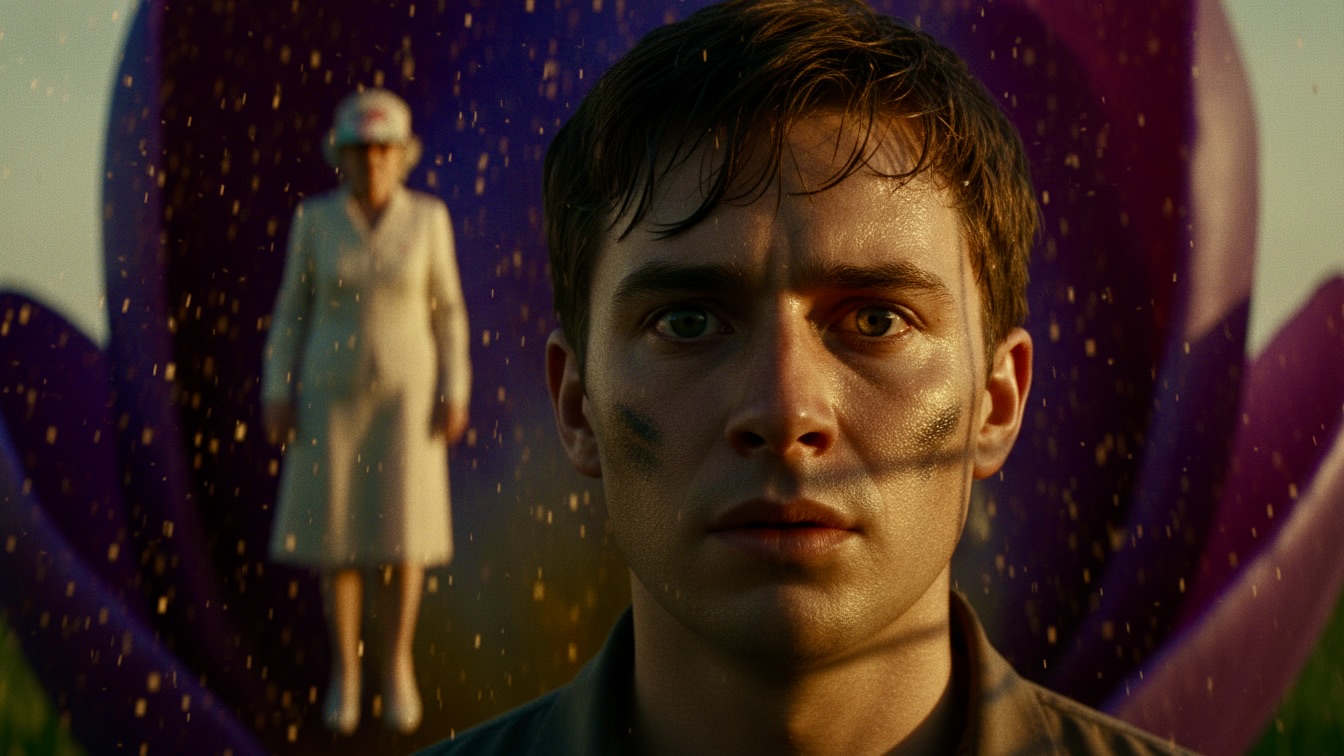
Gerry is a weary technician in Oakhaven, a hyper-controlled utopia where even the birds hum at a headache-inducing frequency. His job maintaining the floral-themed ziplines for the elderly residents is a source of constant tension, symbolized by his perpetually clenched jaw and grease-stained hands. The routine is shattered when he discovers Mrs. Chatters, an eighty-five-year-old resident, floating several feet above her transport basket. She attributes her weightlessness to the "Miracle Tulip" in the town square, which Gerry soon discovers is actually masking a neuro-reactive gas leak from an ancient underground pocket.
When Councilman Barple announces plans to bulldoze the garden to build a parking hub, Gerry realizes the seniors will lose their newfound sense of vitality and freedom. Instead of following orders, he orchestrates a daring "demonstration" at the zipline station. He bypasses safety protocols to help the seniors launch themselves into the air, where the gas allows them to drift like dandelion seeds. In a final act of rebellion, Gerry destroys the zipline mechanism and joins the residents in the sky. He leaves behind his mechanical burdens and the sterile world of Oakhaven to embrace a literal and metaphorical state of transcendence.
The narrative primarily explores the conflict between artificial order and organic liberation. Oakhaven is presented as a "perfect" environment, yet this perfection is described as suffocating and sterile. The town’s reliance on self-driving pods, virtual simulations, and strict safety protocols suggests a society that has traded genuine human experience for a controlled, risk-averse existence. The "Miracle Tulip" serves as a powerful symbol of this deception, as its beauty is merely a facade for a chemical anomaly that the authorities wish to suppress rather than understand.
Another central theme is the reclamation of agency and dignity in the face of aging. The seniors in Oakhaven are treated by the council as liabilities or "husks" to be managed and eventually moved into virtual realities. Their physical ascent into the air represents a psychological break from the gravity of societal expectations and the limitations of their aging bodies. By floating, they are no longer dependent on the infrastructure of the town, turning a "glitch" into a "feature" of their final years.
The story also examines the nature of rebellion through the lens of physics and chemistry. Gravity functions as a metaphor for the bureaucratic and social weights that keep the citizens of Oakhaven grounded and compliant. Gerry’s decision to "hold the line" and then eventually let go represents a transition from a life of maintenance to a life of movement. The destruction of the garden and the subsequent explosion of violet dust signify the end of the town's static perfection and the beginning of an unpredictable, airborne future.
Gerry is a man defined by his internal and external friction. His permanent grease stains and locked jaw serve as physical manifestations of his psychological entrapment within the rigid structures of Oakhaven. He is a "rule-follower" not out of loyalty, but out of a weary survival instinct, fearing the loss of his tech license while simultaneously loathing the "utopia" he helps maintain. His perspective is initially cynical, viewing the miracle of the tulip as a liability rather than a wonder, which highlights his deep-seated distrust of the environment around him.
His transformation is triggered by the joy he witnesses in Mrs. Chatters and the cold pragmatism of Councilman Barple. As he realizes that the authorities intend to seal the vent and return the seniors to their "chairs," his motivation shifts from self-preservation to a desire for collective liberation. The act of unhooking the main carabiner is his ultimate psychological release. By the end of the chapter, the flaking of the grease from his hands symbolizes his shedding of his former identity as a cog in the town's machine, finally allowing him to relax his jaw and breathe.
Mrs. Chatters represents the spirit of defiance and the refusal to be diminished by age. She is the first to embrace the "glitch" of weightlessness, viewing her condition with a playful levity that contrasts sharply with Gerry’s anxiety. Her visor with a built-in heads-up display suggests she is tech-savvy, yet she chooses to abandon the safety of her "lily" basket for the unknown potential of the air. She acts as a mentor to Gerry, encouraging him to stop being a "hero" and instead "be a cloud."
Councilman Barple is the personification of the sterile, oppressive bureaucracy that governs Oakhaven. He is obsessed with liability, air filters, and "Mark-IV shuttles," viewing the residents as data points rather than people. His blindingly white suit reflects his desire for a world without "stains" or irregularities. Barple’s horror at the sight of the floating seniors stems from his inability to control them; to him, defying the laws of physics is the ultimate act of insubordination. He represents the "weight" that Gerry and the seniors eventually leave behind.
The author utilizes a stark contrast in sensory details to emphasize the divide between the mechanical and the ethereal. Early descriptions focus on "grease," "metallic snaps," and "low-frequency rumbles," creating a grounded, industrial atmosphere that mirrors Gerry’s internal state. These are juxtaposed with the "violet light," "golden mist," and "ozone and sugar" associated with the tulip and the act of floating. This sensory shift effectively mirrors the characters' transition from the heavy, predictable world of the ground to the light, unpredictable world of the sky.
Pacing is expertly managed to reflect the escalating tension of the plot. The narrative begins with a slow, rhythmic quality, echoing the "too quiet" nature of the town and Gerry’s repetitive tasks. However, once Gerry discovers the truth about the gas and confronts Barple, the pace quickens significantly. The sentences become shorter and more punchy during the "demonstration" at the zipline station, capturing the frantic energy of the escape and the sudden, explosive climax of the tulip’s destruction.
The narrative voice undergoes a significant tonal shift from cynicism to transcendence. Gerry’s internal monologue is initially filled with bitterness and a sense of being burdened by his responsibilities. As he begins to experience the "lightness" himself, the prose becomes more lyrical and expansive. The final paragraphs, describing the town as a "toy set" and the air as "thick water," illustrate his new perspective. This stylistic evolution ensures that the reader feels Gerry’s liberation as a visceral experience, moving from the "permanent stain" of the beginning to the "thin, cold, and perfect" air of the conclusion.


