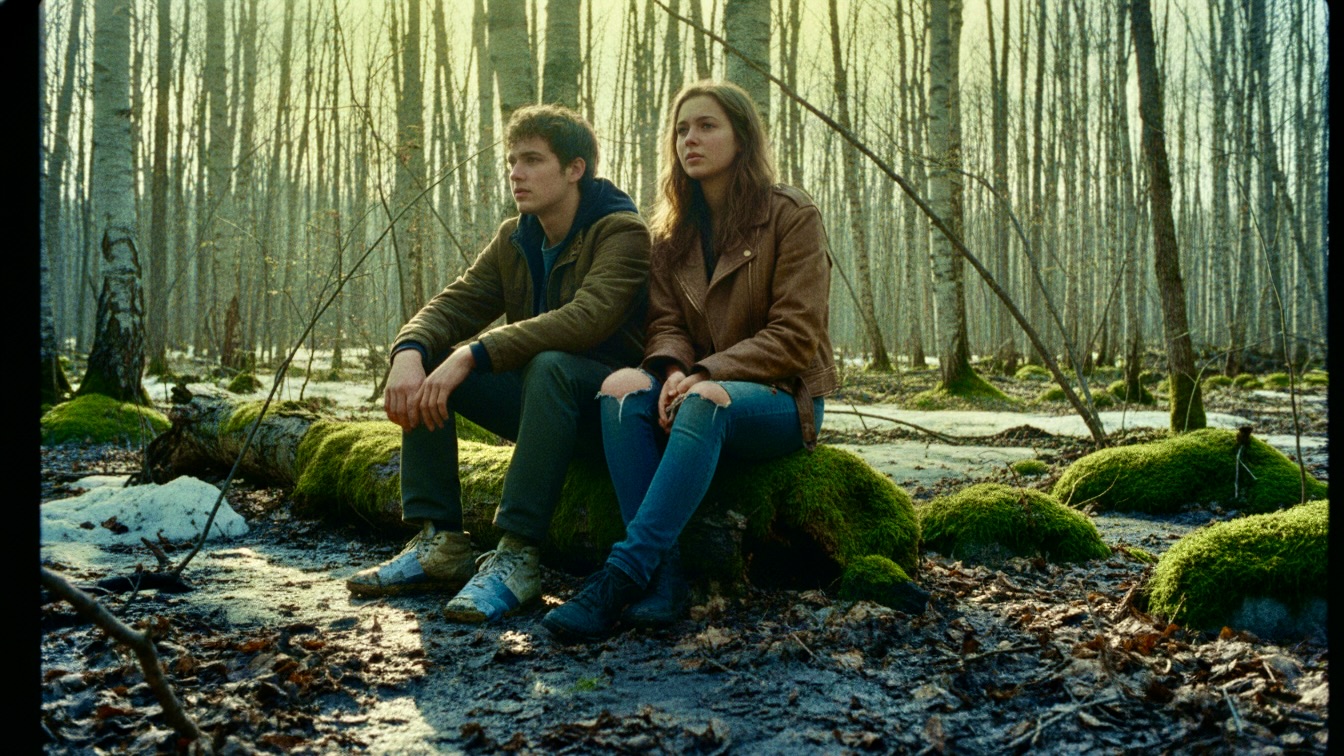
The story follows Peter, a college student who constructs a pair of oversized cardboard Yeti feet in a desperate attempt to impress his crush, Wendy. He leads her into the muddy New England woods behind their campus gymnasium, pretending to track a mysterious creature he claims to have seen the night before. As they venture deeper into the wilderness, Peter’s amateurish ruse begins to fall apart both physically and logically. The cardboard disintegrates in the spring slush, and the two find themselves genuinely lost as the sun begins to set.
The physical disorientation leads to a moment of psychological honesty between the two characters. Wendy reveals that she knew the tracks were a hoax from the beginning, having seen Peter’s "Yeti Fur" kit packaging in the recycling bin days earlier. Rather than being angry, she admits that she went along with the charade as a form of escapism from the anxieties of graduation and an uncertain future. They share a vulnerable conversation and a first kiss, finding a brief moment of authentic connection amidst the lies. However, the story ends on an unsettling note as an inhuman howl echoes from the woods, suggesting that a real mystery may have been watching them all along.
The primary theme explored in this narrative is the conflict between performance and authenticity in human relationships. Peter believes that his true self is insufficient to garner Wendy’s interest, leading him to construct a literal and figurative monster to bridge the gap. This performance is mirrored by Wendy’s own mask of irony and detachment. Both characters are performing versions of themselves that they believe are socially acceptable or protective, yet it is only when the performance fails—when the cardboard feet dissolve—that they achieve a meaningful connection.
Another significant theme is the use of the supernatural as a psychological coping mechanism for existential dread. Wendy explicitly states that she prefers the idea of cryptids like Mothman over the "burning dumpster fire" of the real world and the pressures of adulthood. For these characters, the unknown of the woods is less frightening than the known requirements of LinkedIn profiles and job applications. The cryptid represents a world of possibility and wonder that stands in stark contrast to the sterile, demanding expectations of their impending post-graduate lives.
The setting itself serves as a thematic bridge between childhood and maturity. The transition from the "manicured lawn" of the campus to the "graveyard of dead leaves" in the woods reflects the messy, unpoetic transition into adulthood. Spring is not depicted as a season of beautiful rebirth, but as a cold, viscous, and confusing period of melting snow and mud. This environment mirrors the internal state of the characters, who are stuck in a liminal space where they are no longer children but are not yet ready to be functioning adults.
Peter is a character driven by profound social anxiety and a perceived lack of agency in his own life. He views himself through a lens of inadequacy, labeling himself as a "sit in the library and pretend to read" guy rather than someone of substance. His decision to create the fake Yeti tracks is a manifestation of his desire to be the protagonist of a story he feels he is otherwise failing. He is so preoccupied with the mechanics of his deception that he misses the obvious signs of Wendy’s intelligence and her awareness of his actions.
Psychologically, Peter suffers from a fear of being "mid," a contemporary term for being mediocre or uninteresting. He projects this fear onto his environment, creating a "relict hominid" to give his life and his relationship with Wendy a sense of weight and importance. His internal monologue reveals a man who is terrified of the "after," seeing the real world as a foreign language he cannot speak. His willingness to endure the physical discomfort of wet socks and freezing mud suggests a high level of devotion, even if that devotion is initially channeled through a dishonest medium.
Wendy presents a classic defensive shell of irony and cynicism, common in individuals facing high levels of situational stress. She uses her "for the plot" philosophy as a shield, allowing her to engage with the world without having to be vulnerable. Her oversized leather jacket and thrifted clothes are part of a carefully curated aesthetic that signals her detachment from mainstream expectations. However, beneath this sharp-tongued exterior, she is deeply observant and emotionally intelligent, as evidenced by her immediate recognition of Peter’s hoax.
Her psychological motivation for following Peter into the woods is not a belief in the supernatural, but a desire for a shared delusion that feels better than reality. She is haunted by the prospect of failure and the stagnation of living in her parents' basement. By choosing to play along with Peter’s lie, she is exercising a form of radical empathy. She recognizes his effort to connect with her and rewards it, eventually dropping her sarcastic guard to admit her own fears. Her kiss is an act of reclaiming the present moment from the looming shadow of the future.
The narrative voice is characterized by a blend of self-deprecating humor and vivid, sensory-heavy prose. The author uses highly specific imagery, such as "double-walled corrugated cardboard" and "blue raspberry" vape clouds, to ground the story in a recognizable, modern reality. This groundedness makes the more poetic descriptions of the woods—the "graveyard of dead leaves" and the "flat light"—feel more impactful. The contrast between the mundane campus life and the encroaching wildness of the preserve is mirrored in the shifting tone of the dialogue.
The pacing of the story begins with a frantic, comedic energy as Peter struggles with his cardboard feet, but it slows down significantly once the characters are lost. This deceleration allows for the emotional core of the story to breathe, moving the focus from the external plot of the hoax to the internal landscape of the characters' fears. The transition from sarcasm to sincerity is handled with subtlety, using the physical environment of the moss-covered log to anchor the shift in their relationship.
The ending provides a sharp stylistic pivot into the genre of horror or the uncanny. The introduction of the "long, low howl" serves as a narrative hook that recontextualizes everything that came before. Throughout the story, the author uses the "fake" nature of the Yeti to highlight the characters' humanity, but the final sound suggests that the world is larger and more dangerous than their personal anxieties. This final sensory detail leaves the reader in a state of suspense, mirroring the characters' own uncertain journey toward the "lights" of their future.


