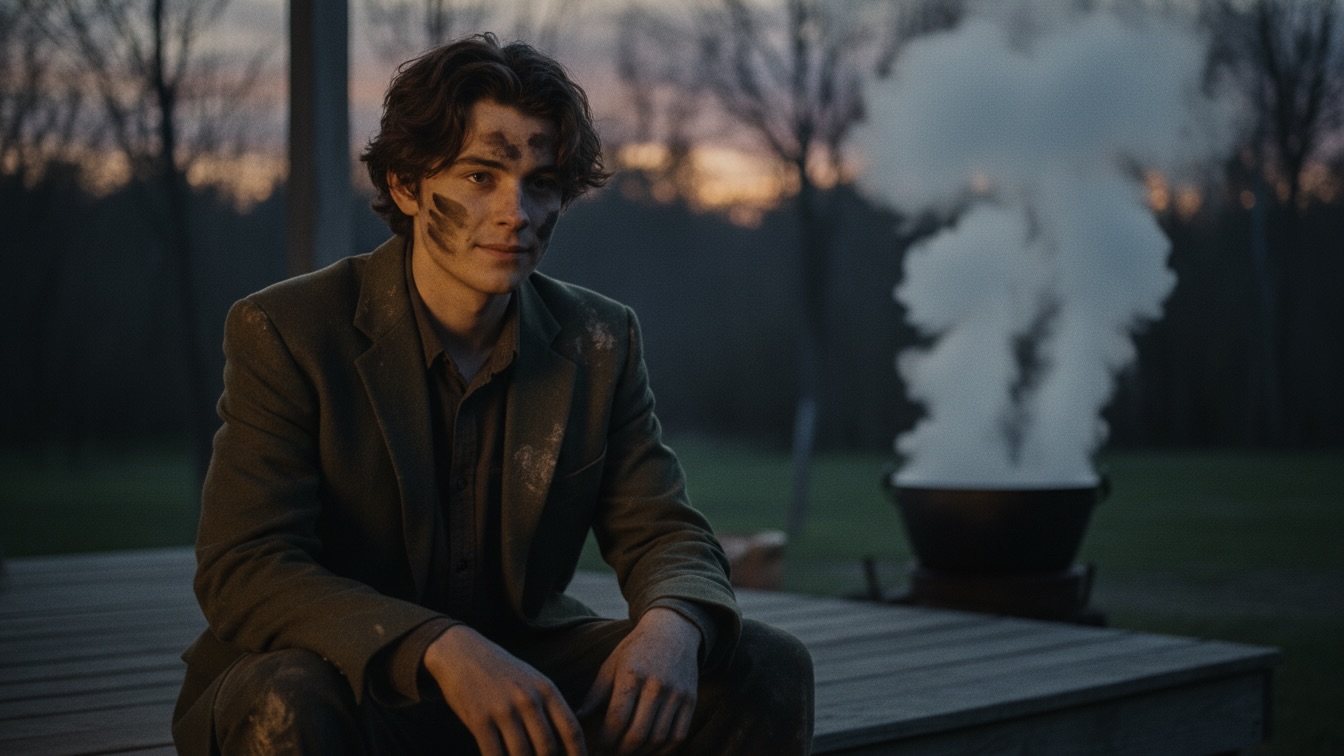
Toby, a teenage influencer known for his "Thoughtfully Alone" persona, arrives at his grandfather Simon’s remote cabin for a planned "Mental Health Retreat" narrative. His primary concern is not his well-being but the loss of cellular service, which threatens a 412-day Snapchat streak and his digital standing. While his grandfather calmly prepares to harvest maple sap, Toby remains obsessed with his phone, eventually attempting to stage a "raw" and "vulnerable" photo of himself in the woods. This performative act backfires when he slips and falls into freezing mud, ruining his designer clothing and exposing the hollow nature of his online brand.
Following the fall, Simon challenges Toby’s superficial understanding of loneliness, labeling his behavior as merely performative rather than truly solitary. Instead of offering pity, Simon invites Toby to participate in the grueling, rhythmic work of tapping the maple trees. As Toby engages in the physical labor, his focus shifts from his dying phone to the precise, slow movements required by the task. By the time the sun sets and his phone finally loses power, Toby finds himself no longer panicked by the silence. He sits with his grandfather by a boiling vat of sap, experiencing a genuine sense of presence and relief that his digital facade has finally crumbled.
One of the central themes explored in this chapter is the conflict between digital performance and authentic experience. Toby views his life through the lens of a "narrative arc," where even his mental health is a product to be marketed to an audience. His anxiety over a dying streak highlights how the digital world commodifies time, turning a personal connection into a chore governed by an algorithm. In this environment, an event only has value if it is documented and shared, leading Toby to prioritize the "shot" over his actual surroundings.
In contrast, Simon represents the theme of natural rhythm and presence. He operates on the "clock" of the running sap, a biological process that cannot be rushed, curated, or paused for engagement. This thematic clash emphasizes how the modern obsession with being seen often prevents individuals from actually being. Toby’s "vulnerability" is a costume he puts on for the camera, whereas the mud and the cold are undeniable, unmarketable realities that demand his full attention.
The story also delves into the concept of loneliness versus solitude. Toby believes he is an expert in isolation, yet he is terrified of being truly alone without a digital audience to validate his state. Simon’s critique clarifies that true loneliness is a heavy, internal burden rather than a visual aesthetic. The transition from the "vacuum" in Toby's stomach to the "relief" of the dead phone suggests that authentic solitude is only possible when the spectator is removed. By the end of the chapter, Toby begins to understand that the "essence" of life, much like the syrup, is what remains after the superficial elements have been boiled away.
Toby is a young man deeply entrenched in influencer culture, suffering from a fractured sense of self that is tied entirely to his digital metrics. He perceives his surroundings not as a physical reality, but as a backdrop for his personal brand. This psychological dependency on external validation has left him in a state of constant hyper-vigilance, where his thumbs twitch in the absence of a screen. He is a victim of the "algorithm," viewing his manager as a taskmaster and his life as a series of content pieces to be managed.
His internal conflict arises from the tension between his curated "Thoughtfully Alone" persona and the genuine emptiness he feels when his connection to the internet is severed. When he falls in the mud, his immediate concern is the "brand" rather than his physical well-being, showing a profound dissociation from his own body. He is so focused on how his life looks to others that he has forgotten how it feels to inhabit his own skin. The mud serves as a literal and metaphorical grounding agent, forcing him to reckon with a reality that does not care about his status.
By the end of the chapter, Toby undergoes a subtle but significant shift. The physical labor of tapping trees forces him back into his body, replacing the digital "vacuum" with a tangible, honest exhaustion. He moves from performative speech intended for an audience to a lower, more grounded voice that seeks instruction rather than attention. The death of his phone acts as a symbolic liberation, allowing him to experience the world without the burden of framing it for others. He finally accepts the "weight" of the silence, finding a peace that his digital life could never provide.
Simon serves as the stoic foil to Toby’s frantic modernity, embodying a rugged connection to the earth that is entirely devoid of artifice. He is a man of few words, choosing to communicate through action and the rhythmic labor of the seasons. His rejection of Toby's digital concerns is not born of ignorance, but of a deep understanding of what truly sustains a person. He views the world through the lens of utility and survival rather than aesthetics or social standing.
He acts as a psychological mirror for Toby, reflecting the young man's shallowness back at him without the cushioning of pity. Simon’s refusal to help Toby up after his fall is a calculated act of discipline, forcing the boy to confront the "dirt and water" of reality on his own. He values precision and respect for nature, as seen in his instructions on how to tap the trees without causing them unnecessary suffering. For Simon, the tree is a living entity to be respected, not a prop for a photograph.
Despite his gruff exterior, Simon provides the grounding influence Toby desperately needs. He offers the "essence" of the woods in a tin mug, a simple gesture that contrasts with the complex, expensive lifestyle Toby usually leads. Simon’s presence suggests a path toward healing that involves silence, manual labor, and an acceptance of the slow, unmonetized passage of time. He does not seek to change Toby through lectures, but through the shared experience of the work, allowing the boy to find his own way back to reality.
The narrative voice utilizes a sharp, satirical tone to highlight the absurdity of Toby’s perspective, particularly through his use of modern slang and marketing jargon. Phrases like "aggressively non-existent" and "vibe is actually cooked" create a jarring contrast against the ancient, timeless setting of the woods. This stylistic choice effectively illustrates the disconnect between Toby’s internal world and the physical reality he inhabits. The author mocks the language of the digital age by placing it in a context where it has no power or meaning.
Sensory details are employed to ground the reader in the visceral experience of the cabin and the forest. The author uses evocative descriptions such as the "wet dog’s funeral" smell of the fireplace and the "tink, tink, tink" of the metal spouts. These sounds and smells serve as a counterpoint to the "black glass" of the phone, which offers only a reflection and no true sensory depth. The mud is described as an "invasive species," highlighting how Toby views nature as something hostile rather than foundational.
The pacing of the chapter mirrors the transition from digital speed to natural slowness. The beginning is frantic, filled with Toby’s rapid-fire thoughts about streaks, managers, and battery percentages. As he begins to work with Simon, the prose slows down, focusing on the "long, slow promise" of the sap hitting the bucket. This shift in rhythm allows the reader to feel the same sense of relief and grounding that Toby eventually discovers. The final image of the "clenched fists" of the buds suggests a quiet, burgeoning hope that matches the character's internal state.


