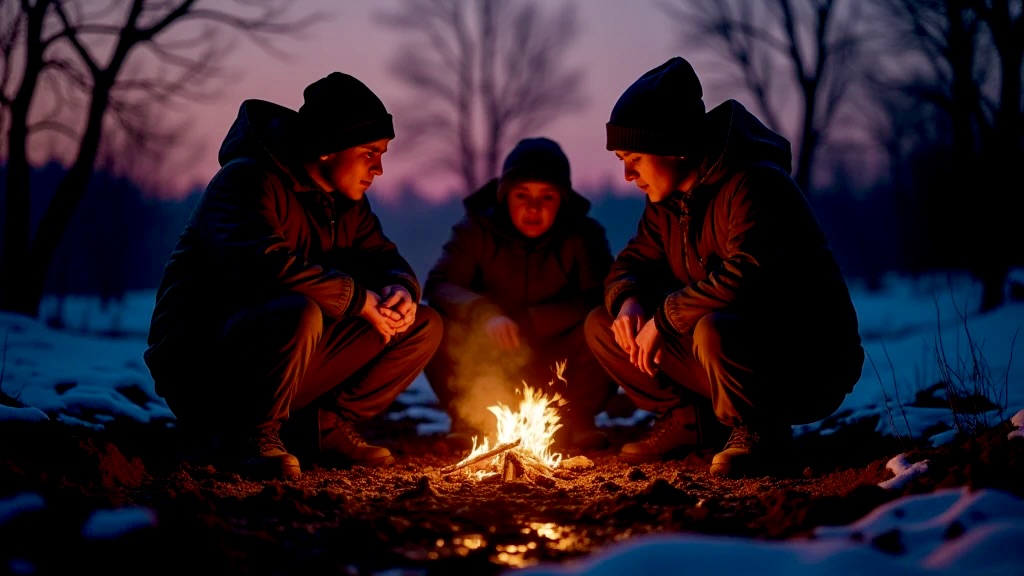
The story follows three friends—Steve, Sam, and Nancy—who embark on a camping trip intended to serve as a digital detox. Their plan quickly unravels when Steve discovers that the fuel can for their stove is empty, leaving them unable to cook or boil water in the harsh, late-April wilderness. As the temperature drops and night falls, the group struggles to maintain a fire and finds themselves shivering in a damp, aging prospector tent. The physical discomfort of the cold is compounded by a mounting, irrational fear when they hear mysterious sounds outside during the night. By morning, the ordeal leaves them shaken and desperate to return to the comfort of their vehicle and the digital world, ultimately questioning their own ability to survive outside of modern infrastructure.
The central theme of the narrative is the fragility of human comfort in the face of an indifferent natural world. The characters attempt to impose a structure of "detox" upon the wilderness, yet the environment rejects their presence, highlighting how deeply dependent they are on the very technologies they sought to abandon. The empty fuel can serves as a potent symbol of this reliance, acting as the catalyst that strips away their illusion of self-sufficiency. Without the ability to manipulate their environment through heat and light, they are reduced to a primal state of vulnerability that they are ill-equipped to handle.
Another significant theme is the psychological tension between curated digital existence and the raw reality of physical survival. While the characters equate their digital lives with safety and normalcy, the story suggests that this comfort is merely an elaborate distraction from the inherent instability of life. The "grey weight" of the season reflects the internal emptiness the characters feel when their external stimulation is removed. By the end of the chapter, the return to their devices indicates that they have not necessarily grown from the experience, but rather have retreated into a familiar, artificial security to escape the existential dread sparked by the wilderness.
Steve occupies the role of the reluctant leader, carrying the weight of the group’s failure on his shoulders. He is defined by his desire to be competent, yet he is constantly undermined by his own negligence, such as forgetting to check the fuel or the flashlight batteries. His internal monologue reveals a man who is beginning to realize that his perceived autonomy is a fabrication. He suffers from a profound sense of inadequacy, feeling the pressure to remain stoic while his own fear threatens to consume him. By the conclusion, Steve is the only character who retains a lingering awareness of the "honest" cold, suggesting he has been more deeply impacted by the ordeal than his companions.
Sam represents the psychological addiction to digital validation, manifesting his anxiety through the repetitive, twitchy movements of his thumb. He views the woods not as a place of beauty, but as a hostile void that lacks the entertainment and information he requires to feel grounded. His pessimism acts as a defense mechanism against the helplessness he feels in the tent. Sam is the most vocal about his desire to return to the grid, as his identity is inextricably linked to the constant stream of content that confirms his place in the modern world.
Nancy serves as the catalyst for the journey, driven by a manic desire to "reset" her dopamine receptors. Her initial enthusiasm quickly curdles into a fragile state of despair when she realizes that her superficial preparation—such as her inadequate clothing—cannot protect her from the elements. She represents the group's collective regression into a child-like state of dependency. Her dependence on Steve to provide answers and safety highlights her inability to process the transition from a world of total control to a world governed by the unpredictable realities of nature.
The pacing of the story is deliberate and claustrophobic, mirroring the characters' descent into the dark of the tent. The author utilizes a slow, rhythmic progression that emphasizes the passage of time during a night that seems to last forever. By focusing on mundane details, such as the smell of wet laundry or the sound of a zipper, the narrative grounds the reader in the suffocating physical reality of the situation. This sensory focus heightens the tension, making every minute sound—like a snapping branch—feel like a significant threat.
The tone is one of creeping existential dread, balanced by a cynical, modern detachment. The author employs a bleak, descriptive style that treats the wilderness as an uncaring, skeletal entity, which contrasts sharply with the characters' colloquial, modern dialogue. This juxtaposition highlights the gap between the characters' digital-age vocabulary and the ancient, silent environment they are attempting to navigate. The narrative voice remains tightly tethered to Steve’s perspective, allowing the reader to experience his growing disillusionment and the haunting realization that the safety of the city is merely a thin, temporary veneer.


