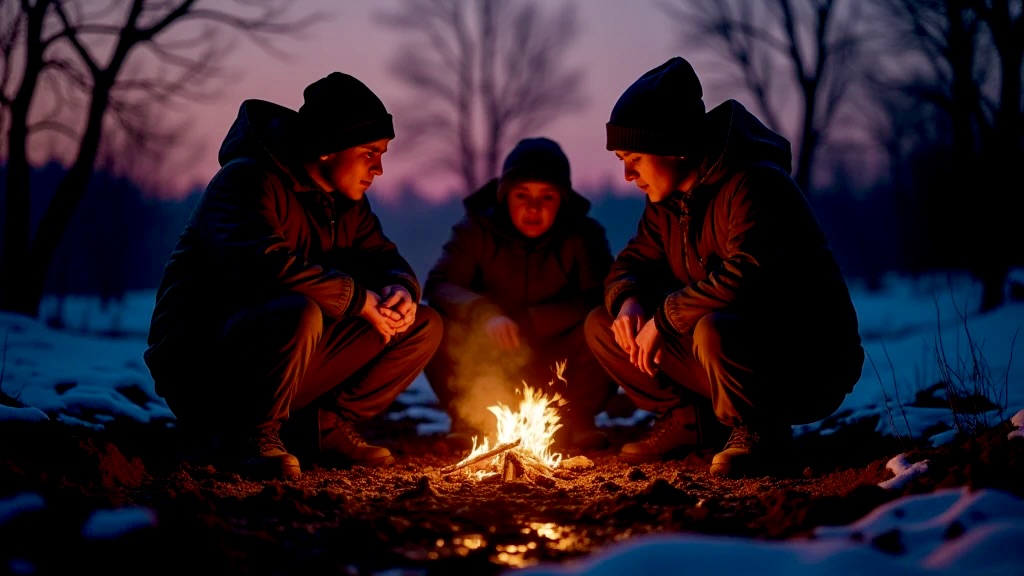
Three friends face the damp reality of a spring camping trip when their stove runs dry at dusk.
Steve shook the red metal can. It was light. Too light. The liquid inside didn't slosh; it just kind of vibrated against the walls of the container. He clicked the striker on the Coleman stove again. A spark jumped, bright and useless. Nothing caught. The smell of cold metal and old grease hung in the air. It was late April. The ground was still half-frozen, a slurry of mud and dead pine needles that clung to everything. They were three miles into the Basin, and the sun was already dropping behind the jagged line of the ridge. The light was turning that bruised shade of purple that meant the temperature was about to tank.
Sam was sitting on a downed log, staring at his phone. The screen was black. He kept tapping it anyway, a reflex he couldn't kill. His thumb moved in a rhythmic, twitchy arc. Swipe. Tap. Nothing. The glass was cracked in the upper right corner, a tiny web of fractures that caught the dying light. He looked like he was mourning a dead relative. The silence of the woods was too loud for him. It wasn't the kind of silence you find in a room. It was the silence of a place that didn't care if you were there or not. It was heavy. It felt like a physical weight on his shoulders.
“It’s dead,” Steve said. He dropped the fuel can. It hit the mud with a dull thud.
Sam didn't look up. “The stove or the can?”
“Both. Can’s empty. I thought I checked it.”
“You thought,” Sam said. His voice was flat, drained of any real heat. He was too cold to be truly angry. He just felt a hollow kind of disappointment. “Classic. We’re out here in the literal mud, and we can’t even boil water. This is mid. This is beyond mid.”
Nancy came out of the tent. She was wearing a puffer jacket that was too big for her, making her look like a neon-blue marshmallow. She was shivering, her shoulders hiked up to her ears. She looked at the stove, then at the fuel can, then at the darkening woods. Her eyes were wide, a little manic. She’d been the one who pushed for this. A ‘digital detox,’ she’d called it. A way to reset the dopamine receptors after a winter spent staring at the feed. Now, the feed was gone, and all that was left was the damp smell of rotting leaves and the realization that her boots weren't actually waterproof.
“Is it working?” she asked. She knew the answer.
“No, Nancy. It’s not working,” Steve said. He sat back on his heels. His knees popped. The sound was sharp in the quiet air. “The naptha is gone. I must have used the old can from last year by mistake.”
“So we just... eat the oats dry?” Nancy asked. She sounded like she might cry, but she was too tired to put in the effort.
“We have the fire,” Steve said, pointing to the small pile of sticks he’d managed to coax into a flickering orange glow. It wasn't much. It was a struggle fire, a collection of damp twigs and birch bark that produced more smoke than heat. It smelled like wet laundry and woodsmoke. The smoke followed them, shifting every time someone moved, finding their eyes with surgical precision.
“That fire is a joke,” Sam said. He finally put the phone in his pocket. He stood up, his joints creaking. “It’s not going to cook anything. It’s barely keeping my toes from falling off. My socks are wet, Steve. Why are my socks wet?”
“Because you walked through the creek like an idiot,” Steve said. He wasn't in the mood for Sam’s brand of pessimism. He was the one who’d hauled the prospector tent up the trail. The canvas was heavy, a thick, beige monster that smelled like a basement. It was a relic from his grandfather, a sturdy thing that had seen better decades. It was currently the only thing between them and a very miserable night.
They stood there for a minute, three figures huddled around a pathetic flame. The wind picked up, a sharp spring breeze that carried the scent of melting snow from the higher peaks. It cut through their synthetic layers like they weren't even there. The ‘Grey Weight’ of the season was settling in. It was that transitional period where nothing was quite alive yet. The trees were bare, skeletal fingers reaching for a grey sky. The birds were silent. The world was waiting for something to happen, but it wasn't happening tonight.
“We should get inside,” Steve said. “The fire’s just a waste of wood now.”
“I’m not going in there,” Nancy said, though she was already moving toward the tent flap. “It’s going to be freezing.”
“It’s warmer than out here,” Steve countered.
They crawled into the tent. The interior was cramped and smelled of old canvas and unwashed hair. They’d spread out their sleeping bags—thin, high-tech things that promised warmth down to zero degrees but felt like tissue paper against the hard, cold ground. They huddled together in the center, a tangle of limbs and nylon. The silence inside the tent was different. It was muffled. You could hear the wind brushing against the canvas, a dry, rasping sound like sandpaper on wood.
“I miss my bed,” Nancy whispered. Her voice was small. “I miss the heat. I miss the sound of the radiator clicking.”
“I miss the scroll,” Sam said. He was lying on his back, staring up at the dark peak of the tent. “I just want to see one meme. One stupid, 15-second clip of a cat doing something dumb. Just to know the world is still there.”
“The world is right here,” Steve said, though he didn't believe it. He felt the cold seeping up through the floor, a slow, relentless invasion. It started in his heels and worked its way up his calves. He thought about the heater in his car, three miles away at the trailhead. He thought about the way the air smelled in a coffee shop. Clean. Warm. Controlled.
“This was a bad idea,” Sam said.
“It wasn't a bad idea,” Steve said. “It’s just... spring. Spring is a lie. It’s just winter with better branding.”
“Facts,” Nancy said. She shifted, her elbow digging into Steve’s ribs. “Sorry.”
“It’s fine.”
They lay there in the dark. The fire outside must have died, because the faint orange glow at the base of the tent vanished. Now it was just black. A deep, absolute black that made you feel like you were drifting in space. Without the screens, without the constant hum of the city, their brains were spinning, trying to find something to latch onto.
“Do you think we’re actually bad at this?” Sam asked after a long time.
“At what? Camping?” Steve asked.
“At being... people. Real people. Like, if the grid actually went down, we’d be dead in forty-eight hours. We can’t even operate a stove without a manual or a YouTube tutorial.”
“We’re fine,” Steve said, but his voice lacked conviction. He was thinking about the empty fuel can. He was thinking about how easy it was to fail when the safety nets were gone.
“I’m so hungry,” Nancy said. “My stomach is actually eating itself.”
“We have the protein bars,” Steve reminded her.
“They taste like chalk. They’re like... survival chalk.”
“Eat the chalk, Nancy.”
They ate the bars in the dark. The sound of crinkling wrappers was deafening. The bars were hard and cold, requiring effort to chew. It felt less like a meal and more like a chore.
Outside, something snapped. A branch. Or a bone. The sound was sharp, echoing through the trees. They all froze. Three sets of lungs held their breath. The wind had died down, leaving the woods in a state of unnatural stillness.
“What was that?” Nancy whispered.
“Just a branch,” Steve said. He felt his heart hammering against his ribs. “The frost makes them brittle. They just snap.”
“That wasn't a branch,” Sam said. He sat up, his sleeping bag swishing. “That sounded like something heavy.”
They listened. The silence returned, but it was thinner now, stretched tight like a drumhead. Every little sound—the rustle of the canvas, the sound of their own breathing—felt amplified. They were hyper-aware of their vulnerability. They were just three kids in a cloth box, miles from anyone else, in a world that didn't have a ‘help’ button.
“Steve?” Nancy’s voice was trembling.
“I’m listening,” he said.
He reached out and found the flashlight. He didn't turn it on. He just held it, the cold plastic a small comfort in his hand. He realized he hadn't checked the batteries on that, either. A cold sweat broke out on his forehead, despite the chill. He felt the weight of the winter they’d just left—the isolation, the screens, the numbing routine. This was supposed to be the escape. This was supposed to be the renewal. But the woods weren't renewing anything. They were just showing them how small they were.
“Maybe it’s just a deer,” Steve said, mostly to hear himself talk.
“Deer don't move like that,” Sam said. “They’re quiet. That was... deliberate.”
They waited. Minutes passed, though it felt like hours. The cold continued its slow crawl up their bodies. Steve felt a cramp starting in his foot. He didn't move. He just stared at the dark wall of the tent, waiting for a shadow to appear against the canvas.
Then, another sound. A soft, rhythmic thumping. Like footsteps. Slow. Heavy.
“Oh my god,” Nancy breathed.
“Shh,” Steve hissed.
He gripped the flashlight tighter. His knuckles were white. He thought about the classic prospector tent. It was thick, but it was just fabric. A knife could cut it. A claw could tear it. A man could walk right through the door. The vulnerability was a physical sensation, a cold blade pressed against his throat.
He realized then that they weren't just escaping the city. They were escaping the illusion of safety. Out here, the rules were different. The social contexts of 2026 didn't matter. The followers, the likes, the digital identity—it all evaporated. There was just the cold, the dark, and whatever was walking around outside their tent.
“Steve, do something,” Sam whispered.
“What am I supposed to do?” Steve whispered back. “Go out there with a dead fuel can?”
“Use the light.”
Steve shifted. He crawled toward the tent flap, his movements slow and agonizingly loud. The zipper felt like it was going to scream when he pulled it. He reached for the metal tab, his fingers numb and clumsy. He took a breath, the cold air stinging his lungs.
He pulled the zipper. It made a sharp, biting sound.
He shoved the flashlight out into the night and clicked it on.
The beam was weak, a sickly yellow circle that barely cut through the dark. It flickered once, twice, then steadied. He swung it around, the light dancing over the mud and the wet trunks of the trees.
There was nothing.
Just the grey trunks, the dead leaves, and the remnants of their small fire. The smoke was still curling up from the ashes, a thin white ghost in the beam of the light.
“See?” Steve said, his voice shaking. “Nothing.”
He turned the light off. The darkness rushed back in, more absolute than before. He zipped the tent shut and crawled back to the center. He felt a wave of relief, followed immediately by a sharp, biting cold.
“It’s just the woods,” he said. “We’re just twitchy because we’re not used to it.”
“I hate it here,” Sam said.
“I know,” Steve said.
They settled back down. The fear subsided into a dull, pulsing anxiety. They didn't talk much after that. There was nothing left to say. They were just three people waiting for the sun to come up so they could leave.
Steve closed his eyes. He tried to think about something else. He tried to think about the spring. The real spring. The one with flowers and warmth and the smell of cut grass. But all he could feel was the grey weight of the mud and the cold canvas of the tent.
He thought about his life back in the city. The constant noise. The endless stream of information. The way everything was curated and smoothed over. This was the opposite. This was raw. This was jagged. It was uncomfortable and terrifying and real.
Maybe that was the point. Maybe the ‘detox’ wasn't about feeling better. Maybe it was about feeling everything. The hunger. The cold. The fear.
He felt Nancy’s head rest on his shoulder. She was finally drifting off, her breathing becoming slow and shallow. Sam was snoring softly, a jagged, uneven sound that grated on Steve’s nerves.
Steve stayed awake. He listened to the woods. He listened to the wind. He listened to the silence.
He thought about the empty fuel can. It was such a small thing. A liter of white gas. If they had it, they’d be warm. They’d be fed. They’d be happy. Without it, they were just animals huddled in a cave.
It was a sobering thought.
He looked at his hands in the dark. He couldn't see them, but he could feel them. They were rough, stained with soot and mud. They felt real.
Eventually, the sky began to turn a pale, sickly grey. The first light of dawn. It wasn't a beautiful sunrise. It was just a slow transition from black to charcoal. The trees began to take shape again, skeletal and indifferent.
Steve sat up. His body ached. Every muscle felt like it had been tightened with a wrench. He looked at his friends. They looked terrible. Their faces were pale, their hair matted. They looked like they’d been through a war.
“Hey,” he said softly.
Sam groaned. Nancy stirred.
“Is it over?” she asked.
“It’s morning,” Steve said.
They packed up in silence. Their movements were efficient, born of a desperate need to be moving. They rolled the sleeping bags, stuffed the tent into its bag, and cleared the site. They didn't talk about the night. They didn't talk about the sound.
Steve picked up the empty fuel can. He looked at it for a second, then shoved it into his pack. It was a reminder.
As they started back down the trail, the sun finally broke through the clouds. It was a weak, watery light, but it was light. It hit the patches of snow on the ridge, making them spark for a brief moment.
Steve looked back at the Basin. It looked different in the light. Less like a trap, more like a place. A hard place, but a place nonetheless.
He felt a strange sense of accomplishment. They’d survived. It was a low bar, but they’d cleared it.
They reached the car two hours later. The sight of the silver SUV was the most beautiful thing Steve had ever seen. He fumbled with the keys, his fingers finally beginning to thaw. The locks clicked. The lights flashed.
They piled in. Steve started the engine. The heater roared to life, a blast of artificial warmth that felt like a miracle.
Sam pulled out his phone. He plugged it into the dash. The screen lit up.
“Oh, thank god,” he whispered.
He started scrolling. His thumb moved with its familiar, lightning-fast precision. Tap. Swipe. Like.
Nancy did the same. Within seconds, they were both gone, pulled back into the digital slipstream. The silence in the car was filled with the soft pings and chirps of notifications.
Steve sat there for a moment, his hands on the steering wheel. He didn't reach for his phone. He just watched the steam rise from his damp clothes. He felt the heat of the vent on his face. He felt the weight of the last twenty-four hours.
He looked at the dashboard clock. It was 10:42 AM. The world was still there. It hadn't ended.
But as he pulled out of the parking lot and onto the paved road, he realized something. The heater was nice. The phone was easy. But the cold... the cold was honest.
He glanced in the rearview mirror at the retreating mountains. The grey weight was still there, hanging over the peaks. It wasn't going anywhere.
He turned up the music, a heavy, bass-driven track that filled the cabin. Sam and Nancy were already lost in their feeds, their faces illuminated by the pale blue light of their screens. They were safe. They were warm. They were back.
But Steve couldn't stop thinking about the sound of the branch snapping in the dark.
He gripped the wheel tighter and drove toward the city.
“As the car sped toward the city, Steve realized the fear from the woods hadn't stayed behind; it had just changed shape.”


