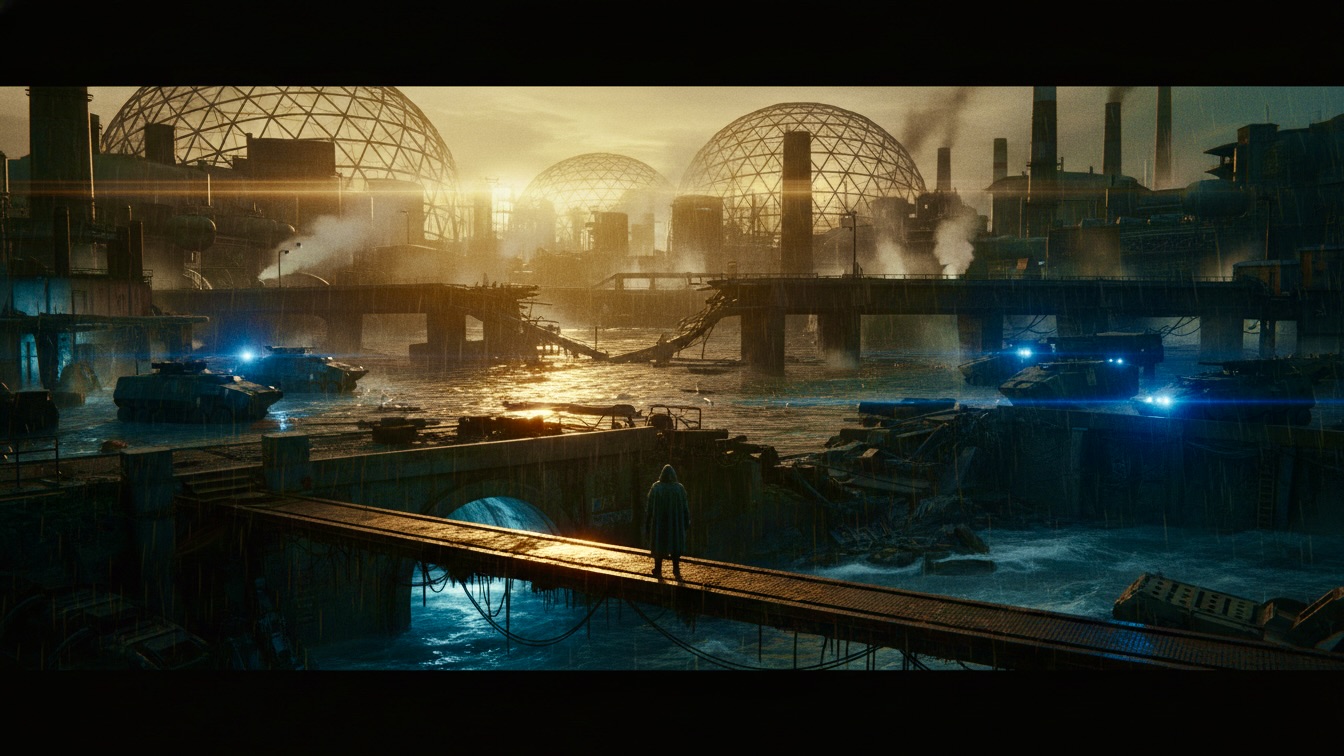
The chapter follows two parallel threads of a desperate rebellion against an oppressive regime. Tariq, a gate guard at Checkpoint Delta, attempts to deflect the suspicions of the cold and calculating Commander Aris after a fugitive named Sarah bypasses his post. Tariq endures a brutal interrogation, attempting to hide his complicity in Sarah's escape while shielding his sick brother, Sam, from the State's reach. Meanwhile, Sarah navigates the toxic, flooded maintenance tunnels beneath the city, battling physical exhaustion and the threat of autonomous drones. She eventually reaches a clandestine relay station in Sector 3, where she successfully uploads stolen Genesis Lab data to the slum nodes before being cornered by State security forces.
The narrative centers on the conflict between individual agency and systemic tyranny. The State is portrayed as an all-encompassing, soulless entity that views human life as data points to be managed or deleted. By contrasting the sterile, blue-lit technology of Commander Aris with the decaying, organic rot of the slums, the story emphasizes the widening chasm between the ruling class and the oppressed.
Sacrifice emerges as the primary mechanism of resistance. Tariq and Sarah both operate under the assumption that their personal suffering is a necessary fuel for a larger truth. The act of the data upload serves as a metaphor for the spread of information as a catalyst for revolution. Even as the characters face physical annihilation, the story suggests that the act of defiance itself is a victory, regardless of the immediate personal cost.
Tariq is defined by his profound sense of protective duty. His primary motivation is not political ideology, but the survival of his brother, Sam. This creates a compelling psychological conflict, as Tariq must force himself to remain calm while his internal state is one of extreme autonomic distress. His transition from a trembling subordinate to a man of cold, quiet resolve highlights his capacity for compartmentalization. When he realizes that his own life is forfeit, he finds a grim peace in the knowledge that he acted for a cause greater than his own fear.
Sarah embodies the archetype of the weary revolutionary. She is driven by a singular, obsessive purpose that keeps her functioning despite hypothermia and environmental toxicity. Unlike Tariq, who operates through deception, Sarah operates through sheer endurance. Her internal monologue reveals a woman who has moved past the stage of hope and into the stage of finality. By the time she is captured, her smile signifies a complete detachment from her own survival, proving that she has achieved her objective and is no longer a prisoner of her own fear.
Commander Aris represents the chilling efficiency of the State. He is characterized by his lack of traditional passion; he does not hate his victims, he simply views them as obstacles or errors in a system that demands perfection. His boredom is his most threatening trait, as it indicates a total absence of empathy. Aris operates with a clinical precision that forces the reader to recognize him not just as a villain, but as a personification of a machine that cannot be reasoned with or bargained with, only dismantled.
The pacing of the chapter is deliberate and suffocating, mirroring the high-stakes pressure experienced by the protagonists. By alternating between the claustrophobic, immediate threat of the interrogation room and the damp, sensory-heavy environment of the tunnels, the narrative maintains a constant state of tension. The use of sensory details—such as the smell of ozone, the visceral sound of boots in the silt, and the sharp bite of safety glass—grounds the high-concept science fiction elements in a tangible, gritty reality.
The narrative voice is detached yet observant, allowing the reader to witness the internal agony of the characters without the intrusion of excessive sentimentality. The author employs a cold, industrial tone that matches the oppressive setting, reinforcing the theme of a world that has been stripped of warmth. This stylistic choice effectively highlights the small, flickering moments of humanity, such as Tariq’s thoughts of his brother or Sarah’s final, defiant smile, making them stand out against the grey, mechanical backdrop of the State.


