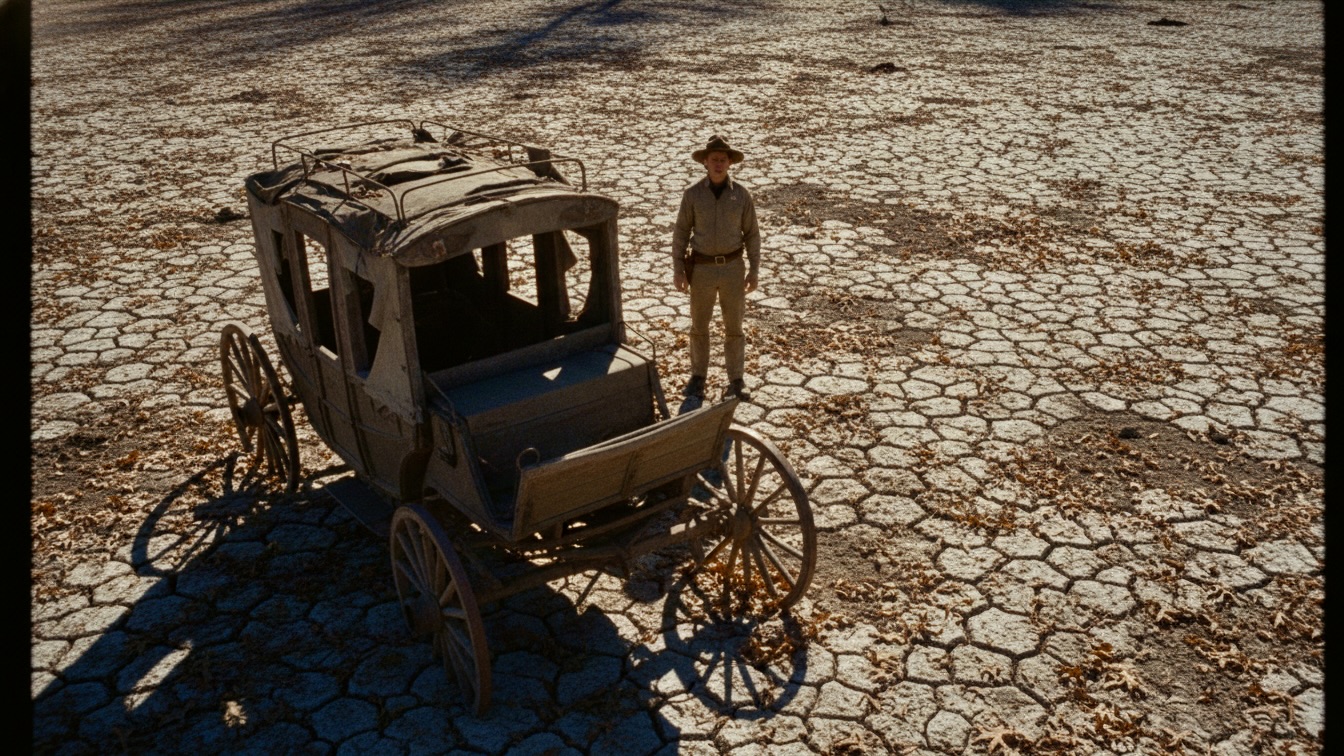
The receding water didn't just leave dead fish. It left three skulls and a rusted lie.
The reservoir bed looked like shattered pavement. Weeks of unyielding autumn drought had baked the mud into jagged, hexagonal plates that stretched out for miles. It was November, but the sun beat down with a harsh, white glare that bleached the color from the dead oak leaves blowing across the basin. The leaves hit the cracked earth and shattered into dust.
Sheriff Jose Thomas stepped out of his cruiser. His boots crunched on the desiccated mud. He didn't look at the dead fish. They were everywhere, silver scales fused to the dirt, eyes boiled white by the sun. He kept his eyes on the anomaly sitting two hundred yards out in the center of the basin.
It was a stagecoach.
The water had hidden it for fifteen years. Now, the drought had dragged it into the daylight. The wood was black and rotted, sloughing off the iron frame like dead skin. Algae clung to the warped spokes, baked into a pale gray crust. Jose walked toward it. The heat radiating off the mudflats made the horizon blur and glitch. His radio cracked on his shoulder.
"Jose. You out there?" Dispatch.
He didn't answer. He pressed the transmit button twice to send a burst of static. Acknowledgment without engagement. He didn't want to talk. His head pounded. The glare from the white mud was blinding.
He reached the coach. The door hung off one leather hinge. He gripped the iron handle. The metal was blistering hot. He pulled. The hinge screamed, a high, mechanical shriek that cut through the dead silence of the basin. The door snapped off entirely and fell into the dirt.
Jose looked inside.
The light shifted. Shadows stretched across the interior. Three skeletons sat slumped against the rotted leather benches. The bones were stained dark brown from the reservoir water. One skull rested on the floorboards, detached, the jawbone resting a few inches away like a discarded piece of plastic.
Jose didn't move. He stared at the ribcages.
His dad used to tell stories about this coach. 'River bandits took it,' his dad would say, sitting on the porch with a glass of bourbon. 'Took the gold, sank the coach, vanished into the hills.' His dad had been the sheriff back then. The legendary Thomas. The man who supposedly chased the bandits to the county line.
Jose leaned closer. A rusted iron lockbox sat wedged under the opposite bench. The lid was pried open. Empty.
But something else caught the sunlight. Something buried in the silt and dried mud at the bottom of the coach, tangled in the ribs of the skeleton closest to the door.
Jose reached in. The fabric of the victim's coat crumbled into dust against his knuckles. He dug his fingers into the hardened silt. He pulled the object free.
It was a star. A deputy badge.
Jose rubbed the mud off with his thumb. The silver was tarnished, almost black in places, but the deep, gouged scratch across the top point was unmistakable. His dad's badge. The one he supposedly lost in a foot chase three towns over, years before he died.
Jose's chest tightened. His lungs refused to expand. He stood up, backing away from the coach. The sun hit the silver star. The glare stabbed into his retinas.
He looked back at the skeletons. At the skulls.
"He lied," Jose said. The words fell out of his mouth, flat and quiet.
He put the badge in his pocket. The metal felt heavy against his thigh. He turned and walked back to the cruiser. The sound of his boots on the cracked mud seemed deafening. He needed to get the bones out of here. He needed to get them to Yates. He picked up his radio.
"Dispatch," Jose said.
"Go ahead, Sheriff."
"Call Doc Yates. Tell him I'm bringing in a delivery from the reservoir. And tell him to keep his mouth shut."
The overhead lights in Doc Yates' clinic flickered. The ballast emitted a constant, high-pitched buzz that drilled into the base of Jose's skull. The clinic was freezing. The air conditioner rattled in the window, blasting cold air over the three stainless steel tables.
Yates stood over the first table. He was seventy, with trembling hands and eyes that missed nothing. He held a magnifying glass over the skull Jose had brought in from the mudflats.
"You see this?" Yates asked.
Jose leaned against the doorframe. He didn't want to get closer. "I see a hole."
"It's not just a hole, Jose." Yates tapped the edge of the fracture with a metal probe. "It's a contact wound. See the radial fractures? The way the bone spalled inward? Someone pressed the barrel directly to the back of this man's head and pulled the trigger. Same for the other two."
Jose looked at the floor. The linoleum tiles were scuffed and yellowing.
"This wasn't a robbery gone wrong," Yates said. "This was an execution. They were dead before the coach ever hit the water."
"Keep this quiet, Doc."
"Quiet? Jose, you've got three murdered men on my tables. The state boys are going to want a look at this."
"Give me twenty-four hours."
Yates put the probe down. He looked at Jose. The old doctor's eyes narrowed. "What did you find out there, boy?"
"Nothing. Just give me time."
Jose left the clinic. He drove to the town hall. The building was brick, baking in the autumn heat. The dead leaves crunched under his tires as he pulled into the Mayor's reserved spot.
Mayor Lenniston Blackwood sat behind a massive mahogany desk. He was a large man, sweating through a custom-tailored suit. A glass of ice water sat on his desk. Condensation ran down the sides, pooling on a leather coaster.
Blackwood didn't look up from his paperwork when Jose walked in.
"Sheriff. You're tracking dirt on my carpet."
"I found the stagecoach, Lenniston. The one from fifteen years ago."
Blackwood stopped writing. He slowly capped his pen. He looked up. His face was completely blank. A muscle in his jaw twitched once.
"The reservoir is low," Blackwood said. "Things surface."
"There are three bodies inside. Executed. Point-blank."
Blackwood picked up his water glass. He took a slow sip. The ice clinked against the glass. "Tragic. River bandits were ruthless back then. Good thing your father ran them off."
Jose walked to the desk. He pulled the tarnished silver badge from his pocket and dropped it on the mahogany. It landed with a heavy, dull thud.
Blackwood looked at it. He didn't flinch.
"I found this in the dirt, mixed in with the ribs of one of the victims," Jose said. "It has the scratch. My dad's badge."
"It's a piece of tin, Jose."
"It's his."
"Your father was a hero," Blackwood said. His voice dropped an octave. It was flat, mechanical. "He protected this town. He built the foundation we stand on. You're out of your depth, boy. You're exhausted. The heat is getting to you. Go home."
"He was dirty. And you know it."
Blackwood stood up. He leaned over the desk. He was suddenly very close. "Listen to me carefully. The drought is hurting the town's economy. People are panicked. We don't need a scandal about a dead hero. We don't need state investigators digging up mud. You take that badge. You throw it away. And you tell Yates to classify those bones as John Does from a bandit raid."
"No."
"You're going to destroy your own name, Jose."
"It's already destroyed."
Jose snatched the badge off the desk. He turned and walked out. The heavy oak door slammed behind him, echoing down the empty marble hallway of the town hall.
Jose pulled up to the sheriff's station. The front door was standing open. The glass panel was shattered, the shards glittering on the concrete steps like crushed ice.
He drew his sidearm. He stepped over the glass. His boots ground the fragments into dust.
The station was destroyed. Desks flipped over. Filing cabinets yanked open, papers scattered across the floor in a chaotic white drift. The radio console was smashed, wires ripped out and dangling from the wall like severed veins.
They were looking for the badge. Or the bones.
Jose's pulse hammered in his throat. He holstered his gun and ran back to the cruiser. He slammed it into gear and tore down Main Street toward the clinic. He didn't use the siren. The town was empty. Everyone was hiding from the heat.
He kicked the clinic door open.
"Yates!"
Silence. The fluorescent lights buzzed. The three stainless steel tables were empty. The bones were gone.
Jose ran through the back hall. He checked the supply closet. Empty. He burst out the back door into the alley. The livery stable stood fifty yards away, its massive barn doors chained open to let the dead breeze through.
Jose sprinted to the livery. He stepped inside. The light was dim, filtering through the slats in the roof, illuminating columns of floating dust.
He saw the shoes first.
They were hovering two feet off the dirt floor. Turning slowly.
Jose stopped. His lungs seized.
Doc Yates hung from the central rafter. A thick hemp rope cut deep into his neck. His hands were bound behind his back with zip ties. A wooden stool lay kicked over in the dirt.
Jose stared at the zip ties. You don't zip-tie your own hands before kicking the stool.
He turned away. He walked out of the livery. The white sun hit him, blinding and absolute.
He drove to his childhood home. The house sat on the edge of town, abandoned since his father died. Paint peeling. Porch sagging. Jose walked inside. The air was stifling, trapped under the baking roof.
He went to his father's office. He grabbed a crowbar from the hall closet. He walked to the center of the room.
He raised the crowbar and drove it into the hardwood floor.
The wood splintered. He ripped the floorboard up. The nails shrieked. He drove the crowbar down again. He tore up another board. And another. Sweat poured down his face, stinging his eyes, soaking his collar. He destroyed the floor, ripping the history of the house to shreds.
Under the floorboards near the desk, his crowbar hit metal.
Jose dropped the tool. He reached into the dark cavity. He pulled out a flat, iron lockbox. It matched the one from the stagecoach. He grabbed the crowbar, wedged it under the hasp, and snapped the lock.
Inside was a leather-bound ledger.
Jose opened it. The pages were filled with his father's jagged handwriting. Dates. Amounts. Payouts.
And names.
The biggest payouts, the monthly stipends that spanned fifteen years, were all listed under one name.
Lenniston Blackwood.
The mayor hadn't just covered it up. The mayor had organized the hit. He had paid the sheriff to execute the passengers and sink the gold.
Jose closed the ledger. He wiped the sweat from his eyes. He looked out the broken window toward the horizon. The sun was finally starting to set, turning the sky the color of dried blood.
The moon hung low over the reservoir. It cast a pale, cold light across the cracked mud. It was midnight, but the heat of the day still radiated from the earth.
Jose stood by the ruined stagecoach. He held the ledger in his left hand. His right hand rested on the grip of his sidearm.
Headlights cut through the dark. A black SUV drove slowly across the basin, its heavy tires crushing the brittle mud. It stopped fifty yards away. The doors opened.
Mayor Blackwood stepped out. He wasn't wearing his suit jacket. He held a pump-action shotgun.
"I told you to drop it, Jose," Blackwood called out. His voice carried across the silent crater.
"You killed Yates," Jose said.
"Yates was an old man who couldn't keep his mouth shut. Just like you."
Blackwood racked the shotgun. The mechanical clack echoed off the distant hills.
Jose drew his gun. He didn't aim yet. "You paid my dad. To kill them. To take the gold."
Blackwood laughed. A dry, hollow sound. "You think I had to pay him to pull the trigger? Your old man came to me with the plan. He wanted the gold. He just needed me to launder it through the town accounts. He executed those people, Jose. He shot them in the back of the head while they begged. He wasn't a hero. He was a butcher."
Jose felt the ground tilt. The words hit him like physical blows.
"He did it for you," Blackwood yelled, walking closer. "To buy that house. To pay for your schooling. You're wearing his badge, standing in his mud, eating his sins!"
Blackwood raised the shotgun.
Jose fired.
The muzzle flash blinded him for a microsecond. The crack of the gunshot was deafening. The bullet hit Blackwood in the shoulder. The mayor spun, firing the shotgun wild. The buckshot slammed into the side of the stagecoach, raining rotted wood splinters over Jose's head.
Jose fired again.
Blackwood dropped the shotgun. He fell to his knees in the dirt. He clutched his leg. Blood leaked through his fingers, dark and thick in the moonlight.
Jose walked toward him. He kicked the shotgun away. He pointed his weapon at Blackwood's chest.
Blackwood looked up, panting, teeth bared. "Go ahead. Do it. Be your father."
Jose stared down at him. The urge to pull the trigger was electric. It buzzed in his fingers. He looked at the ledger in his hand. He looked at the bleeding man in the dirt.
"No," Jose said.
He pulled his handcuffs from his belt. He kicked Blackwood flat onto his stomach and jammed his hands behind his back. The ratcheting sound of the cuffs was sharp and final.
Jose stood up. He reached into his pocket. He pulled out the tarnished silver badge. He walked over to the deepest part of the basin, where a small sinkhole of wet, uncracked mud still remained, black and bottomless.
He looked at the star one last time. He saw the scratch.
He threw it.
The badge hit the mud. It sat on the surface for a second, catching a single glint of moonlight, before sinking silently into the black earth.
Jose turned his back on the pit. He grabbed Blackwood by the collar and dragged him toward the cruiser.
The drought wasn't over, and the town was still broken, but the rot had finally been dragged into the light.
“He locked Blackwood in the cage, but as he turned the ignition, the police scanner crackled with a voice he hadn't heard in fifteen years.”


