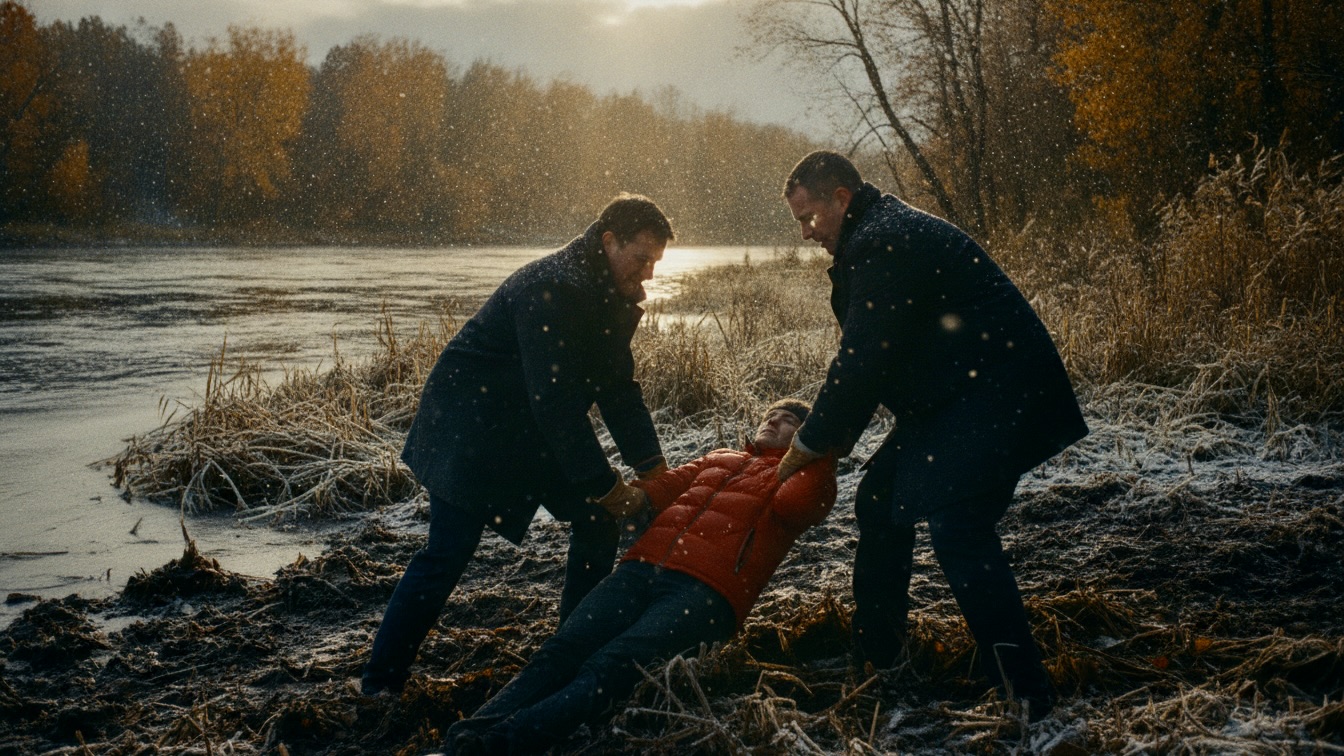
Miller's boot sheared through the half-frozen mud, sending him crashing toward the bloated corpse in the shallows.
Miller's right boot gave way.
The mud on the embankment did not slide. It sheared in a solid, frozen slab. He dropped hard onto his right hip. A jagged piece of concrete embedded in the dirt caught his pelvis. The pain was immediate, a sharp electric spike that radiated down his thigh.
He swore out loud, grabbing blindly with his left hand. His fingers closed around a fistful of dead river reeds. The hollow stalks snapped instantly like dry chicken bones, offering zero resistance.
He slid another four feet down the incline.
The Assiniboine River churned two yards below his boots. The water was a flat, industrial gray. White foam gathered at the edges, choked by plastic bags and rotting elm leaves. The first snow flurries of November whipped horizontally across the water, hitting his cheeks with the stinging velocity of sand.
Roberts was already standing at the bottom, near the waterline.
"Watch your step."
"I just did," Miller said. He pushed himself up. His hip throbbed. The damp cold of the mud was already seeping through the knees of his slacks.
He limped the rest of the way down the slope. The wind off the water was brutal. It didn't feel like weather. It felt like a physical assault. Miller zipped his parka to his chin and shoved his bare hands into his pockets. He stared at the object tangled in the reeds.
"He's stuck in the ice," Roberts said.
"I can see that."
It was a young man. He lay facedown in the shallows. The water had frozen overnight, locking his upper torso and arms in a solid pane of dirty, yellow-tinted ice. His jacket was a cheap nylon puffer, torn at the shoulder. White synthetic stuffing spilled out, frozen into the river like strange sea foam.
Miller stepped closer. The ice cracked under his heel. He ignored it.
"Who called it in?" Miller asked.
"A jogger," Roberts said. "Saw the bright red jacket from the bridge. Thought it was a pile of trash at first. Then he saw the hand."
Miller looked at the hand. The victim's right arm was extended, reaching toward the muddy bank. The hand was submerged, but the ice over the forearm was thin and clear. Miller squatted down. His bad hip flared, but he held the pose, balancing on the balls of his feet.
Through the ice, the victim's skin was stark white, completely drained of blood. But the forearm was marked.
"Give me your flashlight," Miller said.
Roberts handed over a heavy steel Maglite. Miller clicked it on and pressed the lens directly against the ice. The glare cut through the frost.
A tattoo. Black ink. Sharp, geometric lines forming a repeating hexagonal pattern.
Miller's stomach dropped. The cold of the riverbank suddenly felt entirely secondary to the chill moving up his spine.
"You seeing this?" Miller asked.
Roberts leaned over. His shadow blocked the weak autumn sunlight.
"Hexagons," Roberts said. "Like a honeycomb."
"Like the Taylor case," Miller said.
Roberts went entirely still. The wind howled through the bridge pilings above them, a low, metallic shrieking.
"That was June," Roberts said. "That guy was gutted in a storage unit. This kid drowned."
"Look at the back of his head," Miller said.
Roberts aimed his own light at the base of the victim's skull. The hair was matted, frozen into a solid black clump. But beneath the ice, there was a deep, concussive indentation. The skull was fractured. Bone fragments pushed against the frozen scalp.
"He didn't drown," Miller said. "Someone caved his head in, dumped him, and the river froze over him."
Miller stood up. The snow was falling harder now. Large, wet flakes that hit the mud and instantly turned to slush. The sky above the Winnipeg skyline was a bruised, heavy purple.
"We need him out of the ice," Miller said.
"Crime scene unit is twenty minutes out," Roberts said.
"In twenty minutes, this water freezes solid to the bank. The temperature is dropping three degrees an hour. If we don't break the ice now, we're going to have to use chainsaws to get him out tomorrow."
Miller didn't wait for a response. He turned and scanned the bank. He found a massive, rusted railroad spike half-buried in the gravel. He yanked it free. The metal was freezing to the touch. He walked back to the body.
"Miller, wait for the techs."
"No."
Miller raised the heavy iron spike and brought it down hard on the ice holding the victim's arm. The ice shattered. Freezing water erupted upward, splashing Miller's face and jacket. He brought the spike down again. And again. The physical exertion felt good. It pushed the cold out of his muscles. It quieted the static in his head.
He cleared the ice around the arm. He reached into the freezing water. The cold was a violent shock, instantly numbing his fingers. He grabbed the fabric of the victim's sleeve and pulled.
The arm came free. The ice around the torso cracked in a long, jagged spiderweb.
Miller wiped the freezing water from his face with his wet sleeve.
"Help me roll him," Miller said.
Roberts sighed, stepping into the shallow water. Together, they grabbed the dead weight of the victim and heaved. The body rolled over with a wet, suctioning sound as the mud relinquished its grip.
The victim's face was young. Maybe nineteen. His eyes were frozen open, staring blankly at the bruised sky. His lips were blue and cracked.
Miller searched the pockets of the torn puffer jacket. His numb fingers fumbled with the zippers. In the inside chest pocket, he found a folded piece of thick cardstock. It was soaked through, but the lamination had protected the ink.
He pulled it out and held it up to the gray light.
It was a coaster. From a bar.
The logo was faded, but Miller could read the bold red letters.
THE NEON BURN.
On the back of the coaster, written in smudged blue ink, were three numbers. 402.
"He was at The Burn last night," Miller said.
"Place is a dump," Roberts said.
"Place has cameras," Miller said. He shoved the coaster into his own pocket. "You stay with the body. Direct the techs down the bank. Tell them to bring crampons. The mud is turning to glass."
"Where are you going?" Roberts asked.
"To get a drink."
The neon sign above the door flickered, emitting a high-pitched electronic whine that set Miller's teeth on edge. The glass of the front window was coated in a thick layer of city grime and condensation. He pushed the heavy wooden door open.
The interior of The Neon Burn was dark, illuminated only by the sickly green glow of the beer signs and the harsh fluorescent strip above the cash register. The floor was sticky. Miller's boots made a distinct tearing sound with every step he took toward the bar.
Stella was behind the counter. She was violently scrubbing a stainless steel drip tray with a rag that looked like it had been used to clean an engine block. Her hair was dyed a harsh, chemical black, roots showing an inch of natural blonde. She wore a faded band t-shirt with a bleach stain near the collar.
She didn't look up when Miller sat on the vinyl stool.
"We're closed," Stella said.
"Door was unlocked."
"Door is broken. I'm closed."
"I just need a minute, Stella."
Stella stopped scrubbing. She threw the rag onto the counter. It landed with a wet slap. She finally looked at him. Her eyes were bloodshot. She looked exhausted. Everyone in this city looked exhausted by November.
"Miller. I told you last time you came in here, I don't want cops drinking at my bar."
"I'm not here to drink," Miller said. He pulled the laminated coaster from his pocket and slid it across the sticky laminate bar top. "Recognize this?"
Stella looked at it. She didn't touch it.
"It's a coaster. I have five hundred of them."
"This one was in the pocket of a dead kid we just pulled out of the Assiniboine."
Stella's expression didn't change, but her hand twitched, moving slightly away from the coaster. She wiped her hands on her jeans.
"I don't know anything about a dead kid."
Miller pulled out his phone. He opened the photo gallery and brought up the picture he had taken of the victim's face before the techs arrived. He turned the screen toward Stella.
Stella stared at the glowing rectangle. Her jaw tightened. A muscle jumped in her cheek.
"Nineteen. Maybe twenty," Miller said. "Wearing a cheap red puffer jacket. He was in here last night."
Stella looked away from the phone. She looked at the bottles lined up against the mirror.
"Yeah. He was here."
"What time?"
"Late. After last call. Maybe one in the morning."
"Was he alone?"
Stella reached for a clean glass and a towel. She started polishing the glass, a repetitive, nervous motion.
"At first. He sat in the corner booth. Kept checking his phone. Looked jittery. Like he was waiting for a fix."
"Did he get one?"
"Not from me," Stella said.
"Did someone meet him?"
Stella hesitated. She polished the rim of the glass. The silence stretched. The compressor in the beer cooler kicked on with a loud shudder.
"Stella," Miller said. "The river froze over him. He was beaten to death. If you know who he met, you need to tell me now."
"It was a drifter," Stella said quickly. The words tumbled out. "I've never seen the guy before. Older. Maybe forty. Dirty canvas jacket. Heavy boots. He came in through the back alley door."
"What did they do?"
"They argued. Loud. I told them to take it outside or I was calling you guys."
"What were they arguing about?"
"I couldn't hear. The jukebox was on. But the kid looked terrified. The older guy grabbed him by the collar of that red jacket. Practically dragged him out the back door."
"You didn't call it in?"
"People get dragged out of this bar every night, Miller. I'm a bartender, not a babysitter."
Miller looked around the empty bar. He looked at the back hallway leading to the alley exit.
"You have cameras back there?" Miller asked.
"Broken. Someone smashed the lens with a pool cue last month."
"Convenient."
"It's reality," Stella snapped. She slammed the glass down on the counter. "Look, the older guy, the drifter. He had something wrong with his hand."
Miller leaned forward. "What do you mean?"
"His left hand. Two fingers were missing. Index and middle. I saw it when he grabbed the kid's jacket."
Miller processed the information. A drifter with missing fingers. It was a highly specific physical detail. It was something he could track.
"Which way did they go when they left?"
"Alley. Toward the old CPR railyard."
Miller stood up. His hip screamed at the sudden movement. He ignored it, buttoning his parka.
"Thanks, Stella."
"Miller," Stella said. Her voice was quieter now. "The older guy. He didn't just look mean. He looked empty. Like there was nothing behind his eyes. If you find him... be careful."
Miller didn't answer. He turned and walked out the front door. The electronic whine of the neon sign cut off as the door swung shut behind him. The street was colder now. The snow was beginning to stick to the concrete. He checked his watch. 4:15 PM. The sun was already setting. The deep freeze was coming.
The CPR railyard was a graveyard of industrial steel.
Rows of decommissioned boxcars sat rusting on tracks heavily overgrown with dead weeds. The ground was a treacherous mix of loose gravel, broken glass, and wet oak leaves plastered to the iron rails. The fading autumn sunlight offered only a weak, gray illumination that barely penetrated the spaces between the train cars.
Miller walked slowly. His breath plumed in the freezing air. He kept his right hand resting casually inside his parka pocket, fingers curled around the grip of his service weapon. The cold was sinking into his bones, stiffening his joints.
He scanned the shadows. He was looking for recent tracks in the light dusting of snow.
He found them near a switching box. Heavy boot prints. Deep treads. Drag marks beside them. Someone had been pulled through the gravel.
Miller followed the tracks. They wove between two massive, graffiti-covered freight cars. The smell of the river was gone, replaced by the sheer physical presence of decaying metal. The silence was absolute, save for the crunch of his own boots.
He rounded the edge of a rusted tanker car.
A figure was crouched in the dirt fifty feet away, digging violently at the frozen ground with a piece of rebar.
Miller stopped. He drew his weapon. The metal slide was freezing.
"Police. Drop the iron."
The figure froze. He didn't stand up. He slowly turned his head. It was a man in a filthy canvas jacket. His face was weathered, deeply lined, and smeared with grease. He looked exactly as Stella had described him.
Miller focused on the man's hands. The left hand gripped the rebar. The index and middle fingers were gone. Stubs of flesh remained.
"I said drop it," Miller repeated. He took a step forward.
The drifter didn't drop the iron. Instead, he sprang backward with shocking speed. He vaulted over the coupling between two train cars and vanished into the narrow gap.
Miller ran.
He sprinted across the uneven gravel. His boots slipped on the wet leaves. He hit the gap between the cars and squeezed through. The metal was freezing, scraping against his jacket.
He emerged on the other side just in time to see the drifter sprinting toward the rusted skeleton of an old switching tower.
Miller pushed his legs harder. His lungs burned. The freezing air felt like shattered glass in his throat. He closed the distance. Forty feet. Thirty feet.
The drifter reached the steel stairs of the tower and began to climb.
Miller hit the base of the stairs. He took them two at a time. The metal grating was slick with ice. His right foot found a patch of solid frost. His boot slipped entirely.
Miller's ankle snapped sideways. A sickening pop echoed over the empty yard.
Pain exploded up his leg. It wasn't a dull ache; it was a blinding, structural failure. He collapsed forward, his shins slamming against the edge of the steel steps. His gun clattered out of his hand and bounced down the stairs, landing in the weeds below.
Miller cursed, clutching his ankle. He looked up.
The drifter had stopped on the platform above. He looked down at Miller. The empty, dead eyes Stella had described stared back at him.
The drifter jumped.
He didn't run away. He leaped directly off the platform, plummeting eight feet down toward Miller.
Miller rolled violently to the left. The drifter crashed onto the metal stairs exactly where Miller's head had been a second before. The impact shook the entire staircase.
Before Miller could recover, the drifter lunged. A heavy, calloused hand grabbed the collar of Miller's parka. The drifter hoisted him up and slammed him against the rusted railing. The railing groaned under their combined weight.
Miller threw a punch. It was clumsy, driven by panic and pain. His fist connected with the drifter's jaw. It felt like hitting a cinderblock. The drifter didn't flinch.
The drifter brought his knee up, burying it directly into Miller's stomach. The air rushed out of Miller's lungs in a violent huff. He doubled over.
The drifter grabbed Miller's hair and wrenched his head back. He raised a fist, aiming for the center of Miller's face.
Miller reacted blindly. He reached out and grabbed the drifter's left hand. He locked his grip around the two missing fingers, digging his thumb directly into the scarred stumps.
The drifter screamed. It was a raw, animal sound.
Miller twisted the hand viciously. The drifter lost his balance. Miller shoved him backward with everything he had left.
The drifter stumbled, his boots slipping on the icy grating. He crashed backward through the rusted safety railing. The iron snapped like brittle plastic.
The drifter fell backward off the stairs. He hit the gravel bank below and rolled rapidly down the steep embankment, disappearing into the dark, freezing waters of the Assiniboine River.
Miller collapsed onto the stairs, gasping for air. His chest heaved. His ankle throbbed with a sickening rhythm. He dragged himself to the broken edge of the railing and looked down.
The water was black and churning. There was no sign of the drifter. The current was too fast. The water was too cold. If the fall hadn't killed him, the shock of the ice water would.
Miller slumped against the cold steel. He wiped his face. His hand came away bloody from a scrape on his forehead.
He looked down at the metal grating where the drifter had been standing.
During the struggle, something had fallen from the drifter's pocket. It lay on the frosted steel, glinting in the dying light.
Miller crawled over to it. He picked it up.
It was a key. Heavy brass. Rusted around the edges.
Engraved on the head of the key was a number.
402.
The skywalks of downtown Winnipeg formed a massive, elevated labyrinth of glass and steel. They connected the office towers, the malls, and the arenas, allowing thousands of people to move across the city without ever stepping foot into the sub-zero winter streets.
They were climate-controlled. They were brightly lit. They were perfectly sterile.
Miller hated them.
He limped down the carpeted corridor of the Portage Place skywalk. His ankle was tightly wrapped in a tensor bandage beneath his boot, but every step sent a fresh wave of nausea through his stomach. He leaned heavily on a wooden cane he had requisitioned from the precinct's lost and found.
He held the rusted brass key in his left hand. The coaster from the dead boy's pocket had read 402. The key from the drifter's pocket was stamped 402.
Room 402.
He bypassed the retail sections and headed toward the older, neglected wing of the skywalk system. The carpets here were stained. The fluorescent lights flickered. The pedestrian traffic dropped to zero.
He found a heavy steel fire door marked with peeling vinyl numbers. 400-410.
He pushed through the door. It opened into a long, concrete service hallway. The air here was dead, smelling faintly of dust and ozone from the electrical panels.
He walked down the hall. 401.
402.
The door to 402 was solid steel, painted a dull industrial gray. There was no handle, just a heavy deadbolt lock.
Miller slid the brass key into the lock. It fit perfectly. He turned it. The mechanism engaged with a heavy, satisfying clunk.
Miller drew his weapon. He pushed the door open.
The room was a massive, windowless storage space. It was entirely dark, save for a single construction lamp illuminating a folding table in the center of the room.
On the table were dozens of black duffel bags.
Miller stepped inside. He kept his gun raised. He moved silently, ignoring the throbbing in his ankle. He approached the table.
He unzipped the nearest duffel bag.
It was packed tight with rectangular bricks wrapped in heavy plastic and silver duct tape. Smuggled narcotics. Hundreds of kilos.
But that wasn't all.
Stacked next to the duffel bags were rows of unmarked crates. Miller pried the lid off one of the crates. It was filled with high-end, untraceable firearms. Assault rifles. Handguns. Suppressors.
An underground smuggling ring. Operating directly above the streets, using the city's own skywalk infrastructure to move weight without ever risking a traffic stop or a street patrol.
The dead kid in the river wasn't a junkie. He was a mule. He had panicked. He had gone to the bar, met his handler, and gotten his skull caved in for making a mistake.
A shadow shifted in the corner of the room.
Miller spun around, leveling his weapon. "Police. Don't move."
A man stepped out of the shadows. He was wearing a sharply tailored suit, entirely out of place in the dusty concrete room. He raised his hands slowly.
"Take it easy, Detective," the man said. His voice was smooth, completely unbothered.
"Hands on the wall. Now."
The man complied, turning and placing his palms flat against the concrete. Miller closed the distance, kicked the man's legs apart, and patted him down. He found a compact 9mm in a shoulder holster and tossed it across the room. He snapped a pair of cuffs onto the man's wrists.
"You're trespassing, Detective," the man said over his shoulder.
"I'm admiring the inventory," Miller said. "You killed the kid."
"I don't know what you're talking about."
"You sent the drifter to shut him up. The drifter is dead in the river. The kid is dead in the ice. And you're going away for a very long time."
The man chuckled. A low, dry sound. "You think I run this? You think a guy in a suit sitting in a storage room runs the skywalks?"
Miller stopped. The man's confidence was unnerving.
"I'm an accountant, Detective," the man said. "I balance the books. I make sure the shipments align. The people who actually own this room... they don't get their hands dirty. They don't meet in alleys. They don't beat kids to death. They just point a finger, and the problem goes away."
Miller grabbed the man by the collar and shoved him toward the door.
"Walk."
Miller marched the accountant through the skywalks, out into the freezing night, and shoved him into the back of a waiting squad car. He watched the taillights fade down Portage Avenue, disappearing into the swirling snow.
The bust was massive. The drugs, the guns, the accountant. It would make the front page. The captain would be thrilled.
But Miller felt completely hollow.
He walked back toward the river. The snow was falling heavily now, coating the city in a thick, blinding white sheet. He reached the embankment where they had found the body that morning.
The crime scene tape was already coated in ice, snapping wildly in the wind. The hole Miller had smashed in the ice was completely frozen over again, a solid, impenetrable block.
Miller stood on the bank. His ankle throbbed. His hands were numb.
The accountant was right. This wasn't the end. The people who built the system, the people who ordered the hits, were still out there, insulated by money and concrete walls. They were watching the snow fall from high-rise windows, completely untouchable.
Miller stared at the frozen Assiniboine. The ice was thickening by the minute, locking the river, the city, and the secrets tight in a deep, unforgiving freeze. He tightened his grip on his cane, wondering who would be the next to break through the surface.
“He tightened his grip on his cane, wondering who would be the next to break through the surface.”


