The zipper caught on the thermal lining. That was it. My entire existence, boxed into sixty liters.
The nylon zipper teeth snapped. I stared at the jagged plastic edge jutting from the canvas duffel bag. My thumb throbbed where the metal slider had pinched the skin. A drop of blood welled up, dark and thick, smearing across the olive-drab fabric. Sixty liters. The Relocation Authority had sent the mandate three weeks ago, a digital notification that flashed red on the datapad by the door. Sixty liters of volume per citizen. You do not measure a life in years anymore. You measure it in cubic centimeters.
I sucked the blood from my thumb. The copper taste did not register. My focus was on the pile of thermal shirts, the water purification tablets, and the heavily insulated boots I had never worn. The southern latitudes were dying of heat, but they were sending us north. Far north. Where the ice was supposedly stable. I shoved a woolen sweater down into the bag. It resisted. I pressed my knee into the center of the fabric, forcing the air out of the fibers, and pulled the broken zipper. It stuck permanently halfway across.
The room was a hollow shell. The drywall was marked with pale rectangles where posters used to hang. A singular dust bunny trembled in the corner beneath the vent. The ventilation system rattled, struggling to push conditioned air into the apartment. It was November. The digital thermometer on the wall read thirty-four degrees Celsius outside. Fall was a concept we only read about in archived textbooks.
My wrist device chimed. A harsh, electronic bleat. The departure orientation was starting at the municipal center. Section Four residents were required to attend. Failure to scan my biometric signature at the turnstiles would result in a demotion of transit priority. I stared at the pulsing blue light on my wrist. I looked at the broken duffel bag. I looked at the scuffed floorboards.
Then, I looked at the dirty plastic access card sitting on my windowsill. The Arboretum pass.
I grabbed the card. I did not lock the door behind me. There was nothing left to steal. The hallway lights flickered, a symptom of the rolling blackouts that had plagued the sector since August. I took the stairs three at a time. The concrete stairwell echoed with the frantic thud of my boots. People were moving in the corridors, dragging wheeled crates, arguing in hushed, panicked tones. I pushed past a family trying to wedge a framed mirror into a transit container. I did not apologize.
The transit hub was a chaotic swarm of orange departure vests. I slipped through the maintenance alley behind the hub, bypassing the orientation queues. My chest tight, my breathing shallow. The air in the alley was stagnant, vibrating with the low frequency of the subterranean generators. I swiped the plastic card at the rusted turnstile of Sector 7. The light turned green. The heavy iron gate groaned as I pushed through.
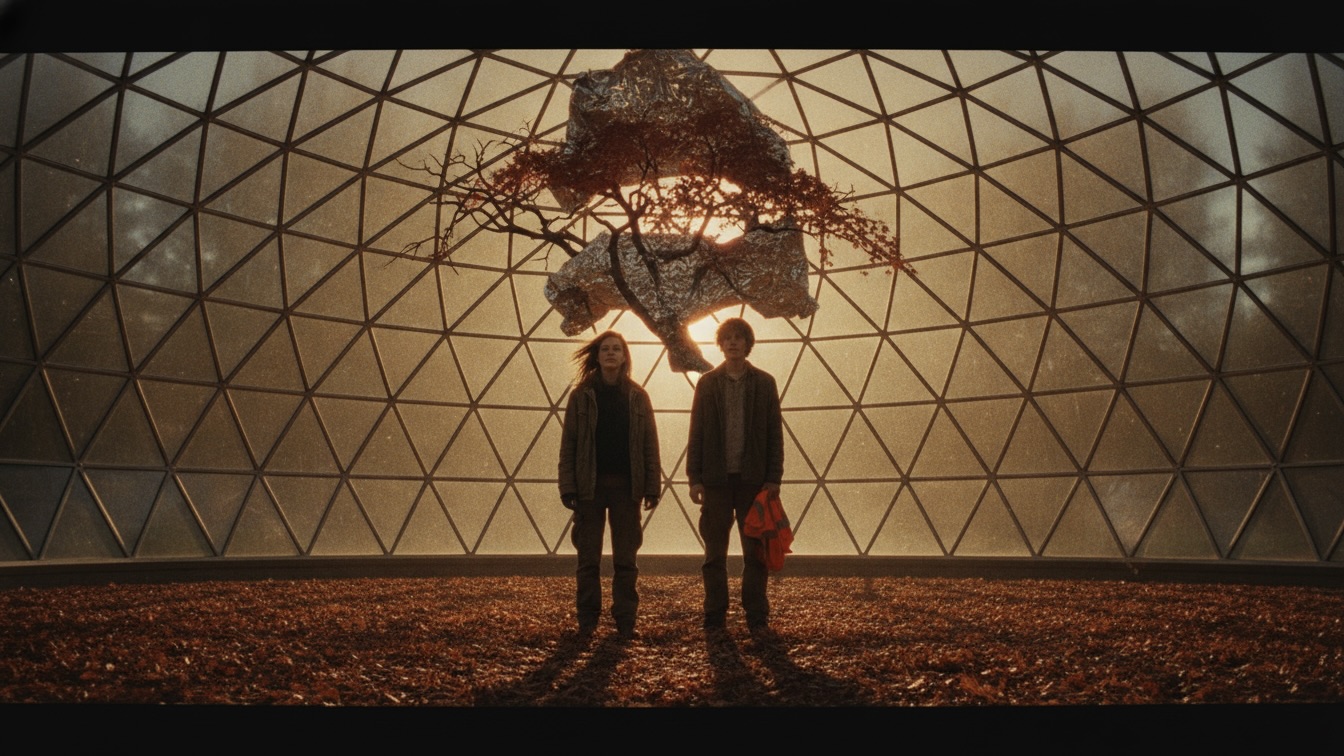
The Arboretum was housed under a massive geodesic dome of reinforced polymer. It was supposed to be a sanctuary. A seed bank and a living laboratory. Now, it was a graveyard. The glass was coated in a thick layer of brown dust. I walked down the central path, my boots crunching over dry, cracked earth. The irrigation lines, black plastic veins running along the ground, were completely flat. Empty.
At the center of the dome stood the red maple.
My mother had engineered it. Eight years of genetic sequencing, splicing drought-resistant proteins into the cellular structure of Acer rubrum. She wanted a tree that could remember what autumn was supposed to look like, even when the world burned. She wanted the leaves to turn red, to drop, to sleep, and to wake up.
I stopped at the edge of the soil bed. The tree was dying.
The leaves were not red. They were the color of rust. Brittle, curling inward like scorched paper. Dozens of them lay scattered on the cracked soil, prematurely severed from the branches. The bark was splitting, weeping a thin, translucent sap that crystallized instantly in the dry heat.
I dropped to my knees. The impact sent a shockwave up my shins. I dug my bare hands into the dirt. It was like plunging my fingers into warm ash. There was no moisture. The root system was suffocating.
I dug frantically, ignoring the dirt wedging beneath my fingernails. I needed to find the primary taproot. I needed to see how deep the desiccation went. The soil scraped my knuckles raw. I hit a thick, woody root. It felt hollow.
My wrist device chimed again. The final warning for orientation. I slammed my wrist against the edge of the concrete planter box. The glass screen spider-webbed, and the blue light died.
I kept digging.
The sound of heavy footsteps crunched on the gravel path behind me. I did not stop digging. My fingers were numb, vibrating with the repetitive impact against the compacted earth.
"You broke your comms."
I knew the voice. Kyle. His shadow fell over the dirt, blocking the harsh, unfiltered sunlight streaming through a crack in the dome. He was wearing the mandatory transit vest. It was a violently bright orange. The color made my eyes ache. He stood with his hands shoved deep into his pockets, his posture rigid, shoulders drawn up to his ears.
"Go away, Kyle," I said. My voice was a dry rasp.
"They locked the doors at the municipal center," he said. "They are running the manifest. Your name flashed red on the main board. They are going to bump you to the second convoy."
"Let them," I said. I pulled a chunk of dry clay from the hole and tossed it aside. It shattered into dust upon impact.
Kyle stepped closer. The toe of his boot nudged the edge of the planter. "This is not a game, Penny. The second convoy leaves in three days. The draft is mandatory. If you are not on the transport, you lose your housing module up north. You will be assigned to the barracks."
"I do not care about the barracks," I said. I hit another root. I scraped at the bark with my thumbnail. It was flaking off in dry strips. "Look at this. The capillary action is failing. The water table dropped too fast. The automated pumps stopped a week ago."
"The pumps stopped because the city diverted the grid to the transport trucks," Kyle said. His voice was rising in pitch, the theatrical calm cracking. "The tree is dead. The entire sector is dead. We are leaving."
"It is not dead," I snapped. I stood up quickly. My knees popped. We were face to face. He was taller than me now, a recent development that always threw my spatial awareness off. His face was pale, tight with an exhaustion that mirrored my own. A small muscle in his jaw twitched.
"You are being irrational," he said.
"I am being precise," I countered. "The cellular structure is intact. It is in shock. It needs pure water. Not the recycled sludge from the secondary pipes. It needs the deep reservoir water."
"The municipal reservoir is locked down under military guard," Kyle said. He reached out, grabbing my elbow. His grip was entirely too tight. "Stop moving for one second. Look at me."
I ripped my arm out of his grasp. The friction of his canvas vest against my bare forearm burned. "Do not touch me. Do not tell me to look at you when you are dressed like a traffic cone, ready to run away."
"It is not running away," Kyle shouted. The sound echoed off the polymer dome, harsh and metallic. "It is surviving! You think I want to go? You think I want to pack my entire life into a box and move to a frozen wasteland?"
"Then stay," I said.
"I want to live!" he yelled.
Silence crashed down between us. The only sound was the distant, mechanical groan of the city's power grid failing and rebooting.
I looked at the falling leaves. Another rust-colored leaf detached from a high branch, drifting down in a lazy spiral. It landed on Kyle's shoulder. He brushed it off violently, as if it were a spider.
The motion triggered a violent spike in my chest. A memory overlaid the present. Three years ago. The hospital room. The steady, relentless beep of the heart monitor. Outside the window, a line of engineered maples dropping their leaves in a synchronized, programmed death. My mother's hand in mine, her skin paper-thin, her pulse erratic. The exact moment the monitor flatlined, a gust of wind had stripped the branch bare outside the glass. The falling leaves. The total loss of stability. The sudden, absolute quiet.
I swallowed the bile rising in my throat. I looked at the tree. It was not just a plant. It was the last physical proof that she had existed. That she had tried to fix things.
"I am going to the reservoir," I said. I wiped my dirty hands on my pants.
"Penny, no," Kyle said. The anger vanished, replaced by a sudden, hollow panic. "They have drones. They have lethal authorization. You cannot steal from the primary water supply."
"Watch me," I said.
I turned and walked toward the maintenance shed at the back of the dome. There were heavy-duty jerry cans inside. Twenty liters each. I needed two. I kicked the door of the shed open. The hinges screamed.
Kyle stood in the center of the dome, his orange vest glowing in the dim light. He did not follow me immediately. He just stared at the dying tree, his hands clenched into fists at his sides.
I grabbed the plastic cans. They were heavy, even empty. I threw a coil of syphon tubing over my shoulder. When I walked back out, Kyle was still there.
"You are going to get yourself shot," he said.
"Then you will not have to worry about me missing the convoy," I said. I walked past him, heading for the service exit.
The perimeter fence of the municipal reservoir was a ten-foot high chainlink monstrosity topped with razor wire. The metal was hot to the touch, baking under the relentless afternoon sun. I crouched behind a rusted out delivery van, my lungs burning. The two jerry cans knocked against my knees.
The security drone passed overhead. It was a sleek, black disk, humming with a low-frequency vibration that rattled my teeth. Its red scanning laser swept the concrete thirty yards to my left. I held my breath. I pressed my back against the van's tire. The rubber was cracked and flaking.
Once the drone banked east, I sprinted.
I hit the fence hard, my fingers curling through the metal links. The friction tore at my skin. I climbed. My boots slipped on the wire, but I forced my weight upward. At the top, I threw my heavy canvas jacket over the razor wire. I hoisted myself over, the metal bar biting into my stomach. I dropped to the ground on the other side, landing hard on my shoulder. The impact knocked the wind out of me.
I lay on the hot concrete for three seconds, staring at the sky. It was a hazy, chemical white. No clouds. Just a flat, oppressive ceiling.
I rolled over and grabbed the empty cans. The primary holding tanks towered above me like concrete silos. I moved between them, sticking to the shadows. The air here felt different. Dense. Heavy with the mass of millions of gallons of contained water.
I found Valve 4. It was a massive, industrial wheel attached to a secondary bleed line. It was not monitored by cameras; it was meant for emergency pressure release.
I hooked the syphon tubing over the nozzle. I braced my feet against the concrete piling and grabbed the iron wheel with both hands. I pulled. It did not budge. The rust had fused the threads. I gritted my teeth, planting my boots firmer. I threw my entire body weight backward.
With a sharp crack, the wheel turned.
Water surged through the tube. It was shockingly cold. Condensation instantly bloomed on the outside of the plastic line. I shoved the end of the hose into the first jerry can. The sound of water filling the hollow plastic was deafening in the quiet compound.
I filled the first can. Then the second. Forty liters total. Eighty-eight pounds of dead weight.
I shut the valve. I had to drag the cans back to the fence, push them under a gap in the rusted base, and crawl out. The journey back to the Arboretum was a blur of physical agony. My arms felt as though they were detaching from my shoulders. The plastic handles cut deep grooves into my palms.
By the time I reached the polymer dome, the sun was setting. The sky bruised into a sickly purple.
I pushed through the rusted gate. I dropped the cans at the base of the red maple. I collapsed next to them, my chest heaving, sweat stinging my eyes.
I looked up. Kyle was sitting on the edge of the concrete planter. He had taken off the orange vest. It lay discarded on the dirt like a dead flare. He had a shovel in his hand. He had widened the trench around the root system.
"You are an idiot," he said. His voice was quiet.
"I got it," I panted.
"I know," he said. He stood up and grabbed one of the heavy cans. "Help me pour it. Slowly. If we flood it, the roots will rot."
We worked in silence. We tipped the heavy plastic jugs, letting the cold, clean water soak into the ash-dry soil. The earth hissed as it drank. The sound was microscopic, a frantic bubbling as air was displaced by liquid. I watched the water pool and then vanish into the dirt.
Then, the temperature dropped.
It did not drop gradually. It fell like a guillotine. One moment, I was sweating through my shirt. The next, a violent, biting chill ripped through the dome. The hairs on my arms stood up.
I looked at my wrist device. The screen was cracked, but the internal thermometer was still projecting a faint digital readout.
22°C. 18°C. 12°C.
"What is happening?" Kyle asked, stepping back. He wrapped his arms around his torso.
"Atmospheric collapse," I whispered.
The jet stream had completely destabilized. The northern polar vortex, entirely unmoored from its traditional rotation, was sending a massive, unmitigated wave of freezing air down the longitude line. It was a freak frost. A symptom of a dying planet.
The remaining water in the plastic syphon tube began to click.
I looked down. Tiny, geometric crystals of ice were forming inside the plastic. The water we had just poured into the trench was frosting over, creating a delicate, lethal crust of ice on top of the soil.
"No," I said. I dropped to my knees. I clawed at the frozen dirt. "No, no, no. It cannot freeze. The shock will kill the cells. It will rupture the vascular tissue!"
"Penny, the ambient temperature is dropping too fast!" Kyle yelled. His breath plumed in the air, a sudden cloud of white vapor.
"Get the thermal blankets!" I screamed. "From my survival kit! In the shed! Run!"
Kyle turned and sprinted toward the maintenance shed. I pressed my bare hands against the trunk of the maple. The bark was already growing cold. The tree was freezing from the outside in.
Kyle returned with armfuls of emergency thermal blankets. They were packed in tight plastic squares. We tore them open with our teeth. The Mylar unfolded with a violent, crinkling roar, a harsh metallic sound that bounced off the interior of the dome.
"Wrap the trunk!" I ordered. My teeth were chattering. The temperature had plunged below freezing. The air felt thin, sharp, slicing into my lungs with every breath.
We wrapped the silver sheets around the base of the tree, overlapping the edges. We used duct tape to secure them, but the adhesive was stiffening in the cold. We moved frantically, two shadows dancing around a dying pillar. I climbed onto the edge of the planter box, stretching to wrap the lower branches. The Mylar reflected the dim emergency lights of the dome, turning the tree into a twisted, futuristic sculpture of silver and tape.
My fingers lost feeling. I fumbled with the tape, dropping the roll into the dirt.
"I cannot get it to stick!" I cried out. My voice cracked.
"Hold it down, I will tie it!" Kyle stripped the shoelaces from his boots, using them to lash the slippery blankets to the bark. He was shivering violently, his thin shirt completely inadequate for the sudden arctic drop.
We worked for hours. The cold was an entity in the room, pressing against us, crushing the heat from our bodies. We wrapped every branch we could reach. We layered three blankets over the root zone, weighing them down with rocks and clumps of dirt.
When there were no more blankets, we collapsed against the base of the tree.
We sat shoulder to shoulder, huddled under a loose flap of Mylar. The crinkling material trapped our body heat, creating a pathetic, microscopic pocket of warmth. The silence of the dome was absolute, broken only by the rhythmic chattering of Kyle’s teeth and the distant, agonizing pop of freezing wood expanding in the cold.
I stared at my bruised, dirty hands. The adrenaline crashed. The physical exhaustion hit me like a physical blow.
I broke.
A sob tore out of my throat. It was an ugly, jagged sound. I doubled over, pressing my forehead against my knees. I cried for the first time in three years. I cried for the blistered skin on my palms. I cried for the heavy jerry cans. I cried for the broken duffel bag in my apartment. And I cried because I knew, with absolute scientific certainty, that the tree was going to die anyway.
"I could not save it," I gasped, struggling to pull oxygen into my lungs. "I did everything. I stole the water. I dug the roots. I failed her. I failed her again."
Kyle shifted. He put his arm around my shoulder. The weight of his arm was heavy, grounding. He did not say 'it will be okay'. He did not offer empty platitudes.
"You did not fail her," Kyle said softly. The theatrical bravado was gone. His voice was raw, stripped down to the studs. "She died, Penny. The tree is dying. The planet is dying. You cannot engineer your way out of grief."
I looked up at him. His face was illuminated by the pale reflection of the Mylar.
"I am terrified," Kyle whispered. He looked away, staring into the dark expanse of the dome. "I am so scared of tomorrow. I do not know how to be a person up north. I do not know how to live in a barracks. I do not know who I am if I am not walking down this exact street, looking at this exact sky. I put on the orange vest because if I play the part, maybe I will not lose my mind. But I am terrified."
We sat there, vibrating with cold and fear, watching the dark sky through the glass ceiling.
Morning came not with a sunrise, but with a slow, gray bleed of light. The freak frost broke as quickly as it had arrived, the temperature stabilizing back to a dull, humid twenty degrees.
The Mylar blankets hung loose. We stood up, our joints popping, muscles cramped and stiff.
I reached out and pulled the tape from the trunk. The silver blanket fell away.
Half the leaves were on the ground.
The sudden freeze, combined with the shock of the deep watering, had triggered a mass abscission. The ground was blanketed in rust-colored, brittle leaves. The branches were stark, bare, pointing accusatorily at the glass roof.
It was over.
I stood perfectly still. I looked at the bare branches. I looked at the pile of dead leaves.
And then, a physical sensation hit me. A sudden oxygen. The crushing, claustrophobic weight in my chest vanished. The frantic need to fix, to hold on, to arrest the decay—it evaporated. The tree was dead. My mother was gone. The city was empty.
There was nothing left to hoard.
I reached into my pocket and pulled out my multi-tool. I snapped the sterile surgical blade open. I walked up to the tree. I found a single, small secondary branch near the base that still held a faint, pale green hue beneath the bark. The cambium was still alive.
I sliced it off cleanly. A six-inch cutting.
I wrapped the cut end in a damp piece of cloth torn from my shirt, then sealed it in a small plastic specimen tube from the maintenance shed. I slid the tube into the inner pocket of my jacket over my heart.
I turned to Kyle. He was watching me carefully.
"Let's go," I said.
"Are you sure?" he asked.
"I am sure," I said.
We walked out of the dome. We did not look back.
As we stepped onto the street, the deep, guttural roar of massive diesel engines vibrated through the pavement. The relocation trucks had arrived. They were massive, armored leviathans painted matte gray, lined up as far as the eye could see.
I adjusted the collar of my jacket. I felt the hard plastic of the specimen tube against my ribs. I had sixty liters of space left to fill. I started walking toward the convoy.
“I had sixty liters of space left to fill, and as the heavy metal ramp of the transport truck lowered onto the asphalt with a deafening crash, I stepped forward into the gray.”


