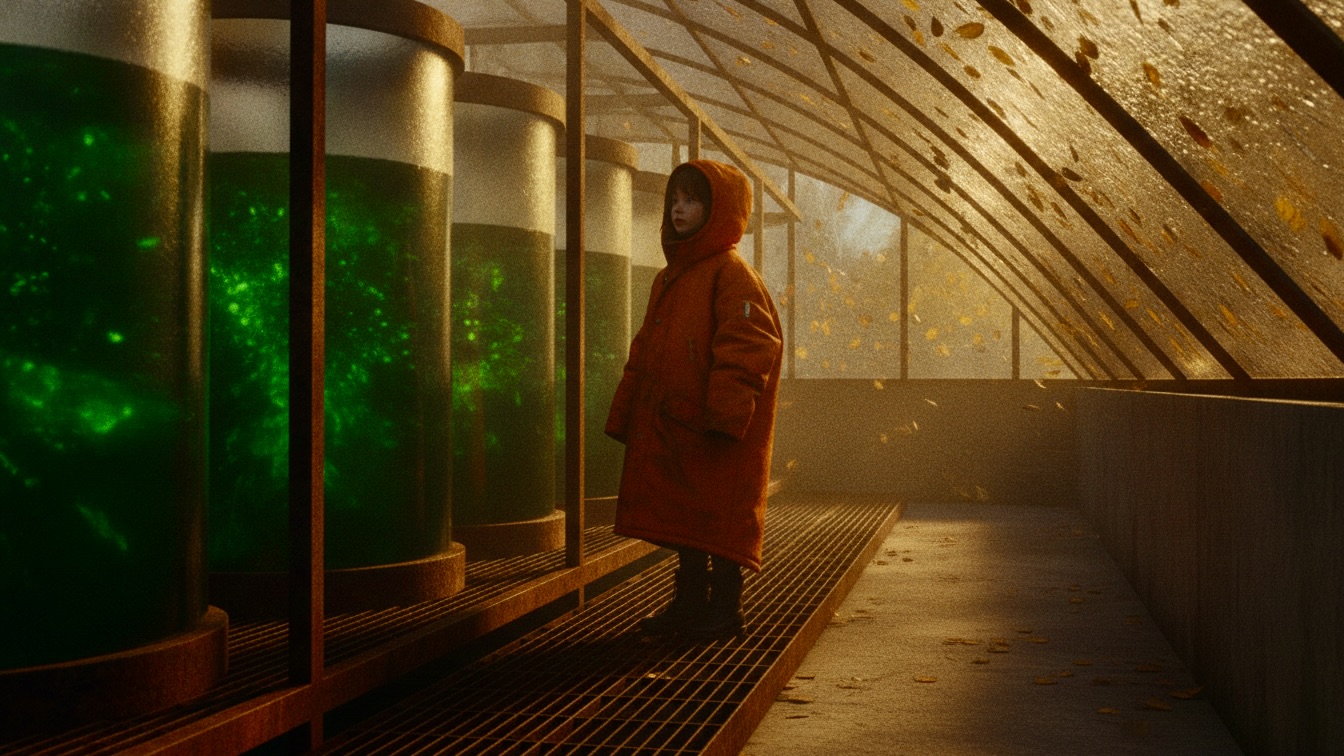
The canopy over Portage Avenue turned sick, bright yellow. Mona knew the noisy, bright summer was finally dead.
The glass above Portage Avenue turned a sick, highlighter yellow.
Mona pressed her knuckles against the cold pane. The metal frame vibrated. It buzzed right up her arm and rattled her teeth.
"Look at it," Mona said.
David coughed. A hard, rattling sound that shook his narrow shoulders.
"Don't look at the canopy," David said. "Look at the dial."
"It's dying," Mona said.
"It's turning over. It's autumn."
Mona hated autumn. Autumn meant the big, bright, noisy summer was gone. The green algae vats stopped bubbling so fast. The sun got thin. The metal walkways turned sharp with ice. She liked the heat. She liked the loud, booming thunderstorms that shook the bio-dome. Now, everything was getting quiet and brittle.
"Read the dial," David repeated. He leaned against the aluminum railing. His face looked grey. Like dirty snow.
"Pressure is at forty," Mona said. She tapped the glass face of the gauge. The needle fluttered.
"Too low."
"I'll crank it."
"Careful."
Mona wrapped both hands around the heavy iron wheel. The metal was freezing. It bit into her palms. She planted her boots on the steel grating. She pulled. Her shoulders popped. The wheel shrieked. A loud, terrible metal-on-metal scream.
"Stop," David gasped.
Mona let go. She stumbled back. The wheel spun a quarter turn on its own.
David doubled over. He grabbed the railing with both hands. His knuckles went completely white. He coughed again. This time, it sounded wet. It sounded like tearing paper.
"David?" Mona took a step forward.
He held up one hand. The universal signal to wait. But he didn't stop coughing. His chest heaved. He slipped. His knees hit the grating with a loud, hollow clang.
"David!"
Mona ran to him. She grabbed his heavy canvas jacket. It was stiff and cold. She tried to pull him up. He was entirely dead weight. He slumped sideways. His cheek pressed against the freezing metal floor.
"Help!" Mona screamed. She looked up and down the long walkway. "Somebody help!"
The massive bio-reactors hummed below them. They were louder than her voice. Huge vats of bright green liquid, churning and bubbling. They didn't care about David. They just kept churning.
Mona slapped the emergency button on the wall. A red light started spinning. A harsh, electronic siren blared.
Medical drones buzzed down from the upper tracks. They looked like giant, white beetles. They landed on the walkway with heavy thuds. Two medics jumped out. They wore bright yellow vests. The color hurt Mona's eyes.
"Back away," the first medic said.
"He can't breathe," Mona said. She didn't move.
"I said back away, kid." The medic shoved her shoulder.
Mona stumbled back. Her boot caught on a raised bolt. She fell hard. Her tailbone hit the steel. A sharp pain shot straight up her spine.
She sat there on the cold metal. She watched them roll David onto a flat stretcher. His eyes were closed. His mouth was open. He looked incredibly small. Like a deflated balloon.
"Where are you taking him?" Mona asked.
"Sector Four Clinic," the second medic said. He didn't even look at her. He slammed the stretcher into the drone.
"But the harvest," Mona said. Her voice cracked. "We have to finish the harvest."
The doors of the drone slid shut. The rotors spun up. The wind from the blades whipped Mona's hair across her face. It stung her cheeks. The drone lifted off, rising toward the yellow canopy.
Mona sat alone on the walkway. The siren stopped spinning. The red light shut off.
The silence was enormous. It pressed against her ears.
She looked down at the vats. The green sludge was bubbling slower. The temperature was dropping. David was gone. She was twelve years old. She was completely alone. And the city needed the algae to survive the winter.
The basement of the bio-reactor was loud. A constant, angry hum.
Mona held the heavy steel wrench. Her hands shook. She squeezed the metal tighter, trying to force her fingers to stay still.
The thermal manifold was a giant metal box covered in twisting copper pipes. A digital screen on the front blinked red.
12 DEGREES.
Algae died at ten degrees.
"Come on," Mona whispered.
She slammed the wrench onto the main bolt. It was stripped. Smooth and ruined. She pulled with all her weight. The wrench slipped. Metal screamed against metal.
Her knuckles slammed into the frozen pipe.
Pain shot up her arm. A violent, electric shock of pain. She dropped the wrench. It clattered loudly on the steel grate. She grabbed her hand, squeezing her fingers together.
A heavy metal door opened behind her. The sound echoed off the concrete walls.
"Mona."
It was Leo. Jack stood right behind him. They both wore thick, shiny winter coats. The kind with the reflective silver stripes. Their backpacks were stuffed tight. Straps hanging everywhere.
"What are you doing?" Mona asked. She hid her throbbing hand behind her back.
"We're leaving," Leo said. He shifted his heavy backpack. The buckles clinked.
"The transport leaves in an hour," Jack added. He wouldn't look at her. He stared at the flashing red screen on the manifold.
"You can't leave," Mona said.
"We have tickets for the southern dome," Leo said.
"The harvest isn't done," Mona said. Her voice was too loud. It bounced off the walls.
"David is gone, Mona. He's not coming back."
"He's at the clinic!"
"He has lung-rot," Jack said. He finally looked at her. His eyes were wide. Scared. "My dad said he's not coming back. He said the whole sector is going to freeze."
"It's not going to freeze. I'm fixing the manifold."
Leo looked at the wrench on the floor. He looked at the red numbers.
11 DEGREES.
"You're just a kid," Leo said.
"We're the same age!" Mona yelled.
"My parents are taking me south. You should come. Your uncle is down there."
"I'm not leaving the vats. If the algae dies, the food printers shut down. People will starve."
"That's not your problem," Jack said.
"Yes, it is!" Mona stepped forward. She shoved Jack in the chest.
Jack stumbled back. His heavy boots scraped against the concrete.
"Don't touch him," Leo said. He pushed Mona back.
Mona hit the metal manifold. The cold iron bit through her thin shirt. The chill sank directly into her spine.
"Fine," Mona snapped. "Go. Go be cowards."
Leo zipped his jacket all the way up to his chin. The zipper made a sharp, ripping sound.
"Have a good winter, Mona," Leo said.
They turned around. They walked out the heavy metal door. They didn't look back. The door slammed shut behind them. A loud, final boom.
Mona stared at the door. Her chest felt tight. Like someone had wrapped a thick rubber band around her ribs. She breathed in sharp, shallow gasps. She kicked the wrench. It slid across the grate and hit the wall with a dull clank.
She looked back at the screen.
10 DEGREES.
The alarm started. A high, piercing beep. Beep. Beep.
The green vats below started to slow down. The bubbles stopped popping. The surface of the algae turned glassy.
Summer was over. The freeze was here.
The main sector siren started. A high, shrieking wail.
Red lights spun on the ceiling.
Mona covered her ears. The sound was too big. It filled the whole basement. It vibrated in her teeth.
FROST WARNING. FROST WARNING.
The automated voice was perfectly calm. That made it worse.
The glass above cracked. A sharp, loud pop. Like a firecracker.
Ice crawled across the high windows. Fast. Like white, jagged spiders. The temperature in the room dropped instantly. Mona saw her breath puff out in a white cloud.
The manifold screen hit 09 DEGREES.
The algae vats stopped bubbling entirely. The bright green sludge turned dark. Thick. Like cold pudding.
Mona ran.
She ran up the metal stairs. Her boots banged loudly on the grating. She burst through the double doors into the main concourse.
It was chaos. Technicians were sprinting. People bumped into her. A man in a blue jumpsuit knocked her shoulder hard. She spun around, almost falling.
"Get to the shelters!" the man yelled. He didn't stop running.
Mona didn't go to the shelters. She ran the other way. Down the long, dark corridor toward the old transit depot.
The air in the corridor was freezing. It burned her throat. Her lungs ached with every breath.
She reached the chain-link fence. The transit depot was abandoned. Inside, piles of old commuter bicycles sat rusting in the dark. They were bright orange. The paint was peeling.
Mona grabbed the padlock on the fence. It was heavy and cold. She didn't have the key.
She picked up a broken piece of concrete from the floor. It was heavy, rough, and scraped the skin off her palms. She raised it high above her head and smashed it down on the padlock.
Clang.
The concrete broke in half. The lock didn't move.
Mona screamed. A wordless, angry sound. She grabbed a loose steel pipe from the wall. She jammed it into the gap between the lock and the chain. She threw her entire body weight backward.
The chain snapped. The gate swung open.
Mona ran to the first pile of bikes. The kinetic batteries were mounted on the rear wheels. Big, black, heavy boxes. They stored energy from people pedaling.
She pulled a multi-tool from her pocket. Her fingers were numb. They felt like thick, clumsy sausages. She flipped open the screwdriver blade.
She jammed it into the battery bracket. She twisted. The plastic housing cracked. She ripped the wire out with her bare hands. A tiny blue spark bit her thumb.
She ignored it. She pulled the battery free. It weighed at least thirty pounds.
She grabbed a second one. She hugged them both to her chest. They were freezing cold plastic. They dug into her ribs.
She ran back down the corridor. Her boots slipped on patches of frost. Her breath came in ragged, burning gasps. Her arms felt like they were going to rip out of their sockets.
She reached the basement. The siren was still screaming.
07 DEGREES.
The algae was freezing. A thin crust of white ice was forming on the top of the green sludge.
Mona dropped the batteries on the floor. Boom. Boom.
She grabbed the red and black jumper cables hanging from the broken manifold. She clamped the red jaw onto the positive terminal of the first bike battery.
A shower of yellow sparks erupted. They hissed and spit onto the steel floor.
She clamped the black jaw.
She grabbed the secondary cables and linked the two batteries together. The wire got hot instantly. It burned her palm. She didn't let go.
She jammed the main power feed directly into the vat's emergency override port.
The screen on the manifold flickered. The red numbers vanished.
A loud, deep thrum vibrated through the floor. The lights in the basement dimmed, then flared bright white.
The vats shuddered.
A single, massive bubble rose from the bottom of the green sludge. It broke the surface of the ice with a wet, heavy smack.
Then another.
The screen booted back up. Green numbers this time.
11 DEGREES.
Climbing.
The vats bubbled. A low, rhythmic, wet sound.
Mona sat on the floor. Her knees were pulled tight to her chest. Her orange winter coat was smeared with black grease.
The bike batteries hummed. They vibrated against the steel grate. The green sludge glowed a tiny bit brighter now. The light cast strange, moving shadows on the concrete walls.
The digital screen on the wall chimed. A soft, polite bell.
Mona looked up.
David's face appeared on the monitor. The video feed was choppy. Pixels jumped across his cheek. He had clear plastic tubes running into his nose. He looked worse than before. His skin was the color of old paper.
"You fixed it," David said. His voice was a thin, raspy whisper. It crackled through the cheap speaker.
"I used the transit bike batteries," Mona said. She didn't smile.
"Smart kid."
"The manifold is completely dead. The batteries won't last forever."
"They'll last until morning," David said. "The day-shift crew will bring a new manifold."
Mona stared at the screen. She watched the way David's chest barely moved when he breathed.
"Are you coming back tomorrow?" Mona asked.
David looked away from the camera lens. He looked at something off-screen. A machine beeping in his clinic room.
"My lungs are done, Mona," he said. He didn't look back at her.
Mona squeezed her knees harder. The seams of her jeans dug into her skin.
"You can't just be done," Mona said. "You're the chief technician."
"Not anymore."
"I don't know how to run the winter harvest alone."
"You just saved the sector's food supply," David said. "You know how."
"I'm twelve!"
"The frost doesn't care how old you are," David said. He coughed. He quickly covered the microphone with his hand, but Mona could still hear the wet, tearing sound. "You did good today, Mona. You kept the spark alive."
The screen went black. The call disconnected.
Mona sat in the dark for a long time. The only light came from the bubbling green vats.
She stood up. Her legs were stiff. Her back ached.
She walked over to the food pallet station. Huge, heavy blocks of dried algae paste were stacked on wooden skids. This was the winter food supply. She grabbed the heavy canvas tarps. She threw them over the pallets, pulling the rough fabric tight. She tied the thick nylon ropes, securing the knots with bruised, clumsy fingers.
She was doing David's job. She was doing a man's job.
She finished tying the last knot. She wiped her hands on her coat.
She walked over to the metal stairs. She climbed them slowly. Her boots felt like they were made of lead.
She pushed open the heavy roof access door.
The cold hit her like a physical blow. It slapped her face and stole the breath right out of her lungs.
She stepped out onto the roof.
The bio-canopy over Portage Avenue was completely frozen. The bright yellow leaves were trapped inside thick blocks of white ice. The city was silent. The loud, booming summer was completely gone, buried under the frost.
Mona walked to the edge of the roof. She gripped the icy metal railing.
She stared up at the endless, crushing grey of the snowy sky, completely alone.
“She stared up at the endless, crushing grey of the snowy sky, completely alone.”


