The chainsaw cuts were jagged, leaving the century-old stump looking like a shattered bone in the mud.
The sawdust clung to the treads of my boots. I scraped the rubber sole against the exposed root, watching the wet, blonde flakes drop into the mud. The stump was massive. Ten feet across. A century-old western red cedar, butchered. The chainsaw cuts were jagged, amateurish, leaving the remaining wood looking like a shattered bone jutting from the forest floor.
I knelt. The ground around the stump was churned into a slurry of pine needles and black earth. Deep, aggressive tread marks cut through the ferns. Amphibious vehicles. Eight-wheelers. They had winched the massive log straight down the embankment toward the river.
I pulled the radio from my chest rig. The plastic shell was cold against my palm.
"Dispatch, this is Tracker Four. I have a fresh kill site at grid line seven-niner. Over."
I held the receiver to my ear. Static hissed. A sharp, digital whine cut through the white noise, vibrating against my eardrum. Jamming signal.
"Dispatch, do you copy?"
More digital squealing. I killed the power and shoved the radio back into its pouch. They were close. You don't run a localized jammer unless you're still in the gorge.
I walked to the edge of the embankment. The river was eighty feet below, a swollen vein of slate-gray water ripping through the canyon. Late October. The autumn rains had been relentless for three weeks. The water level was up four feet, surging over the jagged basalt rocks that lined the banks. The current folded over itself, creating massive, boiling eddies that sucked down dead branches and spat them out fifty yards downstream.
It looked exactly like it did three years ago.
My chest tightened. A sharp, physical contraction in my ribs. I dug my fingers into the rigid nylon of my vest. I closed my eyes, but that only made the visual sharper. Sandy's yellow helmet. The white foam rushing over it. The bright orange paracord snapping under the tension. The way her hand breached the surface, grasping at the empty air for a fraction of a second before the hydraulic undertow dragged her into the dark.
I opened my eyes. The gorge was empty. Just the deafening roar of the water echoing off the canyon walls.
I turned back to the mud. The amphibious tracks led straight into the water. They had a barge. A shallow-draft logging barge, probably retrofitted with twin outboard motors to fight the current. They were taking the timber downriver, bypassing the highway checkpoints entirely.
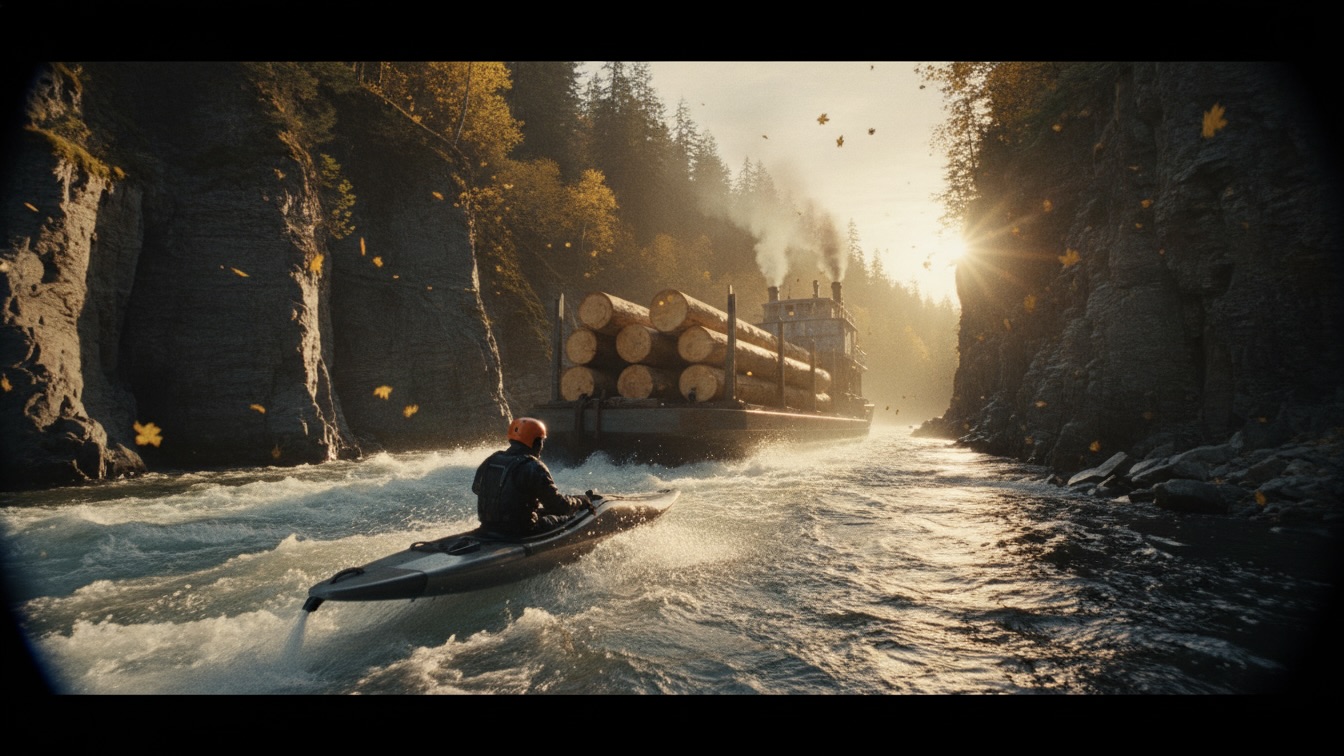
I walked back to my truck parked in the brush. I unlatched the rear gate and grabbed the handle of the jet-kayak. It was a custom rig. Kevlar-reinforced hull, electric jet-drive mounted flush with the stern, designed for rapid pursuit in shallow, rocky water. I dragged it over the moss, the plastic hull groaning against the stones, and slid it down the embankment.
I strapped on my helmet. I checked the seal on my drysuit. I racked the slide on the Glock 20 secured to my chest rig. The metallic clack was loud, definitive.
I pushed the kayak into the shallows. The water instantly gripped the nose, trying to rip it downstream. I swung my leg over, dropping into the seat, and grabbed the carbon-fiber paddle. I hit the ignition switch on the console. The electric jet-drive whined to life, a high-pitched hum that vibrated through the plastic seat and into my spine.
I peeled out of the eddy and hit the main current.
The acceleration was violent. The river grabbed the hull and threw it forward. The autumn wind bit into my exposed cheeks, driving icy pinpricks of rain into my skin. The canyon walls blurred past, a streak of dying yellow maples and dark green firs.
I kept my eyes on the water. Reading the surface. The V-shaped ripples indicating submerged boulders. The flat, boiling spots masking deep hydraulics. I feathered the throttle, letting the jet-drive push me through the turbulent chop.
"Focus," I muttered.
The word was snatched away by the wind. I gripped the paddle tighter, my knuckles turning white beneath my neoprene gloves.
The river bent sharply to the left. The canyon narrowed. The basalt cliffs rose higher, blocking out the afternoon sun. The water turned black in the shadows. This was the entry to the Widow-maker gorge. The worst stretch of water in the Cascades.
I saw the first sign of them. A bright orange plastic wedge, used for felling timber, bobbing in a swirling eddy against the left bank.
I pushed the throttle forward. The jet-drive screamed. The kayak surged over a three-foot standing wave, the hull slapping hard against the trough. Water exploded over the bow, hitting me in the chest like a bag of wet cement. I gasped, the cold shocking my lungs.
I blinked the water from my eyes. Up ahead, the river narrowed into a violent chute. The water was a chaotic mess of white foam and jagged black rocks.
I leaned forward. I needed to catch them before the sun dropped below the tree line. If they made it to the delta in the dark, they would vanish.
I dug the paddle into the water, steering the nose into the apex of the V-wave. The kayak plummeted down the chute. The noise was absolute. A roaring, physical pressure that crushed against my eardrums. I braced my boots against the footpegs, letting the hull absorb the violent impacts of the rapids.
I was in the gorge. There was no turning back.
The water here didn't flow. It collided. It ripped itself apart against the submerged basalt shelves. I kept the throttle at seventy percent, using the jet-drive to maintain steering control. If you lose momentum in the Widow-maker, the river spins you, pins you, and crushes you.
I spotted the anomaly fifty yards ahead.
The current was breaking wrong. A smooth, unnatural hummock of water rolling over a stretch that should have been a deep, clear channel.
I cut the throttle. I back-paddled hard, the carbon-fiber blades bending under the strain.
It was a trap.
Two massive Douglas fir logs, stripped of bark, had been cabled together and anchored just inches below the surface. They were positioned perfectly at the exit of a tight bend. If I had hit them at full speed, the Kevlar hull would have split like an eggshell, and the hydraulic pressure would have pinned me under the timber.
"Bastards," I said.
I wrenched the kayak to the right, aiming for a narrow, rock-strewn slot near the canyon wall. The hull scraped violently against the stone. A jarring, bone-rattling vibration shot up my legs. I threw my weight to the left, lifting the right edge of the kayak just enough to slide off the rock.
I cleared the trap by inches.
The river widened. The turbulence smoothed into a fast, deep glide.
The sun dipped below the canyon rim. The light shifted instantly from a harsh, glare-heavy gray to a deep, bruising purple. The temperature plummeted. I felt the cold seeping through the neoprene of my drysuit, settling into my joints.
I saw them.
A quarter-mile ahead. A flat-bottomed steel barge, fifty feet long, loaded with massive sections of old-growth timber. Two massive outboard motors churned the water at the stern. The amphibious eight-wheeler was parked on the deck, strapped down with heavy chains.
I cut the jet-drive entirely. I didn't want the electric hum carrying over the water.
I used the paddle to navigate, staying close to the right bank, letting the shadows of the overhanging cedars hide my approach. The current was carrying me faster than the barge was moving. They were fighting the river, trying to keep the heavy load from spinning out of control.
I closed the distance. Two hundred yards. One hundred.
I could hear the deep, throaty idle of their outboards over the ambient rush of the water. I saw a figure standing near the stern, a rifle slung across his chest. He was looking at the left bank, watching the treeline.
Fifty yards.
I pulled the paddle from the water and laid it flat across my lap. I unholstered the Glock, keeping it low against my chest. I steered with slight shifts of my body weight.
The rear of the barge loomed over me. A wall of rusted steel and peeling black paint. The exhaust ports of the outboards spat heated air and water just feet from my face.
I grabbed the heavy rubber bumper that lined the stern of the barge. The momentum jerked my arm, nearly dislocating my shoulder. I clamped my hand down, my gloves squeaking against the wet rubber.
I clipped a carabiner from my vest to the steel mesh of the barge's railing. The kayak swung violently against the steel hull.
I pulled myself up. The metal was freezing. I hooked my boot onto a welded cleat and hoisted my torso over the railing.
I rolled onto the deck. The steel plates were slick with river mud and machine grease.
I crouched behind a stack of freshly cut cedar logs. The raw wood was bright yellow in the fading light.
Footsteps. Heavy boots ringing against the steel deck.
I pressed my back against the timber. I raised the Glock.
The guard walked around the edge of the logs. He was young, maybe twenty-five, wearing a grease-stained canvas jacket and a black beanie. He held a modified AR-15, the stock tucked under his arm.
He saw my wet boot prints on the deck. He froze.
"Hey!" he yelled.
He didn't hesitate. He swung the rifle toward me and squeezed the trigger.
The muzzle flash was a blinding strobe of yellow light. The noise was deafening, a sharp, concussive crack that hit my chest like a physical blow.
The bullet slammed into the cedar log inches from my face. Splinters exploded outward, sharp as glass. One raked across my cheek. I felt the sudden warmth of blood welling up.
I lunged forward. I grabbed the hot barrel of his rifle with my left hand, shoving it upward. The metal seared the palm of my glove.
He fired again. The bullet punched a hole through the metal awning above us.
I slammed the base of my Glock into his cheekbone. The bone crunched. He staggered back, his hands slipping from the rifle.
I swept his legs. He hit the deck hard, his skull bouncing against the steel plates.
"Victor!" he screamed. "We got a tracker on board!"
More footsteps. Running from the bow.
I dropped the guard's rifle and spun around.
A massive man stepped out from behind the amphibious vehicle. He wore a heavy tactical vest over a flannel shirt. He carried a pump-action shotgun.
"Drop it!" Victor roared.
He racked the slide. The sound was distinct. Heavy. Final.
I didn't drop it. I dove sideways as he fired.
The buckshot tore through the air where my chest had been a fraction of a second before. The pellets shredded the bark of the logs behind me.
I hit the deck and slid on the grease. I fired two rounds toward him. One sparked off the steel hull of the Argo. The other caught him in the meat of his left thigh.
He grunted, stumbling forward, but he didn't go down. He pumped the shotgun again.
I scrambled toward the edge of the barge. There was no cover left.
"You're dead, tracker!" Victor yelled.
He fired.
The blast caught the edge of my Kevlar vest. The impact was like being hit by a baseball bat swung by a machine. It lifted me off my feet. The air was forced from my lungs in a violent rush.
I flew backward. Over the railing.
I hit the water.
The river swallowed me.
The cold was an absolute entity. It didn't just touch my skin; it invaded my bones. It seized my diaphragm, locking my lungs in a rigid spasm. I couldn't breathe. I was tumbling underwater, disoriented, the roar of the current muffled into a deep, terrifying thrum.
I opened my eyes. The water was pitch black. Debris slammed into me. A submerged branch raked across my thigh. A smooth stone cracked against my knee.
I didn't know which way was up. The current was spinning me like clothing in a washing machine.
My lungs burned. The panic flared, a bright, hot spike in the center of my brain.
Sandy.
The image flashed again. Her hand reaching. The water rushing over her helmet.
I thrashed my arms. My hand struck something solid. A rock shelf. I grabbed it, my fingernails scraping against the algae-slick stone. I pulled myself toward it, fighting the immense, dragging weight of the river.
My head broke the surface.
I gasped. The icy air tore at my throat. I was coughing violently, expelling river water.
I was fifty yards downstream from the barge. The boat was a dark shadow moving away, the engine noise fading into the roar of the rapids.
I kicked my legs, aiming for the right bank. The current fought me, trying to drag me back into the main channel. I caught a submerged root, wrapping my arm around it. The wood was slick and rotting, but it held.
I dragged myself out of the water.
I collapsed onto the jagged basalt stones. My entire body was convulsing. Uncontrollable, violent shivers wracked my shoulders and spine. The hypothermia was setting in fast. My drysuit had ruptured when the buckshot hit the vest. Freezing water was pooling inside the legs.
I sat up. The movement was slow, uncoordinated. My fingers were stiff, unresponsive claws.
I forced myself to stand. I stumbled into the treeline, moving blindly through the dark. The ferns brushed against my legs, dumping more cold water onto my gear.
I needed a fire.
I found a hollow beneath the massive roots of an overturned spruce. The dirt beneath it was dry. I fell to my knees.
I fumbled with the waterproof pouch on my belt. My hands wouldn't work. I had to use my teeth to pull the zipper open. I dumped the contents onto the dirt. A magnesium fire starter. A bundle of dry lint and birch bark.
I grabbed the metal rod and the striker. I couldn't grip them properly. I dropped the striker twice.
"Come on," I whispered. My jaw was locked, the words slurring through chattering teeth.
I pinned the rod against the birch bark with my left thumb. I struck it with my right hand. A shower of white-hot sparks rained down.
The bark caught. A tiny, fragile tongue of orange flame.
I cupped my hands around it, protecting it from the wind. I fed it small twigs, dry pine needles. The flame grew. The heat radiated outward, a microscopic sphere of survival in the dark.
I stripped off my ruined drysuit. The cold air hit my wet clothes beneath, shocking my system again. I huddled closer to the fire, holding my bare hands inches from the flames. The skin was pale, wrinkled, completely numb.
The heat began to penetrate. The numbness turned into a deep, agonizing ache.
I stared into the fire. The wood snapped and hissed.
I remembered the last conversation I had with Sandy. We were sitting on the tailgate of my truck, drinking cheap coffee from a thermos. It was the morning of her final run.
"You worry too much, Noel," she had said.
"The river's high," I had replied. "The hydraulics are unpredictable today."
She had smiled. That confident, careless smile. "I know how to read the water."
I hadn't said anything else. I had just nodded. I hadn't told her to be careful. I hadn't told her I loved her. I had just watched her walk away, secure in the belief that she was invincible.
I squeezed my eyes shut. A single tear escaped, instantly freezing against the raw skin of my cheek.
"I should have stopped you," I said to the fire.
The flames crackled, indifferent.
I spent the night feeding the fire, fighting off the encroaching dark. I checked my Glock. It had survived the water. I had one full magazine left. Fifteen rounds.
As the first gray light of dawn crept over the canyon rim, the shivering stopped. My body core was stabilizing. I was exhausted, bruised, and hungry, but I was functional.
I put my damp gear back on. The wet fabric was miserable against my skin.
I walked down to the riverbank. The water was a pale, churning gray in the morning light.
The barge was gone, but they couldn't have gone far. The river narrowed significantly three miles downstream at a place called the Devil's Throat. The water was shallow there, choked with boulders. They would have to navigate it at a crawl.
I knew a shortcut over the ridge.
I started climbing.
The climb was brutal. The underbrush was thick with thorny salmonberry bushes that tore at my clothes and scratched my face. My legs felt like lead. Every step was a negotiation with gravity and exhaustion.
I reached the top of the ridge. The gorge dropped away below me, a steep, densely forested slope ending in a sheer cliff above the river.
I looked down at the Devil's Throat.
The river squeezed between two massive basalt pillars. The gap was barely forty feet wide.
I saw the barge.
It was anchored in a wide eddy a quarter-mile upstream from the narrows. They were waiting for full daylight before attempting the passage. I could see the crew moving around the deck. Victor was standing near the bow, looking through a pair of binoculars.
I moved down the slope, keeping low, using the massive trunks of the fir trees for cover. I reached a rocky outcropping directly above the narrows.
A massive dead ponderosa pine leaned precariously over the cliff edge. Its roots were exposed, clinging to a thin layer of soil. The trunk was perfectly positioned over the narrowest part of the river.
I opened my tactical pouch. I pulled out a block of C4 plastic explosive and two electronic detonators.
I crawled to the base of the pine. I molded the C4 into the deep cracks of the trunk, focusing the blast energy inward to sever the remaining wood. I inserted the detonators and stepped back, unspooling the firing wire.
I retreated to a cluster of boulders fifty feet up the slope. I hooked the wire to the clacker.
I waited.
The sun crested the ridge, flooding the canyon with hard, golden light. The shadows retreated.
The deep thrum of the outboard motors echoed up the canyon walls.
The barge detached from the eddy. It moved slowly, awkwardly, fighting the turbulent water as it approached the narrows. Victor was at the helm, his face a hard, determined mask.
"Come on," I whispered.
The bow of the barge entered the chute between the basalt pillars.
I squeezed the clacker.
The explosion was a sharp, cracking boom that shook the ground beneath me. A cloud of dust and splintered wood erupted from the base of the pine.
The massive tree groaned. It tilted slowly at first, tearing its remaining roots from the soil. Then it fell.
It crashed across the gap, an eighty-foot wall of solid timber dropping directly into the path of the barge.
Victor threw the engines into reverse. The water boiled behind the outboards, but the barge had too much momentum.
The steel hull slammed into the downed tree. The impact sounded like a train derailment. The deck buckled. The massive cedar logs shifted, snapping their retaining chains. One of the logs rolled off the side, crashing into the river and sending a geyser of water into the air.
I stood up from behind the boulder. I raised the Glock.
"Victor!" I shouted. My voice echoed off the canyon walls.
Victor looked up. He saw me standing on the cliff.
"You son of a bitch!" he roared.
He grabbed an assault rifle from the deck and fired. The bullets chipped the rock face ten feet below me.
I returned fire. I aimed for the engine block of the port outboard. The heavy 10mm rounds punched through the plastic cowling. Metal sparked. A plume of black smoke erupted from the motor, and it sputtered and died.
The crew panicked. Three men dove off the stern, swimming frantically toward the rocky shore.
Victor didn't run. He stood his ground on the angled deck, firing wildly up the cliff.
"Come down here!" he screamed.
I shot the starboard engine. It shattered, spraying oil across the deck. The barge was dead in the water, pinned against the tree.
I scrambled down the rocky slope, sliding the last ten feet and landing hard on the riverbank.
I stepped onto the trunk of the fallen pine and walked out over the water.
Victor was backed against the pilothouse. His rifle was empty. He dropped it and pulled a heavy hunting knife from his belt. His leg was wrapped in a bloody bandage from our previous encounter.
I kept the Glock leveled at his chest.
"It's over," I said.
He laughed. A harsh, grating sound.
"You think you won?" he sneered. "We already shipped ten loads this month. This one tree doesn't change anything."
"Drop the knife."
He took a step forward. "You look awful familiar, tracker. I remember a girl wearing the same uniform a few years back. Right about this stretch of water."
My finger tightened on the trigger. The metal pressed against my skin.
"She screamed a lot before she went under," Victor said. He smiled. His teeth were stained with tobacco. "She wasn't a very good swimmer."
The rage hit me like a physical force. It blinded me. I wanted to pull the trigger. I wanted to put a round through his face and watch him fall into the river.
I stared at him. The water roared beneath us.
"Shoot me," he taunted. "Do it."
I lowered the gun.
I aimed at the inflatable raft tied to the side of the barge. I fired twice. The rubber burst. The raft deflated instantly, sinking into the current.
I holstered the Glock.
"The river is rising," I said. "And that barge is taking on water. Good luck."
I turned my back on him. I walked across the log and stepped onto the shore.
"You coward!" Victor screamed behind me. "Come back here!"
I didn't stop. I walked up the embankment.
Twenty minutes later, I heard the heavy, rhythmic thumping of helicopter rotors echoing down the gorge. I stopped on the ridge and looked back.
Two dark green tactical choppers bearing the state insignia hovered over the Devil's Throat. SWAT operatives were repelling down onto the sinking barge. Victor was on his knees, his hands behind his head.
I watched them secure him. I waited for the feeling of relief. The closure. The sense that I had finally balanced the ledger for Sandy.
It didn't come.
There was only the cold autumn wind blowing through the pines, and the endless, indifferent roar of the river below.
The rotor wash from the tactical choppers flattened the dead ferns, but I was already walking into the timber, letting the shadows swallow my tracks.
“The rotor wash from the tactical choppers flattened the dead ferns, but I was already walking into the timber, letting the shadows swallow my tracks.”


