Tommy navigates the frozen brick canyons of Winnipeg's Exchange District, dodging modern outlaws and ancient ghosts of prairie ambition.
Tommy’s left boot had a hole in the sole that was currently welcoming the damp reality of an October puddle. It wasn't just water; it was a slurry of grit and generations of failed urban planning. He kicked a discarded vape pod—neon pink and smelling of nothing because the scent-receptors in his brain had effectively resigned years ago—and watched it skitter across the Tyndall stone. The stone was full of fossils. Little squiggly things that died millions of years ago just to end up as the siding for a boutique marketing agency. The Exchange District was like that. A lot of things had to die to make it look this expensive and abandoned.
He pulled his collar up. The wind in Winnipeg didn't just blow; it searched for weaknesses. It was a predatory air, a draft that knew exactly where your thermal layers ended and your skin began. He looked up at the grain exchange building. Back in 1910, people here were making enough money to buy literal empires, and now, the most profitable thing in a three-block radius was probably a parking meter that didn't take credit cards. He felt a vibration in his pocket. It was his phone, buzzing with the frantic energy of a trapped hornet.
"Where are you?" the text from Jack read. "I'm literally vibrating with anxiety. Also, I think a crow is judging me."
Tommy didn't reply. Typing in this cold was a commitment he wasn't ready to make. His thumbs felt like frozen sausages. He turned the corner onto Princess Street, where the buildings leaned in like they were gossiping about the lack of foot traffic. The brickwork was a deep, bruised red. It was the kind of architecture that demanded you have a top hat and a gambling debt. Tommy had neither, just a student loan and a persistent sense that he had missed the party by about a century.
He saw Jack standing under a flickering streetlamp. Jack was wearing a jacket that looked like it was made from recycled sleeping bags and a hat that sat so high on his head it defied physics. He was pacing. Jack didn't just walk; he agitated the space around him. He was a human glitch.
"You're five minutes late," Jack said, his voice jumping an octave as he saw Tommy. "In heist time, that's like three lifetimes. The security guard probably already finished his sourdough and is looking for things to oppress."
"It’s not a heist, Jack," Tommy said, his breath blooming in a white cloud that vanished instantly. "We're picking up a box. From a basement. That belongs to your uncle. This is basically a chore with better lighting."
"My uncle is an 'archivist of the discarded,'" Jack corrected, making air quotes that looked more like he was trying to catch a fly. "And this building is the old Ashdown Warehouse. It’s got history. It’s got vibes. It probably has ghosts that are annoyed we're not wearing corsets."
Tommy looked at the massive wooden doors of the warehouse. They were reinforced with iron straps. It looked like the entrance to a dungeon or a very exclusive club for people who enjoy tetanus. "Why couldn't he just give you a key?"
"Because the key is a concept," Jack whispered, leaning in. "And also because he lost it in 2014. We’re using the service entrance. The one that’s 'permanently' jammed but actually just needs a specific kind of violence applied to it."
Tommy sighed. His feet were reaching a level of numbness that suggested they might fall off and start their own lives. "Show me the violence, Jack. I'm freezing."
They moved down the alley. The walls were covered in murals that had been tagged so many times they looked like a fever dream of neon spaghetti. Above them, fire escapes hung like iron skeletons, waiting for a chase scene that would never happen. Tommy felt the weight of the city. It wasn't a heavy weight, just a persistent, annoying pressure, like a low-battery notification on the soul. This was the Chicago of the North, they used to say. Now it was just the Winnipeg of the North, which was a significantly harder sell for the tourism board.
Jack stopped at a heavy metal door that looked like it had survived a bombardment. There was a keypad that had been smashed with something heavy and blunt. Jack reached into his pocket and pulled out a screwdriver and a piece of plastic that looked suspiciously like a library card.
"If we get arrested, I'm telling them I'm your emotional support human," Tommy said.
"Relax," Jack muttered, jamming the plastic into the door frame. "The police don't come into the Exchange after dark unless there's a film crew or a fire. We're just two guys in the gig economy of destiny."
The door gave a groan that sounded like a dying whale and popped open. Dark, cool air spilled out. It didn't smell like anything to Tommy, but it felt heavy, like walking into a pool of invisible syrup. They stepped inside, and the door clicked shut behind them, cutting off the orange glow of the streetlamps and leaving them in a world of grey shadows and the hum of a distant transformer.
The interior of the warehouse was a forest of cedar pillars. Each one was the size of a redwood, holding up the weight of a century's worth of hardware and forgotten inventory. Tommy’s flashlight cut a lonely path through the dust motes. The floorboards creaked under his boots, a rhythmic snapping that sounded like small bones breaking. It was a rhythmic, percussive sound that echoed up into the rafters where the shadows were thick enough to hide a small aircraft.
"Section 4-B," Jack whispered. He was holding his phone like a compass, the screen glowing blue against his pale face. "The Uncle said it’s behind the crates of 'experimental gaskets.'"
"What makes a gasket experimental?" Tommy asked. He was looking at a pile of rusted gears that were stacked in the corner like a metallic cairn. "Does it have feelings? Does it want to be a frisbee?"
"Don't be a hater," Jack said. "The early 20th century was a wild time for plumbing. People were just trying things. It was the Wild West of steam valves."
They navigated a labyrinth of crates. The labels were hand-painted in a calligraphy that felt aggressively formal for something containing nuts and bolts. Winnipeg Hardware Co., Est. 1888. Tommy ran a hand over a crate. The wood was rough, splintery. He felt a sharp jab in his palm and cursed. A splinter had embedded itself in his thumb.
"Physical damage already?" Jack asked, not looking back. "Your HP is dangerously low for someone with no health insurance."
"Shut up," Tommy said, sucking on his thumb. The metallic taste of a tiny drop of blood was the only thing he could register. He looked around. The space felt enormous, a cathedral of commerce. He imagined the men who worked here a hundred years ago. They probably had mustaches that required their own zip codes and died of things like 'the vapors' or 'industrial sadness.' They worked fourteen-hour shifts and thought a cold potato was a luxury. And here he was, complaining because his LTE was dropping to two bars.
"Found it!" Jack yelled. The sound bounced off the brick walls and seemed to rattle the windows three floors up.
"Keep it down," Tommy hissed. "You want the ghosts to find us? Or worse, the hipster squatters?"
Jack was pointing at a small, lead-lined box tucked under a shelf. It looked out of place, like a piece of high-tech equipment from a 1950s sci-fi movie. It had a heavy iron handle and a lock that looked like it required a literal blood sacrifice.
"This is it?" Tommy asked. "It looks like a portable nuclear reactor for a dollhouse."
"It’s a ledger," Jack said, his voice dropping to a theatrical conspiratorial tone. "But not just any ledger. It’s the original payroll for the 1919 General Strike. My uncle says there are names in here that would change the 'heritage' status of half the mansions in River Heights."
Tommy looked at the box. "So we're here for historical gossip?"
"In this town, history is the only thing we have that isn't under construction," Jack replied. He grabbed the handle and pulled. He groaned. His face turned a shade of purple that matched the sunset they had just missed. "It’s... heavy. Why is paper so heavy?"
"Gravity works harder on things that are important," Tommy said. He stepped in and grabbed the other side of the handle. On the count of three, they hoisted it. It felt like lifting a small boulder made of condensed bureaucracy.
Suddenly, a light flickered at the far end of the floor. It wasn't a flashlight. It was the steady, clinical beam of a high-end tactical torch.
"Uh, Jack?" Tommy whispered.
"Yeah?"
"We have company. And I don't think they're here for the gaskets."
A voice boomed from the darkness, amplified by a megaphone that made it sound like the voice of a very angry god. "Attention unauthorized personnel! You are trespassing on private property owned by the Exchange Development Group. Drop the asset and put your hands on your heads!"
"Asset?" Jack squeaked. "They called a box of old paper an asset. That’s so corporate. I hate it."
"Run?" Tommy suggested.
"Run," Jack agreed.
They didn't so much run as they did a coordinated stumble while lugging forty pounds of historical scandal between them. Tommy’s boots hammered against the floorboards, the sound like a drum kit falling down a flight of stairs. Behind them, the tactical light swept through the pillars, illuminating the dust like a strobe light in a very depressing nightclub.
"They have boots!" Jack panted. "Professional boots! I can hear the traction!"
"Focus on your own feet!" Tommy shouted. They reached the service entrance, but the heavy door had swung shut. Tommy threw his shoulder against it. Nothing. The door was as solid as the city's refusal to fix the potholes on Main Street.
"The fire escape!" Jack pointed to a window high on the wall. A narrow metal ladder led up to it.
"We are not carrying this box up a ladder," Tommy said.
"Then we're leaving it?"
Tommy looked at the box, then at the approaching light. The light was closer now. He could see the silhouette of a man in a tactical vest. This wasn't a mall cop. This was a private security contractor, the kind of guy who spends his weekends watching videos about 'optimal tactical reloads.'
"Tie it to your belt!" Tommy yelled. Jack didn't ask questions. He pulled off his recycled sleeping bag jacket, threaded the sleeves through the box's handle, and tied it around his waist. He looked like a man trying to smuggle a safe in his pants.
They scrambled up the ladder. Tommy went first, his fingers gripping the cold iron. The metal was slick with condensation. He reached the window, which was luckily missing a pane, and hauled himself through. He turned back and grabbed Jack’s hand, pulling him up as the box clanged against the rungs of the ladder with the subtlety of a church bell.
They tumbled out onto the fire escape. The cool night air hit them like a splash of ice water. The Exchange District lay below them, a grid of orange and shadow. They were four stories up, standing on a platform that felt like it was held together by prayer and rust.
"Down!" Tommy commanded. They scrambled down the zig-zagging stairs. Each step sent a vibration through the entire structure. It was a rhythmic, metallic screeching that surely alerted every coyote in the Red River Valley.
They hit the alley floor just as the back door of the warehouse burst open. Two men in black gear stepped out.
"Freeze!" one of them yelled. He didn't pull a gun, but he pulled a taser, the little red laser dot dancing across Tommy’s chest like a hyperactive ladybug.
"Not today, Rent-A-Cop!" Jack yelled, and then he did something Tommy didn't expect. He threw his heavy jacket—with the box still attached—into a dumpster and jumped in after it.
Tommy didn't have time to process the tactical genius or insanity of the move. He followed. He landed on a pile of what felt like discarded cardboard and old menus. The dumpster smelled like nothing, which was a blessing, but the texture was unmistakable: trash.
"Stay low," Jack hissed.
The security guards ran past the dumpster, their footsteps echoing down the alley toward Albert Street. They were looking for two guys running, not two guys becoming one with the refuse of a sourdough bakery.
Tommy lay there, his heart hammering against his ribs like a bird in a cage. He looked at Jack. Jack had a piece of lettuce stuck to his hat.
"You're a genius," Tommy whispered. "A disgusting, trash-covered genius."
"It’s called 'environmental camouflage,'" Jack said, adjusting his glasses. "In the urban wilderness, the dumpster is the apex predator's blind spot."
They waited for five minutes, listening to the city. A distant siren. The hum of the wind. The sound of a pigeon landing on the rim of the dumpster. The bird looked at them with a cold, unblinking eye, then pecked at a piece of crust near Tommy’s head.
"We need to move," Tommy said. "Before they double back."
They climbed out, hauling the box with them. They were covered in dust and bits of paper, but they had the 'asset.' They ducked out of the alley and onto Bannatyne, moving quickly through the shadows. The street was empty, the grand old buildings standing like silent sentinels of a bygone era.
"Where to?" Tommy asked.
"The old theater on McDermot," Jack said. "My uncle has a friend who works the night shift. We can hide there until morning."
The Pantages Playhouse was a relic of a time when people went to the theater to feel important. Now, it was a quiet shell, used for the occasional fringe play or a corporate seminar on synergy. They slipped through a side door held open by a very sleepy man named Derek, who looked like he hadn't seen the sun since the late nineties.
"Is that it?" Derek asked, nodding at the box. He didn't seem surprised that two teenagers covered in dumpster residue were carrying a lead-lined chest into his lobby.
"The cargo is secured, Derek," Jack said with a salute.
Derek pointed toward the stage. "Go to the green room. There’s a space heater and some leftover pizza from the tech rehearsal. Don't touch the props for 'Macbeth.' They're cursed."
"Everything in this city is cursed, Derek," Tommy said, finally feeling the warmth of the building seep into his bones.
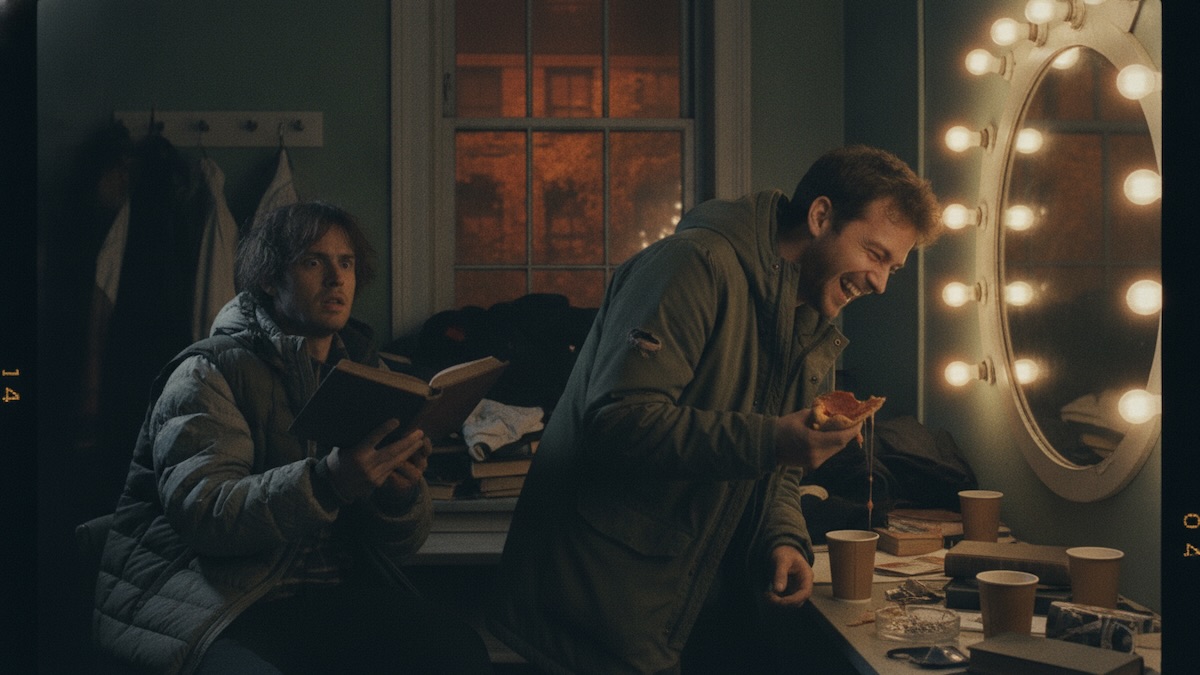
They found the green room. It was a cramped space filled with mismatched couches and a mirror lined with lightbulbs that made everyone look like they were auditioning for a role as a corpse. Tommy slumped onto a velvet sofa that had lost most of its velvet in the Great Depression. Jack set the box on a low table and immediately started working on the lock with a pair of needle-nose pliers he’d produced from his boot.
"Aren't you curious?" Jack asked, his tongue poking out the corner of his mouth as he picked at the iron latch.
"I'm tired, Jack. I'm tired and my left foot is a block of ice," Tommy said. He opened a pizza box on the table. There was one slice left. Cold pepperoni. He took a bite. It was stiff, salty, and the best thing he had ever tasted.
"Think about it," Jack said, his voice dropping. "The 1919 strike. The moment this city almost became something else. This box has the names of the people who funded the opposition. The 'Citizens' Committee of One Thousand.' The guys who called in the North-West Mounted Police to charge the crowds on Bloody Saturday."
Tommy chewed slowly. He looked at the ornate molding on the ceiling. "And what are we going to do with it? Cancel a bunch of dead guys?"
"No," Jack said, and for once, he wasn't joking. "We’re going to give it to the museum. But we’re going to make sure the story gets out first. Real history. Not the version they put on the plaques in the park."
There was a sharp click. The lock on the box snapped open. Jack paused, his hand trembling slightly. He looked at Tommy.
"Do it," Tommy said.
Jack lifted the lid. There was no golden glow. No puff of ancient air. Just a stack of leather-bound books, their covers cracked and peeling like old skin. Jack reached in and pulled out the top volume. He opened it to a random page.
His face fell.
"What is it?" Tommy asked, leaning forward.
Jack turned the book around. It wasn't a ledger of names. It was a collection of hand-drawn diagrams. Detailed, meticulous drawings of... birdhouses.
"Birdhouses?" Tommy repeated. He took the book. The Ornithological Architect: A Guide to Avian Housing in the Red River Valley, 1915.
"Wait," Jack said, diving back into the box. He pulled out another book. Seed Varieties of the Western Plains. Another. The Collected Poetry of Archibald Henderson, Volume III.
Tommy started to laugh. It started as a low rumble in his chest and turned into a full-blown cackle that echoed through the empty theater. "Your uncle... the 'archivist of the discarded'... sent us on a heist for a box of vintage birdhouse blueprints?"
Jack stared at the books, his mouth hanging open. "He said... he said it was the keys to the city. He said it was the most important thing he owned."
"To him, it probably is!" Tommy gasped for air. "He’s a nerd, Jack! We’re nerds! We just risked our lives for 1919's version of Pinterest!"
Jack looked at the book in his hand, then at Tommy, and finally, a slow, painful smirk spread across his face. "To be fair, this bluebird manor design is actually pretty sick. Look at the gables."
Tommy shook his head, leaning back into the sofa. The adrenaline was gone, replaced by a heavy, comfortable exhaustion. Outside, the first hints of dawn were beginning to grey the sky over the Red River. The Exchange District was still there, a collection of beautiful, ridiculous buildings filled with the ghosts of people who thought they were building the future, only to leave behind a box of birdhouse drawings.
"We’re still giving it to the museum," Jack said, hugging the book to his chest. "It’s still history."
"Sure, Jack," Tommy said, closing his eyes. "Just don't tell them about the dumpster."
They sat in the silence of the old theater, two young men in a city that was too old for its own good, waiting for the sun to come up over the prairie.
“As the light of dawn touched the box, Tommy noticed a small, hidden compartment in the lid that Jack hadn't seen yet.”


