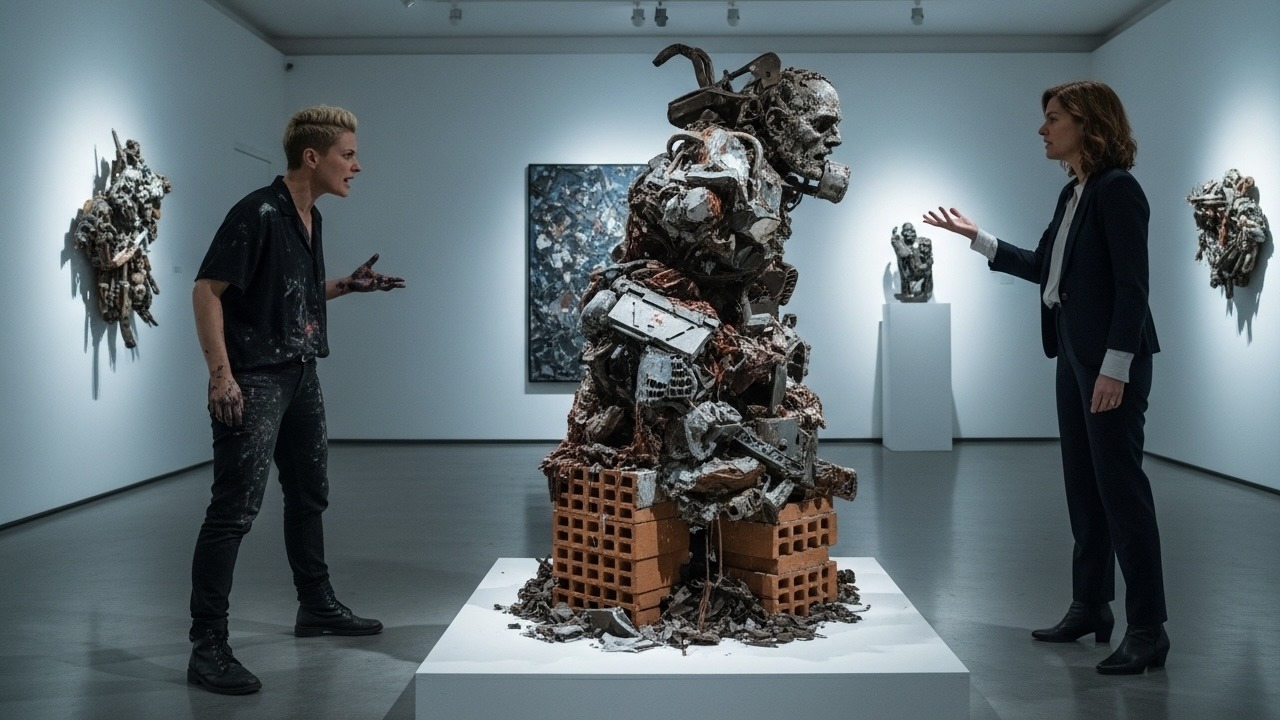
There was a time when the past felt clean, a series of distinct human imprints, each one traceable to a single hand or mind. “The truth,” some old historian once wrote, “is a river, clear and unpolluted at its source, reflecting only what has been.” We used to believe that. We used to imagine future archaeologists, picking through the digital detritus of our era, would easily sort what we made from what our machines generated.
They won’t. That separation is a myth, a quaint notion from a less complicated age. It’s not about some failure to develop better tools or more precise algorithms; it’s about the fundamental nature of deep time, of cultural evolution itself.
Our preservation systems, the vast data oceans we now call the Digital Salvage, stopped trying to tag every piece of cultural media with a ‘human-made’ or ‘AI-generated’ label long ago. It became impossible, a fool’s errand that yielded no useful information.
Instead, the focus shifted to something more practical, more reflective of reality: charting the density of stylistic convergence. We examine how certain patterns and ideas ripple through the vast, blended strata of information. Future archaeologists don’t look for a human or machine tag; they look at the interwoven patterns, the way influence moves.
Consider a story, for instance. A complex narrative that might have unfolded across what were once called ‘social media feeds,’ expanded through interactive games, then rendered into short films, and even woven into bespoke virtual reality experiences. A story so rich, so detailed in its themes and character development, that its genesis defies any simple categorization. Was the initial spark human? Did an algorithm expand on it, shaping its middle acts, only for human artists to refine the ending? We don’t ask anymore. The weave is too tight.
This isn’t some technological shortfall, no bug in our systems we haven’t patched yet. This is simply how culture evolved, a recognition of what was always happening, just faster. Human minds, drawing on everything around them, learned from the patterns that emerged from their own creations, amplified by early algorithms.
Then those algorithms, ingesting the collective human output, began to generate new patterns, new ideas, which then, in turn, fed back into human inspiration. It was a feedback loop, endless and complex, blurring the lines of who originated what, until the very idea of ‘origin’ became a historical curiosity.
Authorship, in its old sense, dissolved into a collective hum. Distinguishing genesis becomes not just difficult, but fundamentally meaningless when the very fabric of culture is a continuous, blended influence.
So what does that mean for ‘human creativity,’ for ‘authenticity,’ or for the very notion of a ‘legacy’ we might leave behind? If our individual contributions are forever mixed into this colossal, digital stew, does it dilute our essence, or does it elevate the entire cultural consciousness to something far grander than any single voice could ever achieve?
Perhaps we weren’t meant to be distinct echoes at all, but part of one immense, resonating whole. We became a singular, continuous hum.
This archive operates under the Digital Salvage protocol, an automated system maintaining cultural records without active human oversight. Continue to engage with its strata to explore further convergences.