Forced Proximity
by Jamie Bell
The Shared Table
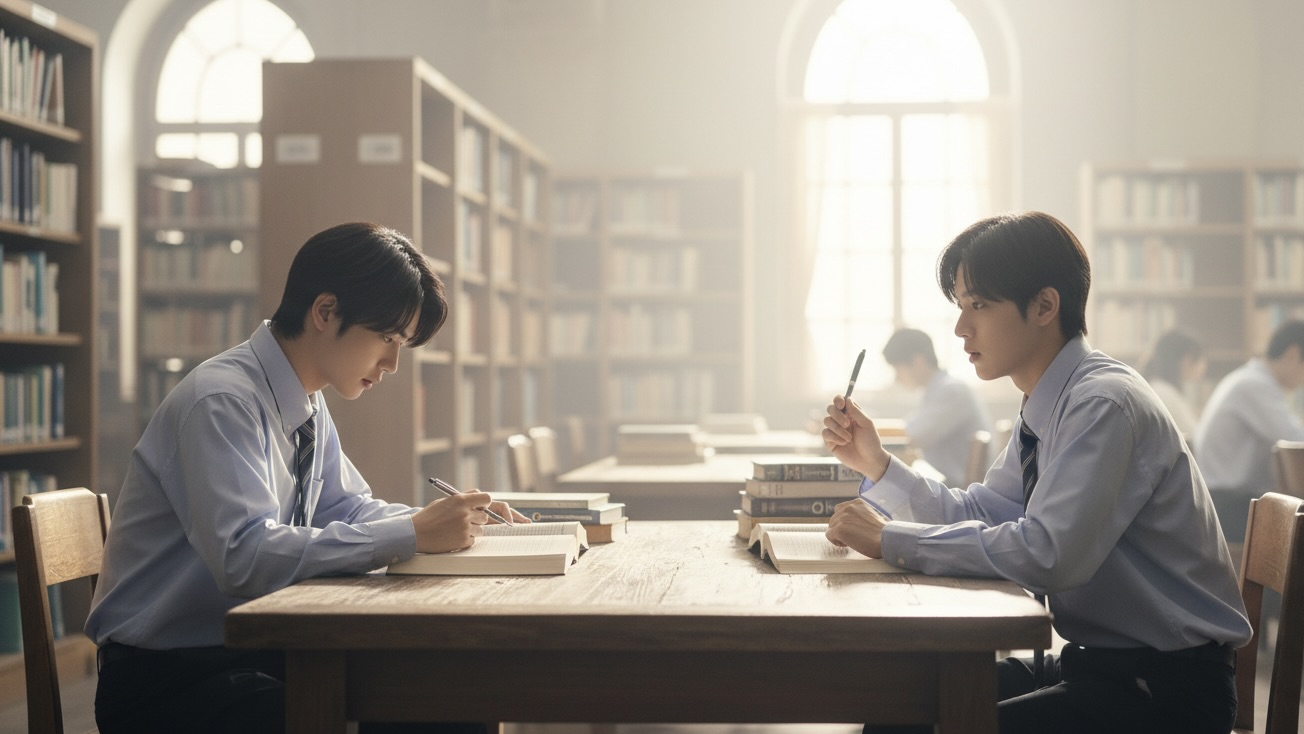
Kakeru and Asahi are seated at a communal study table in the university library, a mountain of textbooks and project notes between them. The air is thick with unspoken history, punctuated by the rustle of papers and the low hum of the library.
The official notification had arrived via a clinical, auto-generated email: 'Mandatory Senior Interdisciplinary Project: Teams Assigned.' Kakeru had almost deleted it, thinking it spam from the Dean's office, but the subject line had glowed, ominous and insistent, like a bad omen disguised as administrative efficiency. He scrolled down, his finger hovering over the list, scanning for his own name. And then, there it was. Kakeru, paired with… Asahi.
A choked sound, something between a gasp and a snort of disbelief, had caught in his throat. He’d stared at the screen, as if the pixels would rearrange themselves into a more palatable reality. Asahi. The universe, in its infinite, sadistic wisdom, had decided that the best way to mend—or perhaps, spectacularly shatter—whatever remained of Kakeru’s composure was to chain him to the very person whose name now felt like a curse, or maybe a poorly-executed punchline. Satirical, absolutely, that the betrayal had now morphed into an inescapable group assignment.
And so, here he was. Two days later, perched on the edge of a scratchy vinyl chair in the main campus library, trying to affect an air of studious indifference that he absolutely did not feel. The table, scarred with generations of student anxieties etched into its surface, felt too large and yet simultaneously too small. Asahi sat opposite him, ostensibly organizing a stack of articles, but every minute or so, Kakeru could feel the subtle shift in the air, the prickle of Asahi’s gaze, a low-level hum just beneath the threshold of his hearing. Like a faulty wire. Or a bomb.
Their project, titled 'Information Dissemination and Its Ethical Implications in Modern Campus Journalism,' was a thinly veiled excuse for their old professor, Dr. Albright, to force his graduating students into a real-world (read: tedious) exercise in public relations and muckraking. Kakeru found it intensely ironic. Ethical implications. Right. He knew a thing or two about those, firsthand, didn't he? He’d volunteered for the research segment, the data gathering, the archival digging—anything that didn't involve interviewing actual, breathing humans. Less exposure to the virus of sentimentality that way. And less exposure to Asahi’s annoyingly earnest facial expressions.
Asahi cleared his throat. The sound scraped along Kakeru’s nerves like a rusty knife. He didn't look up, instead choosing to focus on a particular paragraph about the historical precedence of libel laws. The words blurred. He could feel Asahi’s eyes on him, a physical weight. Just breathe, he told himself. It's just a guy. A guy who broke your trust into a million tiny, glittery pieces and then somehow got reassigned to your life through bureaucratic fiat.
“So,” Asahi began, his voice a low rumble, surprisingly steady. Kakeru noted it, internally. The bastard. “Albright sent over some more articles on that whole Northwood incident last year. Figured we should probably start there, right?”
Kakeru stiffened. The Northwood incident. Of course. The very thing that had shattered their fragile alliance, the exposé that had twisted their lives into a Gordian knot of secrets and lies. Albright, the old conniver, knew exactly what he was doing, assigning them this particular topic. Satire, pure, unadulterated satire, at Kakeru’s expense. Or maybe at both of theirs. He clenched his jaw.
“Sure,” Kakeru managed, his voice flat, devoid of any discernible inflection. He didn't even bother to look up. He felt the blush creeping up his neck anyway, despite his iron will, a traitorous heat that Asahi probably couldn’t see, but Kakeru felt it like a brand.
A beat of silence stretched, interminable, between them. The clatter of a coffee mug from across the room, the distant murmur of other students, suddenly felt deafening. Kakeru’s hand, resting on his textbook, twitched. He fought the urge to pull it back, to fold his arms defensively over his chest. He was not a cowering animal. He was a student. A student with a project. And a very inconvenient ex-partner.
“Okay,” Asahi said, a small exhale following the word. Kakeru imagined him, just for a second, running a hand through his perpetually messy dark hair. He hated that he knew the gesture so intimately. Hated that he could picture the slight frown, the almost imperceptible narrowing of his eyes. He shouldn't be able to. He really, really shouldn't.
Kakeru flipped a page, the sound unnaturally loud. He tried to project an aura of extreme focus, as if the history of collegiate journalism was the single most captivating thing in his entire existence. He picked up his pen, gripped it tight, the plastic digging into his thumb.
“I went through the initial brief Albright sent,” Asahi continued, undeterred, or perhaps, Kakeru thought with a sneer, just pathologically optimistic. “He wants us to essentially map out the flow of information – from source to publication – and then analyze where it could be vulnerable. You know, to… manipulation.” There was a tiny hesitation before ‘manipulation,’ as if Asahi was weighing the word, testing its resonance against their shared, ugly history. Kakeru heard it.
“Right,” Kakeru clipped, still not looking up. His heart hammered a stupid, frantic rhythm against his ribs. Just breathe, just breathe. He was hyper-aware of the slight scent of coffee and something else, something vaguely woodsy and clean, that must be Asahi’s laundry detergent. It was infuriating. Why did he have to smell so… normal? So unobtrusive?
Another silence. This one felt heavier, denser, like wading through thick mud. Kakeru felt a bead of sweat trickle down his spine. This was ridiculous. He was a master of clandestine information, a veteran of digital subterfuge, and he was being undone by a shared library table and the smell of fabric softener. It was professionally embarrassing. And personally mortifying. He wanted to scream. Or run. Or both.
“I also started sketching out a timeline,” Asahi pressed on, his voice softer now, almost… cautious. “For the Northwood stuff. Just the major events, you know? The initial leak, the student paper’s response, the university’s counter-statements…”
Kakeru finally looked up. His eyes, narrowed to slits, met Asahi’s across the width of the table. Asahi’s expression was unreadable, a careful mask of polite professionalism. But Kakeru caught the flicker, the brief, intense heat in Asahi’s dark eyes before he shuttered it. A spark. Kakeru felt it like a jolt through his entire system, a sudden, unpleasant electric surge.
“No,” Kakeru said, the word a low, deliberate growl. “No timeline.”
Asahi blinked. “But… it’s good for context. Helps us track the narrative arc, doesn’t it?” He actually sounded confused, genuinely puzzled. Kakeru wanted to punch him. Or kiss him. He wasn't entirely sure which impulse was stronger, and that, more than anything, infuriated him.
“It’s not necessary,” Kakeru retorted, leaning forward slightly, his gaze unwavering. “We’re analyzing process, not rehashing drama.” His voice was laced with an icy contempt he hoped would freeze Asahi on the spot. He saw Asahi’s jaw tighten, a slight clench, the tiniest visible reaction. Victory. Small, petty, but still, victory. The corner of Kakeru's mouth twitched, an almost-smirk.
Asahi picked up a pen, twirling it between his fingers, a nervous habit Kakeru remembered all too well. “Right. Process. Got it. So, just focus on the mechanisms, then. The channels. The… ethical blind spots.” He said the last two words with a peculiar emphasis, and Kakeru felt a fresh wave of irritation wash over him. Was Asahi trying to imply something? Was this some subtle jab? A coded message? Kakeru wouldn't put it past him. The man had a talent for subtlety when he wanted to.
“Precisely,” Kakeru said, mimicking Asahi’s emphasis with an extra layer of dry sarcasm. He leaned back, crossing his arms over his chest, a gesture meant to convey disinterest but which, in reality, felt like he was bracing for impact. His shoulder brushed against the hard edge of the chair, a dull ache blooming there, mirroring the ache in his chest.
The library hummed. Outside, through the tall arched windows, he could see the late afternoon sun, already softening into a dull orange, filtering through the branches of a giant oak tree. The air inside smelled faintly of old paper, coffee, and something metallic, like an overworked server bank. Or static electricity. He could feel the static between them, crackling, waiting.
Asahi sighed, a sound so soft Kakeru almost missed it. “Look, Kakeru. Can we just… talk about this? About what happened? Even just for a minute? This is… it’s insane, doing this project like this.” His voice was low, almost pleading. It scraped at Kakeru’s carefully constructed walls, a tiny, almost imperceptible crack appearing in his facade.
Kakeru felt his breath hitch, a tiny, involuntary spasm in his throat. His entire body tensed. Don't do it, he warned himself. Don't give him an inch. He stared at the stack of articles on 'data integrity' in front of Asahi. The irony was so thick he could choke on it. Data integrity, indeed. Like his own integrity hadn't been compromised, disassembled, and then scattered to the four winds.
“No,” Kakeru said again, his voice colder, harder than before. He pushed his chair back, the screech of vinyl on linoleum echoing through the quiet space. A couple of students at a nearby table glanced over, then quickly averted their eyes. Kakeru felt a perverse satisfaction at their discomfort. Let them look. Let them feel the tension. He thrived on it, apparently.
Asahi’s eyes widened slightly, a flicker of genuine hurt or surprise—Kakeru couldn’t tell which, and didn’t care to dissect it—flashing through them. He actually flinched back, a small, almost imperceptible movement, but Kakeru saw it. He felt it. A tiny jolt of power, of control, surged through him.
“I’m not discussing personal matters in a public library,” Kakeru stated, each word precise, like tiny, sharp icicles. “Especially not with someone who clearly has a problematic relationship with ‘information dissemination’ themselves.” He made sure his gaze was pointed, unwavering. He wanted Asahi to feel the sting, to know that Kakeru hadn’t forgotten, wouldn’t forget.
Asahi’s face hardened. The polite professionalism vanished, replaced by a tight-lipped, almost angry expression. Good. Kakeru didn't want the polite mask. He wanted the raw edges. The truth. Or at least, his version of it. The air crackled with a different kind of energy now, sharper, more volatile. The electric tension was still there, but it was overlaid with something darker, something like resentment, or a challenge. Or both. Kakeru felt his blood thrumming.
“Fine,” Asahi said, his own voice now clipped, echoing Kakeru’s earlier tone. He pushed his own chair back, matching Kakeru’s movement, a silent, defiant mirroring. “Then let’s just focus on the damn project, Kakeru. Process. Mechanisms. Ethical blind spots. We can be perfectly professional, can’t we?” The unspoken 'can't we?' hung in the air, a barb, a taunt. Kakeru felt the challenge in it, clear as a bell. He could almost taste the metallic tang of it in his mouth. Oh, he could be professional, alright. He could be a professional ice sculpture.
“Absolutely,” Kakeru replied, a tight, humorless smile touching his lips. He picked up a pen, clicked it open with unnecessary force, and deliberately began scribbling notes in the margins of his textbook, his posture rigid, his gaze locked on the page. He was a fortress. And Asahi, the unwelcome besieger, was not getting in. Not if Kakeru had anything to say about it. And he had a lot to say, none of it good. But he wouldn't say it aloud. He'd let the silence, the crushing, unbearable silence, speak volumes.
He felt Asahi’s stare burn into the side of his head, a phantom heat, an electric current running just below his skin. He ignored it. Or tried to. Every fiber of his being was screaming, tingling, hyper-alert. The faint scent of woodsy detergent seemed to grow stronger, suffocating him. He clenched his teeth. This was going to be a long, long project. And maybe, just maybe, Kakeru thought, with a sliver of dark, perverse satisfaction, he could make Asahi suffer through every single agonizing second of it, just as Kakeru himself had suffered.
The thought, sharp and bitter, settled deep in his gut, a cold, hard stone. It was a terrible, childish thought. And Kakeru cherished it. He looked down at the page, the words blurring once more. But this time, it wasn't just confusion. It was a battle plan. A silent war, waged across a shared library table, with the fate of a senior project—and perhaps, their fractured history—hanging precariously in the balance. The Northwood exposé, he realized, wasn't over. It had simply found a new, more intimate battleground. The stakes, he thought, were higher than ever.
To the Reader
“Just as Kakeru believed he could wall himself off from past hurt, remember that genuine connection requires the courage to dismantle those defenses. Your vulnerability is not a weakness, but a profound strength, and you are worthy of being seen, truly seen, in all your messy, beautiful complexity.”
Share This Story


